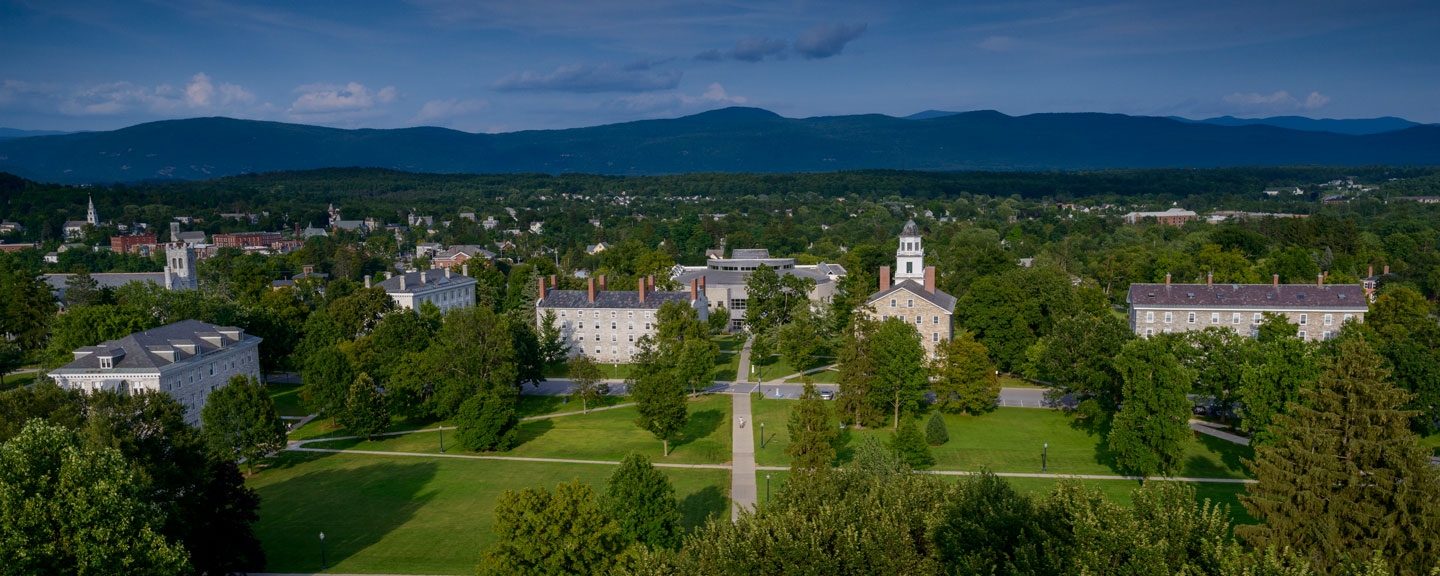
The Residential Experience

An Excerpt from "The President's Report 1996-97"

John M. McCardell, Jr.
President
Middlebury College

In the autumn of 1994, I placed before the College community a vision for Middlebury as we approached our bicentennial and looked beyond that event into a third century. The vision included emphasis upon certain "peaks" of excellence. The metaphor was apt. These peaks, visible above the clouds, discernible from a great distance, would identify Middlebury College. They would rest upon a sure foundation of general excellence in the liberal arts. They would comprise language, especially language pedagogy; literature; international studies; environmental studies with a core of natural science; and enhanced opportunities for "applied" experiences in the liberal arts. In succeeding years, as we have reported annually in this document, we have made progress in all of these areas. The peaks are indeed rising, and are increasingly recognizable from afar.

Less well remembered, though also a part of the visionary challenge, was the posing of a hitherto unanswered question, namely, should we seek, in the course of developing our then-new Commons System, to make our students' social and residential experience a "peak" of excellence? Put another way, should we develop structures, arrangements, spaces, and programs that would, over time, differentiate the social, residential, dining, and extracurricular experiences of our students in a qualitatively evident way from the experiences they might have at other institutions?

The answer to this question was far from self-evident. Student life, in general, varies little from place to place, at least in the liberal arts college orbit. Few, if any, institutions have dared to go beyond certain kinds of change to reconsider the educational purposes of living, eating, studying, and socializing in an academic community. Most of the time, most institutions, though larger, more diverse, and more complex than ever they were when these arrangements were first put in place, have simply grown every other aspect of their operation in proportion to the growth in enrollment: for instance, in the case of Middlebury, the decision to increase enrollment from 1,200 to 1,800 students in the late 1960s was accompanied by decisions to increase a centralized dean's office, support services, and dining service by about 50 percent, on the theory that we were a single community, and one that would remain, at the far end of growth, encompassable by all its members.

Had enrollment remained steady at 1,800, these would have remained settled questions. But as enrollment in the 1980s began to move toward and beyond 2,000 students, our claims of encompassability were put to the test, and the assumptions upon which those claims had been based were challenged. For we were now larger than most of the high schools attended by most of our applicants, and yet we claimed to offer the peculiar benefits of an intimacy based on size and scale that more accurately reflected the College of the past than the reality of the College of the present. What, if anything, was inherently superior educationally in continuing operation as an ever-larger single entity? Indeed, students and faculty, as well as alumni, came increasingly to lament the disappearance of familiarity, the decline of community spirit, the fragmenting of lives into separate, nonintersecting spheres, in spite of well-intentioned rhetoric about size, scale, and broad human relationships.

Middlebury, of course, was hardly alone in these concerns, and dealt with them more skillfully than many other institutions. To this day we have been largely spared the baleful effects of the "culture wars" that have buffeted, with little benefit, many other campuses. Ours is still a remarkably coherent community, where difference, while respected and understood, is not an end in itself, but rather a means to a greater end, and that end is community.

Moreover, the College did make some significant decisions about student life during this period. Conspicuous among these was the inauguration of the Commons System five years ago, which sought to give, through the clustering of groups of residence halls, a new sense of identity and scale, with an academic emphasis, to a student body of over 2,000. Though the College might have gone further at that time to create a more comprehensive and highly articulated system of residential life, the pace of change in our community seemed to have quickened sufficiently at the moment of the Commons System's creation, and wise counsel to allow the new system time to take shape prevailed.

Last spring, however, a special committee on campus reviewed the progress of the Commons System after five years. It discovered that virtually no current student questioned the existence of the system or proposed that it be eliminated. Indeed, to a great extent, the system had, by creating diverse sub-communities within the larger student body, extended the range of social life, created new leadership opportunities for students, brought faculty and students into closer contact, and thus addressed many of the most compelling claims of the residential liberal arts college.

Nevertheless, problems were identified. Commons membership turned over every year, as students moved on to different residence halls. Centralized dining in a crowded Proctor and a remote Freeman International Center seemed insufficiently conducive to relaxed or prolonged conversation. Faculty associates, though living in commodious and proximate houses on the edge of campus, had difficulty attracting large numbers of students to Commons events.

Most of the concerns turned on the question of continuity and the relatively greater benefits of continuing membership in a particular Commons over four years. At the same time, the College's plan gradually to grow to 2,350 students by the year 2004 reopened the question of whether we might dare to recast residential life in the interest of providing a superior educational experience in a new century.

As this is written in late summer, these decisions are yet to be made. The mere fact that they are under study is a testimony to the willingness of our community to ask the hard question and consider the bold choice. I happen to believe that if the College is willing to reexamine basic principles of what it means to be a residential liberal arts institution, it will be drawn to the enduring appeal of size and scale, and will conclude that the moment has arrived to redefine the educational experience at Middlebury College in a way that is consistent with our own history, supportive of the needs of our students, and above all closer than ever before to providing what society will expect of its educated men and women--its leaders--in the years to come. In essence, this examination goes to the heart of a fundamental question: What kind of college ought we to be?

As we revisit these questions, we must go beyond our own little world to the expectations the larger world continues to have for the residential liberal arts college, which, at its best, reflects the educational benefit of living the life of the mind in small, integrated communities, and on ground shared by students, faculty, and staff. Such a system of small communities should include the following features as the standard against which we measure ourselves:

  • It should clarify the objectives of a liberal arts education. While we assume the importance of study across the curriculum, we must give students more opportunities to consider the long-term consequences of what they have learned in the classroom. These communities should be places where faculty, staff, alumni, and guests regularly encourage students to look outward from the confines of their own experience and to reflect upon how and why education matters. This outward turn is especially important in those institutions in isolated or rural settings.
  • It should establish an educational environment that is more than simply task-oriented. Students take on challenging academic work every day, and they are graded on their efforts. Indeed, one could argue that academic pressure-being "stressed out"-is a major cause of an ethos that demands one "play hard" in one's free time. A properly designed and functioning residential system should provide a place where students discover the pleasures of learning apart from the process of evaluation, of learning for its own sake.
  • It should encourage the continuation of conversations between students and faculty, among students, and within the extended college community. There is not enough time in the classroom, in office hours, or anywhere else on many campuses for members of the community to discuss topics-intellectual issues, current events, music, or anything vital to our culture-not directly relevant to classroom work. Faculty have interests beyond their academic work, and should have opportunities to share these with students. Meals, receptions, and other on-site activities, in encompassable settings, provide occasion for such exchange.
  • It should allow students to test ideas and stretch themselves. If college is a place where students experiment and make mistakes in order to grow as individuals, then a residential system ought to enhance this developmental process by supporting activities, from intramural sports to in-house theatre, that enhance such growth. Moreover, there should be a wide range of opportunities to develop leadership skills and to learn the responsible uses of power and authority through self-government. Whether enabled by adults or fellow students, these activities should encourage intelligent risk taking, which is a significant part of education broadly defined.
  • It should promote development by encouraging respect for others. Self-awareness depends on awareness of other people, and of how one's own behavior, words, and deeds affect and are understood by others. A residential system properly defined must build communities that stress the importance of responsibility, accountability, diversity, civility, and integrity. These abstract values will take on concrete importance through routine human interactions, planned and unplanned, that residence in a small community generates naturally.
  • It should build a connection to the larger college that extends beyond the four-year experience. Continuing residence in a small community should give students a home on campus, to which they could return as graduates. Ongoing contact with a dean, faculty member, or other administrator would ensure that no student "slips through the cracks" and that no student graduates without establishing a personal relationship with at least one faculty member. And from those relationships should develop a greater sense of loyalty to the college that made such an experience possible.
  • Finally, it should nurture students in their individual growth and build in them the confidence necessary to succeed in the world beyond college. This encouragement should come not only from adults but also from fellow students. As much as the viability of a residential community depends upon strong adult leadership, it must also build upon the active participation of self-educating students.
  • It seems to me that our current arrangements cannot automatically be expected to continue to bear the burden of these expectations. At the same time, I believe we should not hold any lesser expectations than these. In the months ahead you will be hearing more about our discussion of these issues on campus. I am prepared to articulate, and to lead us toward, a bold reconsideration of our residential system, in ways that restore size and scale to daily life while retaining all the benefits of growth. I believe that the time has come to confront these issues and to address them boldly and with vigor, and I look forward to continuing this conversation with members of our extended family.

    Gateways For: