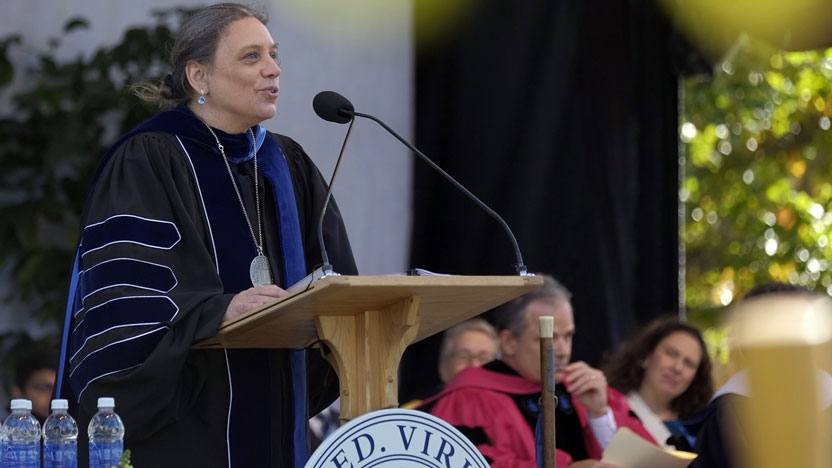
Remarks at the Inauguration
of President Ronald D. Liebowitz,
Middlebury College, October 10, 2004

President Liebowitz, members of the Board of Trustees, honored guests and delegates, faculty, staff, students, alumni, friends.


When President Liebowitz called and asked me if I would speak today, he told me that in his inaugural address, he planned to talk about the future of Middlebury College, and he asked if I would provide some historical background for his address, by focusing on how the College came to be what it is today.


I am truly honored to have been asked to address you today on this very joyous and significant occasion. This has actually been a week of joyous and significant occasions. Earlier this week, all around the world, the Jewish people celebrated the holiday of Simchat Torah. It is a wonderful holiday. As you may know, Jewish congregations read the Five Books of Moses—the Torah—from beginning to end throughout each year. We do a portion each week. Simchat Torah is the day each year when Jews read the last words of Deuteronomy, and begin anew by chanting the first words of Genesis. It is a particularly joyous occasion, and in my synagogue, everyone dances with the Torah while our klezmer band—the Chopped Liver River Band—plays joyous songs. That's the real name of the band, honest! I'm the third clarinetist in the Chopped Liver River Band—there are only three clarinets!


Each time we read through the Torah, it's a little different. We have learned much from earlier readings, and we build upon those, but there is always something new to learn, new interpretations, and more people exposed to the words of the Torah. I had this thought (while playing third clarinet) that a College Presidential Inauguration is sort of the academic equivalent of Simchat Torah. The college and its constituencies conclude one presidency and joyously begin again with a new leader, who, while standing on the shoulders of those who came before, sees new ways of proceeding, presents new ideas, opens the College's opportunities to new people, and leads the college to new heights of excellence.


On Simchat Torah, Jews read the first word in Genesis: B'reshit—In the Beginning—B'reishit barah Elohim et ha-shamayim v'et ha-aretz--In the Beginning, God created the heavens and the earth. Hey, after all those greetings from the Language School deans, I thought it might be good to give a little equal time to Hebrew—okay? B'reishit. B'reishit comes from the root word Rosh or Head (as in Rosh Hashanah—the Jewish New Year which we just celebrated: Rosh is head and Hashanah is the year—thus, head of the year). Today, we celebrate Middlebury's new Rosh—Middlebury's s new head—Ronald David Liebowitz-- the new President of this College as he is inaugurated and the College begins its story anew. B'reishit!


B'reishit, In the beginning. Historians are very interested in beginnings. Actually, the truth is, we are obsessed with them. The history of Middlebury College that I wrote begins with "B'reishit" In the beginning: I quote myself (boy, it is FUN to quote yourself!): "In the beginning, it was the town's college. The pioneers from Connecticut and western Massachusetts who settled the frontier village of Middlebury also founded Middlebury College and nurtured it through its early years. They wanted the area to grow and prosper and be inhabited by an educated and religious citizenry; a college would help achieve all these ends. The origins of the College are therefore interwoven with the history of the town and the aspirations of its early settlers." This is a key concept to understanding much of the first 125 years of the College's history and how the College came to be what it is today.


How would we describe Middlebury today? The college website—and we all know how accurate those web sites are!—says, among other things, that Middlebury is an outstanding independent, coeducational, liberal arts college with a distinctly international character that is nationally recognized for its leadership in a number of academic areas, including language study and instruction. How DID Middlebury College develop in this way? I only have a few minutes, so I thought I would focus on three specific aspects of this description: First, Middlebury as an "independent college"; second, Middlebury as a "coeducational college"; and, third, Middlebury as an institution recognized for "excellence in language study and instruction."


Let's start with Middlebury as an "independent college." We used to say "private college." When did that change? Anyway, "independent" usually means that a College does not receive a direct subsidy from some level of government. Middlebury was arguably the first "independent" college in the United States. By that, I mean that the Vermont state legislature, when it chartered Middlebury College in 1800, refused to allow the College to obtain support from state lands that had been set aside for the purpose of supporting higher education in Vermont. The University of Vermont, which had been chartered in 1791 but had not opened its doors until late in 1799, objected strenuously to the chartering of Middlebury College in 1800 and, when the state legislature met in Middlebury in 1800, and voted to charter the new college, UVM's representatives were absolutely apoplectic about the possibility of sharing the proceeds from the state's lands with the fledgling College. Later, UVM's first president, Daniel Saunders, wrote a scathing recollection of the events surrounding the chartering of Middlebury College:


"In October, 1800, a Rival College was instituted and legalized by the Legislature at Middlebury, where the assembly was then sitting, which enabled the whole town to indulge in the intrigue, art and misrepresentation for which it soon became notorious. … The arguments used by Middlebury to obtain a grant were such as these, that they asked no public funds and that they intended not to interfere with the State University. How sincere they were in not having a wish to interfere with University at Burlington is evident by making the effort the very next day after obtaining their grant to seize upon the funds. Whatever be the future result of Middlebury College from the sinful means used to give it birth and being, it, at least, deserves anathema. Time will show how far divine providence will permit to prosper an institution founded in falsehood and iniquity."


On this beautiful Sunday, we should all be grateful that President Saunders's predictions about the ways of Divine Providence have proven to be inaccurate.


But to say that Middlebury College was independent of public support at its inception is really a misnomer—private, yes, but not independent. It was very dependent on the community that had given it birth. In the beginning, this was the town's College. It was not founded by an ideological group or a religious denomination to further its purposes. The pioneers from Connecticut and western Massachusetts who settled the frontier village of Middlebury in the late18th and early 19th centuries wanted the area to grow and prosper, to be the center of a civilized, educated, and religious citizenry; a college would help achieve all these ends. Indeed, a major reason for the founding of Middlebury College was the town's desire to enhance its reputation, aid its growth, and educate its sons. Town boosters not only wanted a college in frontier Middlebury, they desired churches, a secondary school, and anything and everything else--including becoming the county seat and even the state capital--that would attract more settlers and help the town develop into the most important community in the state and the region.


And the community nurtured the College in its first century and beyond. We stand before a magnificent new library. But in 1800, there was no library. To create the College's first library, 34 citizens of the town each subscribed the then-princely sum of $25. By 1802, there were 494 books, and the subscribers, who technically owned the library for a number of years, had the right to borrow the books. Faculty, trustees, and other friends of the college donated additional books, so that the library possessed nearly 1,000 volumes by 1810. In a similar manner, the first professor, Frederick Hall, was paid through a community subscription, and the first buildings were constructed primarily with funds from the townspeople.


Middlebury was very much a local and regional college throughout the 19th centuryand even the first part of the 20th century with most students attending from nearby communities in Vermont and New York. And throughout this period, Middlebury citizens aided the College, and many former Middlebury residents who had forged successful careers elsewhere also gave significant financial support to the school. Look at the names on many of the College's older facilities—Painter, Starr, Stewart, Battell, Warner, Porter Munroe. It's a veritable who's who of the leading families of this town. We'll get back to Battell in a few minutes.


In the early years, if the town had not supported the College, it would not have continued to exist. After all, there weren't any alumniwhen the College was founded—think about that one—and they were not much help in the first quarter century or so of the College's existence. Aaron Petty, for example, the College's first (and only) graduate in the Class of 1802, never gave a cent to the College. Of course, he died six months after graduation! Fortunately for the College, later graduates have fared better for the most part, and a goodly number of them have remembered the College with significant financial support! Indeed, Middlebury has only been able to maintain its status as one of the outstanding independent four-year liberal arts colleges in the country because of generous private support from alumni and friends.


Let's talk about the second aspect—how Middlebury as a "coeducational college." While many of Middlebury's comparison schools admitted women for the first time only about 35 years ago, Middlebury has been coeducational for over 120 years. Most important, the decision to admit women—quite controversial at the time—proved to be an essential part of the College's success.


After a promising start in its first 36 years—the College boasted 168 students in the fall of 1836 and a freshman class as large as the one at Harvard—Middlebury College suffered through nearly a half century of setbacks and decline between 1836 and 1880; indeed, the College almost disappeared several times and by the early 1880s, there were only 37 students enrolled, and few people knew that Middlebury—isolated in the Vermont hills—even existed. When several women applied for admission in 1883, the College could hardly argue there wasn't any room! But there was plenty of opposition, because not only was higher education for women highly controversial (some people actually thought that higher education would cause women to become ill and possibly die), educating men and women together was also looked upon with disfavor. Opponents of coeducation claimed that men's colleges would be feminized and unnatural—the men would become effeminate and the women coarse and masculine; that women—inferior intellectually—would keep men from learning at a rapid pace; that women, because of their very different nature, needed a very different curriculum from the men; that coeducation would lead to gross immorality and foolish love affairs, and, perhaps, worst of all, men would refuse to attend a coeducational college. For all these reasons, there were few colleges in the East that were coeducational.


The first Middlebury women performed very well. In fact, let's do a little comparison of the first female graduate, May Belle Chellis, Class of 1886, and Aaron Petty, the first male graduate in 1802. Remember Aaron? May Belle and Aaron both finished first in their class, but Aaron was the only member of his class, and May Belle beat out six guys. And unlike Aaron, May Belle lived for another 50 years and was a supporter of the College. I think May Belle wins this competition hands down.


The decision to admit women was a major reason for the College's revival in the late 19th century. Enrollment rose from 37 in the fall of 1883 to 108 (48 of them women) in 1897, and it has just kept going up ever since. The admission of women also was a major reason for the high quality of the Middlebury student body in the 20th century. Between 1883 and 1970, outstanding women who wanted a coeducational experience found that there were relatively few good coeducational liberal arts colleges in the East—the result was that Middlebury women were usually better academically than the men. These outstanding women students raised the reputation of the College, which, in turn, helped attract better faculty. Middlebury men didn't catch up to the women until all the other schools went coeducational in the early 1970s and women had has many opportunities as men to attend the best schools.


I look at the decision to admit women as the College's first move towards creating a more diverse student body. Yes, it's true that Alexander Twilight, Class of 1823 was probably the first African-American to graduate from an American college, and there were many poor boys in College here before the Civil War. But by 1882, the only students were white Protestant middle class men from nearby towns and states. Today, the College boasts students and faculty from a wide variety of religious, ethnic, and socioeconomic backgrounds, and they come from all 50 states, the District of Columbia, and from around the world. This transformation is a tribute to the College's leadership in recent years. I would particularly point to the administrations of Presidents James Armstrong, Olin Robison, and John McCardell, each of whom worked very hard and quite successfully to make the College a more diverse and interesting place. But it is the initial decision to admit women in 1883 that not only helped save the College 121 years ago but also set the school on the road to being a more diverse and exciting institution.


There is a tremendous creativity and excitement on this campus, and it has grown remarkably over the past 40 years. It is due, in large part, I believe, to an increasing diversity among the students and staff. The University of Michigan, my doctoral alma mater, knew what it was doing recently when it doggedly defended affirmative action and diversity as important educational principles. Just one example: Historians have argued that the reason that China fell steadily behind Europe in development after 1400 or so was because China closed its borders to ideas and people from other cultures and places. Europe, on the other hand, was relatively wide open, and, because of that, a more diverse and creative intellectual and scientific culture was fostered that spurred exciting developments in many areas of human life. That's what has been going on increasingly at Middlebury and at other schools that affirmatively encourage diversity in their staff and student bodies. The year 1883 and the admission of women was just the beginning of diversity for Middlebury.


Finally, let's talk about the third aspect—Middlebury's excellence in language study and instruction. Even though Middlebury College has a wonderfully balanced curriculum with excellence in the sciences, social sciences, and humanities, when people think of Middlebury, many of them think "languages." How did this all happen? The B'reishit—the "In the Beginning" —here is 1915 when two distinct but very important things occurred.


First, Fraulein Lilian Stroebe, Professor of German at Vassar College, decided that Middlebury had the ideal physical plant and summer climate to accommodate her two-year old German summer school. This school was highly unusual in its emphasis on isolation, advanced training, and intensiveness. The German school not only proved a success, it also encouraged the development of a French School, on the same model, in the next summer, and a Spanish school in 1917. An Italian School was opened in 1932, a Russian School in 1945, a Chinese School in 1966, a Japanese School in 1970, Arabic in 1982, and, most recently, a Portuguese School in 2003.


Furthermore, beginning in 1949, the College opened its first School Abroad in France in cooperation with the University of Paris. Since that time, the C.V. Starr-Middlebury Schools Abroad program has developed 16 sites in Argentina, France, German, Italy, Russia, Spain, and Uruguay. These schools are designed to immerse every student as completely as possible in both the language and the culture of the host nation. All course work is taught in the target language. Students often have the opportunity to enroll directly in the local university, where their classmates will be from the host country, or to take courses designed exclusively for program participants. What an amazing story for a small liberal arts college in the mountains of Vermont to be a pioneer in the area of language instruction, with an international reputation, and a student body—in the regular academic year as well as in the summers—attuned to the increasing internationalizing of our world. And the great irony is that it was the isolation of Middlebury College in the Green Mountains that appealed to Fraulein Stroebe in 1915.


I said there were two things that happened in 1915 that started Middlebury on the path of excellence in the languages. The other was the death of Joseph Battell. Eccentric conservationist, lover of Morgan horses, wealthy town philanthropist, amateur scientist, innkeeper, and newspaper editor, Battell died in 1915 and left the College his Green Mountain kingdom of 30,000 acres of virgin timber—all the land that he could see from his Bread Loaf Farm—about 15 miles from here--which he had lovingly bought piece by piece to protect the land from lumber interests. Proudly, he often said: "Some folks pay $10,000 for a painting and hang it on the wall where their friends can see it while I buy a whole mountain for that much money and it is hung up by nature where everybody can see it and it is infinitely more handsome than any picture ever painted."


I wish I had time to tell you more about Battell. What a character. Oh, I guess I will anyway. Battell was not a 20th-century man. He despised automobiles. He refused to register at his Bread Loaf Inn any guests who arrived by car, and he filled the pages of his Middlebury Register with accounts of car accidents. He loved horses. For years, he painstakingly compiled, and subsequently published a massive and important body of information on his favorite type of steed, the Morgan horse. A local aristocrat and patron in outlook, he beautified the town by helping to erect the stone bridge over Otter Creek, the modern Battell Block, and other public works projects. His religious, philosophical, and scientific ideas were often unusual and the form in which he presented them—two enormous volumes of dialogues between a teen-age girl and a pine tree on top of a mountain—did little to enhance his reputation. But his concern for the environment and the preservation of the Green Mountains speak strongly to today's world, and his unconventional idiosyncrasies seem unimportant when one stands on the Middlebury Bread Loaf campus today and views the incomparable gifts that Joseph Battell gave us all.


One of the gifts he gave Middlebury was all that mountain land. The College sold most of it to the government in the 1930s and built Forest Hall with the proceeds, but the College kept Battell's Bread Loaf Inn, and the lands that are now the Bread Loaf campus and the Snow Bowl. At first the College was going to sell the inn and the land there, too, but in 1919, College leaders thought that perhaps they could duplicate the success of the fledgling summer language schools by starting an English school at the Bread Loaf Inn. The Bread Loaf School of English was created in 1920, and, several years later, in 1926, the Bread Loaf Writers Conference was established, as well. In 1977, the College expanded the Bread Loaf School of English through a summer program at Lincoln College, Oxford, enabling students to obtain the same graduate credits for a summer session at Lincoln that they could obtain at Bread Loaf. In recent years, the School of English has established additional sites in Alaska and New Mexico.


The reputation of the College has been immeasurably strengthened by its excellence in language study. And both events of 1915 are related to the hills that surround Middlebury—the same hills that isolated Middlebury in the 19th century gave it its strength in the 20th century and now. On Mead Chapel, above us on the hill, it is written "The Strength of the Hills is His Also," and the Strength of the Hills, the beauty of the hills and the location of the College have been critical historical factors for Middlebury.


I have tried briefly to relate how Middlebury became an outstanding independent college, blessed with support from this town and from wonderful alumni and friends; and how the relatively early admission of women and the more recent efforts to diversify the campus in other ways have made Middlebury an exciting place to study and teach; and finally how Middlebury developed a magnificent peak of excellence in language study and instruction, in part because of the beautiful peaks around us.


Today, as we celebrate the inauguration of a new president, Ronald David Liebowitz, Middlebury in a sense, begins anew, b'reishit. May President Liebowitz build upon the great work of past administrations, and find new ways to engage the College's friends and supporters here and around the world so that it may remain a strong, independent college; may President Liebowitz find new ways to diversify the College community to ensure an exciting and creative learning environment; and may President Liebowitz find new ways to offer students outstanding educational experiences in languages and in all areas of the curriculum.


B'reishit. In the beginning of the Liebowitz presidency, I hope that all of us here today who love and admire this College will support President Liebowitz in his work. Thank you for this opportunity to address you today.