Intensive Language Program / Premier Cycle

The information below is provisional and some course descriptions may be changed or added.

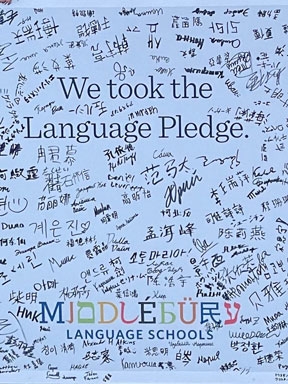
The Intensive Language Program (seven-week session) is designed for people whose proficiency in the French language is similar to that of a college undergraduate, from pure beginner to intermediate and advanced. Each level of the program involves four or five hours of classroom instruction per day and carries a total of three units of credit (the equivalent of nine semester hours). Although all students must sign the Language Pledge, those who are placed at the beginner levels may observe a modified version of the Pledge for the first ten days of the session. All books required for the courses will be available for purchase from the Middlebury College Store. Students will arrive on Friday, June 27, and courses begin on Monday, June 30.


Level I: Beginners 3101-3102-3103
Coordinator: Barbara Sicot Koontz
Instructors: Barbara Sicot Koontz , Romain Bontems, Nicolas Houdelette, Richard Mattei

This course is intended for students with no or minimum previous experience of the French language. We will develop the four competencies (listening and writing comprehension and expression) with extra emphasis put on oral communication. We will work with two different kinds of support: a method, Reflets, as well as realia. The entire class will also revolve around a creative oral and writing project in response to the needs of students.

Texts : Maia Grégoire- Grammaire Progressive du Français (Niveau débutant)- Paris, CLE International- 2004 ; Guy Capelle, Noëlle Guidon- Reflets (méthode de français 1)- Paris, Hachette- 1999 ; Guy Capelle, Noëlle Guidon- Reflets (Cahier d’Exercices)- Paris, Hachette- 1999.


Level II: Early Intermediate 3211-3212-3213
Coordinator Corinne Fertein
Instructors : Corinne Fertein , Simone Muller, Jose Nuñez, Véronique Ogden

Level Two is an integrated, intensive program for students who have received some previous instruction in (or exposure to) French, but who have reached only minimal proficiency and are not yet able to function independently in full immersion.

Level Two focuses on:

* Developing listening comprehension, oral competence, and socio-cultural communicative proficiency;

* Systematic acquisition of strategies for oral and written expression through progressive practice, with topical review of basic morphological and syntactic structures;

* An overview of various cultural aspects of French-speaking communities worldwide, through readings and multimedia resources.

The course is divided into 3 units. Students will be taught 4 classes a day:

Vocabulary and civilization (3211);
Introduction to literature (3212);
Oral activities (3213);
Grammar.

For this course students will be asked to:
- do presentations using Powerpoint,
- film presentations using their personal digital cameras and/or mobiles (if they have one),
- memorize poems and short texts for the literature class.

Texts: This course makes extensive use of authentic materials: literary excerpts, magazine and news articles, comic strips, songs, film clips and web sites.

In addition, the following texts are required:
- Grégoire M et Thievenaz O, Grammaire progressive du français Niveau intermédiaire (600 exercices) (CLE International 2003) ISBN 2090338482 ;
- Thievenaz O, Grammaire progressive du français Niveau intermédiaire : Corrigés (CLE International 2003) ISBN 2090338490
- Le Robert Micro, dictionnaire d'apprentissage de la langue française (Edition Poche, Édition 2006). ISBN 2849022527
- Blondeau N, Allouache F, Né M-F, Littérature progressive du français, Niveau intermédiaire, avec 600 activités, CLE International 2003. ISBN 2090337567


Level III: Upper Intermediate 3305-3306-3307-3308
Coordinators: Florian P. Croisé & Dominique J-S Lanni

Level Three is for students who have had significant previous instruction in French and who are already able to function independently in full immersion. Typically, students at this level demonstrate textual/writing ability beyond the sentence level. The individual components of the program are designed to complement one another, and all include intensive study of the language. Students will also arrive at a broader appreciation of French and Francophone cultures and literatures. N.B. All four courses are required.

The four course segments share the following common objectives:

* Develop aural/oral proficiency through use of video and audio-based media, theater, movies, songs, and TV programs. Students will be invited to express themselves in real-life conversations and through drama activities. Emphasis will be placed on pronunciation, intonation and sentence rhythm;

* Integrate the characteristics of non-verbal language into communication in French (gesture, posture, facial expression, voice inflection, etc.);

* Review selected grammatical structures in close coordination with topics and activities taught in class;

* Provide a broad introduction to French and Francophone culture and literature through the study of articles from the press, plays, short stories, poems, and excerpts from novels.

Texts: La grammaire progressive du français" niveau intermédiaire chez Cle International; Le Robert Micro-Poche (Paris, Le Robert).


3305 La Dramaturgie : les mécanismes fondamentaux du récit dramatique / Dramaturgy: fundamental mechanisms of the dramatic narration
Instructor: José Plyia 

This course aims at developing ease, fluidity, and efficiency in oral expression through the medium of theater. It will focus on the rules and mechanisms to build and write a play through Francophone contemporary theater: the character, his goal, the obstacles, the conflict, the climax, the cliffhanger, the milking, the topper, etc. With the support of different plays (print or DVD) of Koltès, Mouawad, Pliya, we will try to explore, by theory and practice, the Francophone theater today. (.5 unit)

3306 Voyage dans l’écriture/Journey in Writing
Instructor: Laurent Patenotte

This French composition course features a creative approach to process writing. Learners, in groups of two or three, select a genre, a mini-novel, skits or epistolary novel, and construct a story with embedded grammatical, rhetorical, and stylistic constraints. User-friendly instructive tools intended to stimulate creativity and facilitate language accuracy are readily available on the instructor's website. There, learners have access to a panoply of descriptive and narrative excerpts featuring various genres, moods, and registers. They also find pedagogically relevant reference works such as lexical and semantic webs, dictionaries, encyclopedias, grammatical descriptions, and literary, historical and Francophone civilization links. This carefully orchestrated course is a natural environment for 'scaffolding' and 'noticing' the gap between the language they experience from the various sources of input and their own output. It also aims at targeting 'avoidance' and 'overuse' strategies that often immobilize learners' language development and creativity.

(.5 unit)

3307 A travers cinéma, chansons et littérature / Through Cinema, Songs, and Literature
Instructor: Florian P. Croisé

Through the examination and use of authentic French materials, the course will discuss current topics in French society and focus on oral language (pronunciation, communication, etc.). Aural and visual materials will include feature-length films, songs, and literary texts (poetry, drama, and short story). Films: On connaît la chanson, Les choristes. (1 unit)

Texts: Coursepack of literary texts; Molière, Le Bourgeois gentilhomme; Guy de Maupassant, Boule de suif.

3308 Introduction au(x) monde(s) francophone(s) / Introduction to Francophone World(s)
Instructor: Dominique Lanni

In this course students will discover the peoples and cultures of various Francophone regions, such as Quebec, Morocco, French Guyana, Lebanon, and the Antilles, through a variety of documents that will demonstrate the range and diversity of Francophone cultures: short stories, plays, songs, recipes, etc. Authors to be considered include Milan Kundera, Michel Tremblay, Jacques Roumain, Copi, Ferdinand Oyono, Tahar Ben Jelloun, Jacques Rabemananjara, Kim Lefèvre, Salah Stétié et Dewé Gorodé.

Students will also continue to perfect their oral and written competence in French through individual and group presentations. (1 unit)


Level IV: Advanced

Coordinator: Pascal Somé

This level has a three-tiered structure, in which each course carries one unit of credit:

- All students must take the course in advanced grammar and composition

- Students choose one of the three oral production classes

- They choose two of the courses on literature and culture and society.

1. Required Grammar and Composition Course

3411 Écrire: de la grammaire au texte / Advanced Grammar and Composition
Instructor: Kogh Pascal Somé & Isabelle Pagnon Somé

This course enables students to construct progressively a repertoire of textual forms (narrative, descriptive, expressive, and argumentative) in order to communicate flexibly and fluently in writing. Concurrently, students will review fundamental grammatical structures and principles through numerous and varied exercises. This class includes a daily plenary session (1 hour) and is complemented by a voluntary writing workshop.

Texts: Delatour et al, Grammaire du français (Hachette, 2004); Boularès & Frérot, Grammaire Progressive du français, Niveau avancé (CLE Internationnal, 2004); Girardet et Frérot, Panorama de la langue française, Méthode de français 3 (CLE International, 2001).

Recommended: M.P. Caquineau-Gündüz, Y. Delatour, J. P. Girodon, D. Jennepin, F. Lesage-Langot et P. Somé, 500 exercices de grammaire (Paris, Hachette FLE).

2. Oral production courses. Choose one within the three

3460 Communication orale professionnelle / Professional Oral Communication
Instructor: Christine Guyot-Clément

To speak, to present one's ideas, and to make public speeches are not natural activities. Oral expression in all its aspects will be practiced in this course specifically designed for students who have, in their professional life, to present, to debate, to persuade, or, simply put, to express themselves orally.

Text : Campus 4 livre de l'élève,  Clé International

3450 Langue orale et théâtre / Theater and Language
Instructor: Anne-Marie White & Mylène Roy

This course aims at developing ease, fluidity, and efficiency in oral expression through the medium of theater. By interpreting characters in short contemporary plays, students work both on phonetic and intonative accuracy and on their body language. All those who engage in public speaking (teachers especially) will find dramatic training invaluable in improving the quality of their voice, of their posture, and generally in making them feel more comfortable when addressing an audience. Daily work includes vocal, breathing, and other exercises in addition to rehearsing scenes that will be performed in a public show toward the end of the summer session.

3414 Lectures interprétatives à haute voix / Oral Interpretation of Texts
Instructor: Jean Verrier

In all literatures and in French Literature in particular, many texts can be compared to musical scores, and become alive when read orally. Preparatory warm up activities will help us reflect on the "music" that one can put on words. We will learn how to interpret orally texts chosen from a small anthology ranging from the Middle Ages to today's literature. Some of these will be presented in a public performance during the summer.

In addition to a course pack to be purchased at the College bookstore, students will need to buy the following works: Molière: Don Juan; Jean Tardieu: La Comédie du langage (Folio Gallimard n°1861)

3. Literature, Culture and Society : Choose two within the four

3455 Du texte, au théâtre, au film / From Text to Theatre to Film
Instructor: Jean Verrier

Theater, said Molière, is made to be played. But it is an ephemeral art and until recently only traces of texts and written eye witness accounts survived. However the way that societies have interpreted and staged these texts reveals the essence of those societies. More recently cinema allowed the capture on film of some of these interpretations and stagings, but in the absence of a live audience. The personal point of view of each spectator is replaced by the mechanical eyes of two or three fixed cameras. This is not theater, this is filmed theater, and it ages quickly. However it seems that a new "genre" has emerged in recent decades, of which the last movie directed in 1994 by the French film maker Louis Malle, Vania 42ème rue, and based on the text of the early 20th Century Russian author Chekhov, might be emblematic. Interpreted by contemporary New York actors, we cross languages, cultures and media. More precisely it is the television, extended by the DVD, that is the main media of this new genre. Going from the movie to the text, it is an easy access to a new language and culture. This is what we will do by viewing several filmed French plays of Molière, Corneille, Marivaux, H. Cixous, J.-M. Koltès, N.Sarraute, V. Novarina... Extracts will be studied in class to reflect on how different media can change meanings. Students will be invited to compare their interpretations, to develop analysis grids and to write reviews for the Gazette.

Required texts: Molière: Dom Juan; Jean-Marie Koltès: Dans la solitude des

champs de coton, Les Éditions de Minuit

3412 Les grands discours de l’éloquence politique française / The Great Speeches of French Political Rhetoric
Instructor: Nicolas Roussellier

This course will study a variety of modern political speeches from the French Revolution to today. It offers a panorama of the evolution of French political rhetoric according to its historical, political, intellectual, and religious context. Students will have the opportunity to become familiar with political literature and will work on the art of rhetoric and political discourse in a concrete and lively manner, notably through enrichment of vocabulary, knowledge of the diversity of language styles, analysis of argumentation, and discursive strategies. Students of this course will have the opportunity to write by themselves a political speech which will be performed in a special event, the Soirée de l’Éloquence politique, held at the end of the summer session in the Warner Hemicyle.

Texts : Chaussinand-Nogaret G., Les grands discours parlementaires de la Révolution : de Mirabeau à Robespierre : 1789-1795, Armand Colin, 2005.

Anceau E., Les grands discours parlementaires du XIX siècle, de Benjamin Constant à Adolphe Thiers, 1800-1870, Armand Colin, 2005.

Garrigues J., Les grands discours parlementaires de la Cinquième République, Armand Colin, 2006.

3429 Le cinéma du Maghreb et de l’immigration / Cinemas of the Maghreb and Immigration

Instructor: Bachir Adjil

N.B. This course will be offered from June 30 to July 22, 2 hours a day.

This course will study the historical and cultural aspects of the Maghreb and immigration though cinema. It will explore the double image that characterizes this type of cinema. The first image will focus on the French vision of the Maghreb and its representation in France’s former colonies. The second image will focus on Maghrebian directors and their vision of their societies. We will also explore the integration in France of the second generation of immigrants (the "Beurs"), especially issues of citizenship, exile, etc. Examples will be taken from films such as: Julien Duvivier’s "Pépé le Moko", Gillo Pontecorvo ‘s "La Bataille d'Alger", M. Allouache ‘s "Omar", C. Ruggia ‘s "Le Gone du Chaaba", Y. Benguigui ‘s "Inchallah dimanche" and A. Kechiche’s "La Graine et le mulet", among others.

Text: a course pack that is to be purchased at the college bookstore.

3485 Les formes de politisation de la jeunesse /Young people and politics in France today : continuity and change
Instructor: Anne Muxel

N.B. This course will be offered from July 23 to August 14, 2 hours a day.

Youth is an intensive period of transaction during which individuals, in different ways, will enter adulthood and discover politics. Young people have to negotiate with their primary socialization, and especially with their family legacy, to make their own choices and to appropriate specific attitudes, behaviour and roles in this field. First of all, this course will give the opportunity to better understand this process and to study political identity during this period of life. Are young people in politics so different from their elders? Can we observe some generational characteristics? Are all young people politically similar? This course will also explore the different forms of politicization among the young. Are they interested? Do they vote and how do they vote? Are they engaged and how are they engaged? Lastly, working with different data, surveys and studies, this course will offer an overview of French political life today.

Texts : O.Galland, Sociologie de la jeunesse, Paris, Armand Colin, 2007

P.Perrineau (ed), Atlas Electoral 2007, Qui vote quoi, où, comment ?, Paris, Presses de Sciences Po, 2007

A course pack that is to be purchased at the college bookstore