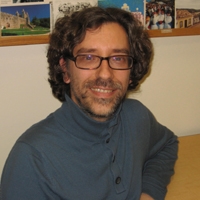
Patricia Saldarriaga
Professor of Spanish
Email: psaldarr@middlebury.edu
Phone: work802.443.3258
Office Hours: By appointment
Download Contact Information
Patricia Saldarriaga completed her M.A. at the Ludwig Maximilian Universität in Munich, Germany, and her PhD. in Spanish and Literary Theory at the University of Washington in Seattle. She has been at Middlebury College since 1999, where she teaches courses in Golden Age literature and art, contemporary poetry, and Spanish language. She has taught a number of graduate courses in the Middlebury Language School (Middlebury VT and Guadalajara, Mexico) on different topics of the Baroque. She is the author of Los espacios del Primero Sueño de Sor Juana Inés de la Cruz. Arquitectura y cuerpo femenino (Iberoamericana/ Vervuert, 2006). In addition, she has published a variety of articles on Renaissance and Baroque literature, as well as two books of poetry. She is currently working on a project that studies 17th and 18th century Mexican poetry on the Virgin of Guadalupe, specifically the relationship between religion icons and the construction of the Virgin as a national symbol. She is also a member of the Hispanic Baroque Project.
Courses
Courses offered in the past four years.
▲ indicates offered in the current term
▹ indicates offered in the upcoming term[s]
SPAN 6560 - Literary Analysis
This course will introduce the graduate student to the techniques of literary analysis, critical thinking, reading, and interpreting Hispanic literary texts. It is divided into three segments, each of which is devoted to the analytic strategies pertinent to one major genre: narrative, poetry, and drama. Each student will write several papers and actively participate in class discussions. (1 unit)
Required text: Juan Carlos Onetti, Los Adioses (Editorial Punto de Lectura, 2007) ISBN 978-84-663-2011-5; Federico Garcia Lorca, La casa de Bernarda Alba (Amazon, paperback).
LiteratureSummer 2011
SPAN 6659 - Sor Juana & Cult of Baroque
Sor Juana Inés de la Cruz and the Culture of the Baroque
This seminar will focus on the life and writings of the 17th-century Mexican nun, Sor Juana Inés de la Cruz (1649-1695), who is considered not only one of the major literary figures of Colonial times, but also the first feminist of the New World. We will study her poetry, drama, autobiographical letters, and theological writings in the context of the main cultural trends of the Baroque: the new scientific discoveries, painting vs. poetry, the debate on Holy images, theories about the female body, women educational discourse, and others. (1 Unit)
Required texts: Sor Juana Inés de la Cruz, Obras completas (Mexico: ed. Porrúa, 2007); Octavio Paz, Sor Juana Inés de la Cruz y las trampas de la fe (Mexico: Fondo de Cultura Económica); Michel Foucault, La historia de la sexualidad. La voluntad del saber vol. 1 (Mexico: Siglo XXI); additional readings will be available in electronic form on Segue.
LiteratureSummer 2011
FYSE 1353 - Poetry in Exile
Poetry in Exile
In this seminar we will read and study poetry written in Spanish and English. We will cover a selection of 20th and 21st century Spanish-American and Spanish poets who wrote in exile, such as Vicente Huidobro, Pablo Neruda, Jorge Luis Borges, Federico García Lorca, César Vallejo, Cristina Peri Rossi, Julia Álvarez, and many others. Our main purpose is to undertake close readings of poetic texts, taking into consideration issues of voice, space, and diasporas. This seminar will be taught in Spanish and will cover comparisons between the two languages. This is an appropriate seminar for native speakers of Spanish, students who are bilingual, and students who have scored 720 or above on the Spanish SAT II, or 5 on the Spanish AP.
Fall 2011
INTL 0703 - LAS Senior Thesis
SPAN 0220 - Intermediate Spanish II ▹
Intermediate Spanish II
A course for students seeking to perfect their academic writing skills in Spanish. The course is also an introduction to literary analysis and critical writing and will include reading and oral discussion of literary texts. The course will also include a thorough review of grammar at a fairly advanced level. This course may be used to fulfill the foreign languages distribution requirement. (SPAN 0210 or placement) 3 hrs. lect./disc.
Spring 2008, Fall 2010, Spring 2012
SPAN 0300 - Intro to Hispanic Literature ▹
An Introduction to the Study of Hispanic Literature
This course in literature and advanced language is designed to introduce students to literary analysis and critical writing. The work will be based on the reading of a number of works in prose, drama, and poetry. Frequent short, critical essays will complement readings and provide students with practice in writing. This course is required for Spanish majors. (SPAN 0220 or equivalent) 3 hrs. lect./disc.
Spring 2009, Spring 2011, Spring 2012
SPAN 0321 - Spanish for Heritage Speakers
Spanish for Bilingual/Heritage Speakers
This course addresses the needs of Spanish speakers whose formal education has been primarily in English. The main goals are to improve writing skills, practice critical reading, and develop a richer vocabulary adequate for academic oral and written expression. The readings and discussions will include topics of interest for the Latino population, history, literature, politics, etc. Students will review Spanish grammar, prepare presentations, and lead discussions and debates. The materials for the course will include: TV-news, movies, videos, and texts (literary, journalistic). (Placement test and by approval) 3 hrs. lect./disc.
Fall 2008
SPAN 0354 - Cervantes: Novelas ejemplares
Cervantes’ Novelas ejemplares
Miguel de Cervantes (1547-1616) is considered by many critics as the creator of the modern prose novel. This claim is based not only on Don Quixote, but also on a collection of twelve short pieces, the Novelas ejemplares, published in 1613. In this course we will read and discuss these stories, approaching them from a literary and cultural perspective. This course will be taught in Spanish. (At least two Spanish courses at the 0300 level or above, or by waiver).
Spring 2008
SPAN 0367 - Contemp Latin American Poetry
Contemporary Latin American Poetry
In this course we will study the major currents of contemporary Latin American poetry. Beginning with Darío, we will read texts by Martí, Vallejo, Neruda, Paz, Lezama Lima, Varela, Hahn, Ollé, Belli, Pizarnik, Mazzotti, Chirinos, M.A Álvarez, and other poets from Brazil, Central, and South America. Discussions will cover, among others, the relationship between poetry and politics; country vs. city; body and nutrition; love, sexuality, and eroticism. We will also include critical and theoretical readings that will complement close readings of poems. This course satisfies the IS advance language requirement in Spanish. (At least two Spanish courses at the 0300-level or above, or by waiver) 3hrs. lect./ disc.
Spring 2009
SPAN 0373 - Painting And Poetry
Painting and Poetry in the Spanish Golden Age
In this course we will explore the relationship between painting and poetry during the Spanish Renaissance and Baroque by focusing on relevant themes of the time: the revival of interest in figures from pagan mythology (e.g. Europa, Venus, Vulcan, Laocoön); the Council of Trent and its influence on Christian painting and literature; the representation of women according to the period norms of beauty; and melancholy as sickness. Paintings of El Greco, Zurbarán, Velázquez, among others, will be analyzed in conjunction with their counterparts in literary texts by Theresa of Avila, Garcilaso de la Vega, Lope de Vega, Francisco de Quevedo, and Sor Juana Inés de la Cruz. Satisfies the IS advanced language requirement in Spanish. (At least two Spanish courses at the 0300 level or above, or by waiver) 3 hrs. lect./disc.
Fall 2010
SPAN 0391 - Lat Am Cultural Studies
Latin American Cultural Studies: Texts and Concepts
In this course we will apply Cultural Studies methodology in various cultural contexts, focusing on Latin America. Among the concepts studied will be those of nation, hegemony, postcolonialism, subalternism, performance, heterogeneity, hybridity, aesthetics, race/ethnicity, and gender. Each concept will be used in an analysis of a literary, cinematic, performative, and other artistic work. We will be analyzing, among others, the literary works of Faustino Sarmiento, José Martí, Pedro Lemebel, Manuel Puig, and José María Arguedas; the cinema of Jorge Bodansky and Barbet Schroeder; as well as testimonial literature and various other forms of popular culture. lect./ disc.
Fall 2011
SPAN 0402 / LITS 0402 - Cervantes y Don Quixote
Cervantes y Don Quijote
A detailed discussion and analysis of the Quijote, with additional readings from major literary and cultural sources. (Senior majors with at least two Spanish courses numbered 0350 or above, or by waiver.) 3 hrs. sem.
Fall 2011
SPAN 0403 - What is Baroque
What is Baroque?
In this seminar we will explore the concept of the Baroque in the literature, arts, and sciences of the 17th and 18th centuries, taking special care to differentiate between aesthetic and historical definitions of the term. We will study representations of the Baroque in Hispanic poetry, drama, painting, architecture, and music. We will also focus on its connections with philosophy, astronomy, mathematics and anatomy. Students will also be encouraged to look for traces of the Baroque in contemporary culture. Other questions to be considered include: What is the difference between Baroque and neo-Baroque? What do we mean when we use the adjective "baroque" to describe a contemporary painting, a film or a video game? Can we talk about a Baroque revival in the 20th or even the 21st century?
Spring 2011
SPAN 0439 / RELI 0439 - Hispanic Religious Painting
Hispanic Religious Painting in the Golden Age
The use of holy images can be traced back to the debate between iconoclasm and iconolatry. During its last session in 1562-1563, the Council of Trent regulated the use of holy images in Spain and its colonies. In this course we will study the reasons why religious images were predominant in European and Spanish American art of the Renaissance and Baroque. We will also concentrate on the representation of divinity, saints, heaven, modes of praying and visions. We will study the religious iconography associated with these themes, and we will also pay attention to the relationship between passion and eroticism, visual deceit, and body rhetoric for the representation of ecstasies. Among the artists considered will be El Greco, Velázquez, Alonso Cano, José Juárez, Cristóbal de Villalpando, as well as other anonymous painters from the Andean countries. Satisfies the IS advance language requirement in Spanish. (Senior majors with at least two Spanish courses numbered 0350 or above, or by waiver.) 3 hrs. sem.
Fall 2008
SPAN 0500 - Independent Study ▹
Independent Study
The department will consider requests by qualified juniors and senior majors to engage in independent work. (Approval only)
Spring 2008, Fall 2008, Winter 2009, Spring 2009, Fall 2010, Spring 2011, Fall 2011, Spring 2012
SPAN 0705 - Senior Honors Thesis ▹
Senior Honors Thesis
The department will award honors, high honors, or highest honors on the basis of a student's work in the department and performance in SPAN 0705. (Approval only)
Spring 2008, Fall 2008, Winter 2009, Spring 2009, Fall 2010, Spring 2011, Fall 2011, Spring 2012
SPAN 1015 / WAGS 1015 - Two Mexican Icons
Two Mexican Icons of the Baroque and their Legacy
Two female figures of the Baroque have deeply influenced the way contemporary Mexico imagines itself as a nation: the Virgin of Guadalupe and Sor Juana Inés de la Cruz. Apparitions of the Virgin of Guadalupe are dated from 1531, and she has evolved into a symbol of the Mexican nation since the first texts about her were published in 1648. We will study the history of the representation of the Virgin in art, poetry, and popular culture from the 17th to the 21st century. We will also explore the figure and writings of Sor Juana Inés de la Cruz (1651-1695), known as the first feminist of the New World, some of whose poetry, drama, and autobiography reflect on the Virgin Mary and the Virgin of Guadalupe. (At least two Spanish courses at the 0300 level or above, or by waiver.)
Winter 2011