Edge-Effect

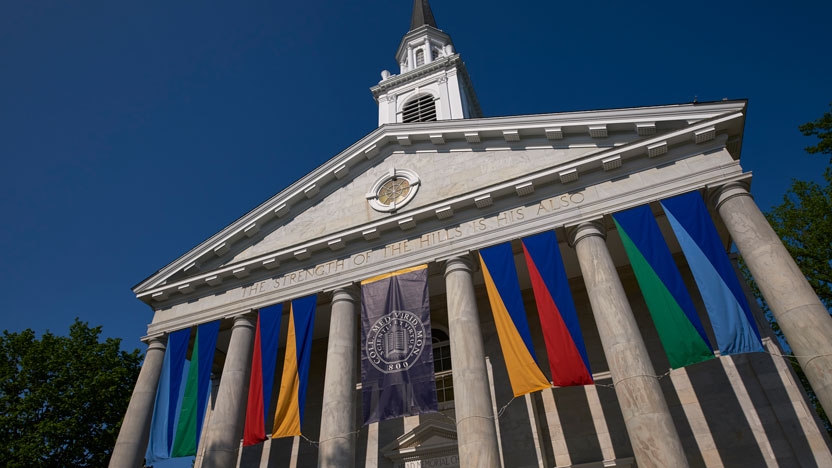
Middlebury College Graduation

January 30, 2009

Thank you, Ron, for that generous introduction. I’d also like to express my appreciation to Abby and her eight colleagues on the organizing committee for the invitation to address you this afternoon. It’s truly a privilege to do so, and the most important thing I have to say is, congratulations to all the members of this admirable and engaging group of graduates!

You’re stepping across a threshold this weekend, celebrating your last days together on this beautiful campus as you begin to edge out into the next chapters of your lives. Such a moment has much in common with the sort of environment that ecologists call an ecotone. This is the term for a zone that lies between two distinct ecosystems, and which both includes some species from each of those habitats and harbors some that are unique to that borderland. In addition to their high degree of biological richness, as measured by species richness and biomass, such edges can be highly dynamic places. Examples would be a rocky shoreline with its the twice-daily reversals of the tide and the brushy margin steadily advancing from a woodland into an unmown meadow. Ecotones are promising yet risky environments for the plants and animals venturing in from either side. Exploring a new field of resources, a creature may discover life more abundant, but it may also just end up being what’s for lunch.

This combination of unpredictability with rich potential is summed up in the related ecological term “edge-effect”—which is the title and topic of my remarks to you today. As I look back over my thirty-five and a half years of teaching at Middlebury, so many of my most rewarding experiences have played out along a dynamic edge of what kind or another. My guess is that this has also been true for many of you, and may continue to be so, especially in the most creative and growthful aspects of your careers to come. In this spirit, let me pause over several manifestations of edge-effect in our life together here.

The first of these has to do with the moments in which we have escaped from conventional or familiar frameworks in our interactions with one another. In an American Studies class of last fall called “Fast Food/Slow Food,” we complemented our readings, discussions, and films with three dinners cooked by teams drawn from the whole class. These were complicated affairs and time-consuming affairs. The cooking teams for each class had design a menu, based on whatever provisions were seasonably available, shop, divvy up the tasks, cook, and serve the meal. As if that weren’t enough, the teams also ended up framing each meal thematically: the first dinner was produced for a dollar per each person who would be eating, in accordance with an exercise called “the Food Stamp challenge”; this was in direct response to certain questions of social justice raised by Eric Schlosser in his book Fast Food Nation. Our second meal was cooked and served at the Cornwall home of Amy Trubek and Brad Koehler, who have an orchard of heirloom apples behind their house; so every thing we ate and drank that night included apples in some form. We held our final dinner at the home of Deb Evans and Will Nash, Heads of Wonnacott Commons; those cooks chose to make each course of this meal a parody of typical fast-food fare, but using exclusively wholesome and local ingredients.

Not only were these three meals delicious, but they both fostered a stronger sense of community in the class and brought issues from our readings into high relief. Because they moved out into a zone beyond our normal meeting-hours and format they were able to shape and illuminate our semester together.

Over the Winter Term just past I’ve been the convener of a seminar for new faculty members at Middlebury. In preparing for this experience I’ve had occasion to read several provocative books about teaching. One of these, entitled “The Courage to Teach,” by Parker Palmer, explains his concept of “the community of truth.” Rather than being a hierarchical transfer of knowledge based on expertise, it is a network of perceptions from knowers with different backgrounds and talents.

Palmer writes, “In the community of truth, knowing and teaching and learning look less like General Motors and more like a town meeting, less like a bureaucracy and more like bedlam.” His accompanying diagram shows a circle “knowers” around the periphery, who are connected by arrows both to each of the others and to the “subject” in the center. This picture reminded me of the old trick in which people are challenged to connect all the dots in a squared-off pattern of points without lifting one’s pencil or drawing through any one dot twice. It’s impossible to do so—unless one looks beyond the implied boundaries of the square that we have so automatically focused on. This is the sort of excursion outside of the familiar that people mean when they speak of “thinking outside the box”; or, in recent discussions of alternatives to petroleum in our industrial and transportation systems, of “thinking outside the barrel.”

The richness of edge-effect is found when the hermetic, conventional, and fragmentary are enmeshed with surrounding realities rather than continuing to be walled off. It’s another lesson closely related to Middlebury character and mission. After all, the ideal of a liberal education both involves connections between our studies and their broader social and environmental contexts and encourages links between courses and disciplines within the curriculum. Writers, artists, and scientists often make use these days of a term that first arose (if I’m not mistaken) in sports: “being in the zone.” Over the years, many of my students here have told me about feeling in the zone during those special semesters when all their courses felt significantly connected. I remember this kind of experience vividly from my own undergraduate years, as a kind of bliss in which every reading and conversation built on all of the previous ones; in which wholeness replaced the experience of dividedness. Even now, in exhilarating moments when I feel that I’ve gotten back into the zone as a writer or teacher, there generally seems to be some sort of edge-effect in operation: a surprising and adventurous connection that whirls me into new insights.

I’d like to tell you about a recent scholarly project that felt this way. Though an ardent amateur naturalist, I lack the professional competence or credentials of an ecologist. So when I got to know a biologist at Harvard named Glenn Adelson who loved the poetry of Robert Frost as much as I did, it felt like a great to pool our insights about the ecological content of a single, short poem, “Spring Pools.” Here’s how it goes:

These pools that, though in forests, still reflect

The total sky almost without defect.

And like the flowers beside them, chill and shiver,

Will like the flowers beside them soon be gone,

And yet not out by any brook or river,

But up by roots to bring dark foliage on.

The trees that have it in their pent-up buds

To darken nature and be summer woods—

Let them think twice before they use their powers

To blot out and drink up and sweep away

These flowery waters and these watery flowers

From snow that melted only yesterday.

This is a poem evoking the transience of spring’s beauty—especially in New England, where, as Frost observed, summer, fall, and winter—especially winter—are long. “Spring Pools” is a beautifully brief poem about the beauty and brevity of Spring. Field naturalists have long shared Frost’s knowledge of this fleeting season: they call the watery flowers of the poem’s haunting penultimate line “spring ephemerals,” and call those flowery waters “ephemeral pools.” Nor is Frost by any means the first poet to comment on the transitory nature of Spring’s beauty. He is, however, the first to write about it with a high degree of ecological sophistication. Frost’s understanding and elaborations are subtle, though, and have nowhere been fully explicated. Specifically, at the heart of “Spring Pools” lies Frost’s understanding of three natural processes: the vertical movement of the water table, the perennation of the wildflowers, and the preformation of the buds of the trees. These processes, which have been either undervalued or completely overlooked by Frost’s interpreters, work together to enrich the meaning of the poem, leading to an appreciation of the importance of visibility and invisibility in the natural cycles that Frost presents.

For most critics this has seemed a despondent, almost a desperate poem. What seems to be vanishing, and therefore grounds for melancholy—the snow, the pools, the flowers—is to one who has looked at the pools over many years, long-lasting, and “something for hope.” Though the dialogue of our disciplines, as well our field-trips to ephemeral pools, Glenn and I were able recognize the ways in which Frost identifies himself with a larger he can affirm emotionally and comprehend intellectually.

In northern New England the wild geraniums begin to bloom at the water’s edge in the middle of May. High above them, tiny green shoots poke out from the buds of the ashes, oaks, and basswoods. Within a few days the wet woodland fills with a rose-purple, delicately veined flush of geranium flowers. At the same time, the buds of the trees open and reveal their elongating shoots and unfolding leaves. By the end of May, all that is visible of the geraniums are a few diagnostic leaves and their brown, semi-woody fruits, many of which have already spun out their seeds. The trees above, however, have reached the fully leafed condition they will maintain uninterrupted until late October. The geraniums are just one example of the plants that field naturalists call “spring ephemerals,” plants that can photosynthesize and flower for only that brief period of the Spring when water is abundant and the trees above bear no leaves to block their sunlight.

But as our collaboration helped us see, the visible processes just described are accompanied by invisible processes. The buds that will produce the leaves in the canopy contain fully formed leaf and shoot systems that developed during the summer of the preceding year. Their bursting out in the Spring is a function of cellular expansion from the uptake of water by their roots. The water visible as spring pools in fact represents the highest plane of a water table that saturates the permeable forest soil and rests on top of the underlying bedrock. This table rises and lowers as water is added to or taken from the system. Only when the water table is at its highest level does it appear as visible pools. It is still there, however, at all other times of the year, lying at various distances below the surface. The geranium plant does not disappear; it perennates, that is, it persists as a below-ground rhizome, unseen. Most, if not all, of the spring wildflowers that Frost would have seen surrounding the spring pools of New England are perennials.

One need have only passing familiarity with natural cycles to understand the shift from visibility to invisibility that begins the poem: “These pools that, though in forests, still reflect/The total sky almost without defect.” The word “still” controls this opening couplet, keying the reader into the continuing tensions throughout the poem caused by the changing of the seasons. The pools are in the process of shifting from visibility to invisibility. In fact, as noted above, the pools are not separate entities at all, but ephemeral surface manifestations of the height of the underlying water table. The pools become invisible because the whole water table is lowered by the evapotranspiration of the roots, xylem, and leaves of the trees. Disappearance is complemented by a deeper stability, in a pattern, drawing from both science and the humanities, that encompasses both seasonal processes and the longings of the human heart.

If our stretching of the usual categories in our dialogues and scholarship can sometimes bring a heightened sense of partnership and community at Middlebury College, similar gains may be experiences both in our life as citizens. My other course this past fall focused on the Addison County town of Starksboro. Our assignment was to interview residents and offer back their own stories in ways that might enrich the town’s planning process. In a semester rich with new insights one particularly memorable one came from comments by Greg Orvis and Linda Barnard, both of whose families have lived in Starksboro for many generations. Greg told me a story about the meaning of community in his home-town. His father had been laid off one winter, just as Greg’s mother and he had a newborn to take care of at home. So he asked a farmer named Robert Young if he had any work for him. Mr. Young guessed it might be a good idea to buck up the wood a bit earlier than usual for the spring’s maple-syrup production. Then he came up with a series of other tasks on the farm, including repairs to the saggy old barn doors. Warm weather returned, the economy thawed, and Greg’s dad was able to find a full-time job elsewhere. Six decades later, Greg still gratefully recalls this neighbor’s kind and respectful accommodation to his family’s needs.

Linda had offered a complementary observation to Hillary Gerardi, a member of our class. She remarked that people who have recently arrived in Starksboro often praise the extraordinary sense of community there, while natives like herself are aware of how much has been lost. Her point about those divergent perspectives, though, was that they can offer a valuable starting point for conversation—about how what comes next for the town may be linked to what went before. She thus makes a point of sharing her own stories with newcomers, including tales of the one-room schoolhouse she attended. In both Greg’s story and the efforts by Linda and others today, community can be understood as a lineage of kindness extended tactfully from one generation to the next. Long-established Starksboro families like the Orvises, Cliffords, and Shepards have warmly welcomed and supported arrivals like the Turner and Dubenetsky families. Over the passing years, those newer residents have shouldered considerable responsibility for the functioning of their adopted town.

Such an historically-grounded but forward-looking practice of neighborliness has a lot to do with the achievement of creative community in our Middlebury College classes, too. Whether studying history, exploring literary traditions, mastering scientific methodologies, or familiarizing themselves with the standards of various disciplines, students are asked to begin by listening in an ongoing conversation. But the teachers who frame such conversations need to be equally alert to the fresh insights students bring forward. In other words, meaningful dialogue requires concentration and respect no matter which side of the ecotone one is venturing in from. Energy, attentiveness, and a certain relinquishment of expectations are all necessary.

One of the features of personal ecotones is that they’re always moving, both in an outward sense and in relation to one’s shifting perspective. The meaning of your years at Middlebury will not remain static, and when you venture back into the zone connecting this epoch in your lives with the efforts and accomplish that follow it you’ll renew and revise as well as revisit your undergraduate career. But I hope and believe that this dynamic reality will make all you’ve done here even more valuable and memorable.

In Virginia Woolf’s novel To the Lighthouse, her character Mrs Ramsay hesitates at the moment of leaving the dinner-party to which she has dedicated so much of her energy, insight, and art, and moves on to another realm of activity. Woolf describes the scene this way: “It was necessary now to carry everything a step further. With her foot on the threshold she lingered a moment longer in a scene which was vanishing even as she looked, as she moved . . . and left the room, it changed, it shaped itself differently; it had become, she knew, giving one last look at it over her shoulder, already the past.”

The moment has come for us to leave this circle and edge over into the reception that’s waiting for us around the corner. My wish for all of the graduates who have been listening so patiently to me for these past twenty minutes is that you’ll find wholeness, energy, and satisfaction, looking backward and forward, in the moving edges of your lives.