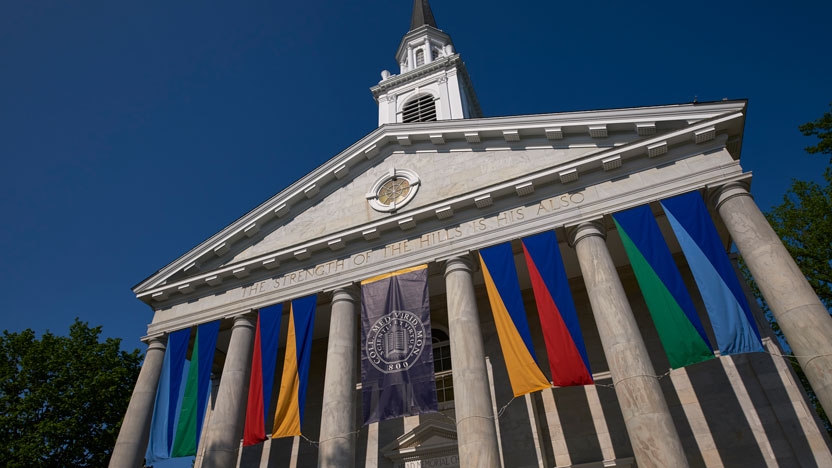
Each year the midyear graduates select a speaker to help them celebrate the completion of their studies. This year the class chose Adrian Benepe '78, City Commissioner, New York City Parks and Recreation.
The following remarks were delivered in February 2007.
Thank you very much, President Liebowitz. It is an honor to be back here in Middlebury and I am thrilled to see the college in such good shape and such capable hands. Good evening to the graduating class of February 2007, and especially to their parents. As the parent of a current Middlebury sophomore, I can appreciate what must a palpable sense of pride you must have in your children’s achievements, and what a huge sigh of relief that you have made your last tuition payment…for now. As for the members of the graduating class, it’s not over yet. I am sorry that I cannot join you for the final and formal ending—the ski down the Snow Bowl slopes. The last time I skied was here in Middlebury, almost 30 years ago, and I am hoping to return home without a leg cast.
I am also honored to be speaking to the advance guard of the Class of 2007. I have been asked by Bill Clinton to try out some of his jokes in advance, so if I don’t get any laughs or if I offend anyone, it’s not me—it’s President Clinton’s speechwriter. And because it’s Groundhog Day, I may have to try out the same material a few times in a row.
And to the faculty here tonight, thank you for being there for me 30 years ago, and being here for these students tonight. It is the extraordinary caliber of the professors here and their devotion of time to the students that separates Middlebury from most of the colleges and universities across the country.
I was really happy to be asked to speak to the February graduates and their parents. It is either a sign that I have made something of myself since I left Middlebury, or all the other potential speakers got gigs in Florida or Hawaii. Regardless, it is always great to come back to Middlebury, and if you have lasted four years here, some small part of you finds a special beauty in the dead of winter in Addison County. In fact, my wife Charlotte Glasser and I have been regular visitors to Middlebury since we graduated in February of 1979. Yes—I was a Feb, and yes, I married a Middlebury woman. Charlotte hung around an extra semester so that she could help me write (and type on a manual typewriter) my honors thesis. And since I was asked to speak, and really since I was first accepted to Middlebury, I have often wondered what being a Feb. conveys.
Graduation addresses are supposed to give the departing seniors a spiritual blessing and possibly a hint as to what may lie ahead. I always believed that being a Feb was kind of like being an Apple computer. The business world might run on Microsoft, but the people who know go for Apples. We weren’t admitted with the rest of the obvious academic stars. We had to prove ourselves and be willing to wait in our suddenly too-small homes, hanging with our younger high school friends, working a menial job, while itching to get to college. I don’t know about you, but I was one of those people that Middlebury took a risk on—a classic under-achiever with mediocre grades but idiosyncratic flashes of potential. I am almost certain that the me of 1974 wouldn’t get near the Middlebury College of today, but I’d like to think that Middlebury is still taking chances on people like me, who for some reason were not ready to learn and work hard until the doors of this college swung open.
That I am here at all, speaking to you, is a tale of serendipity. I’m not sure how many of you had your lives planned out while you were in high school, but I certainly didn’t. It was serendipitous that a person a year behind me in high school invited me to come up and visit Middlebury in the middle of a very snowy weekend here in February. What I encountered was Dr. Zhivago meets The Magic Mountain—a fairy land of eternal, pure and sweeping snows and a community of warm and friendly people who seemed to be best friends with everyone, in the most beautiful piece of the world I had ever seen. I was only admitted to one other college, and Middlebury wisely put me on the waiting list. It was one of those serendipitous moments for me when they let me in, subject to my being willing to wait until February to attend.
Being a Feb provides you with a set of challenges from the get-go. You arrive here at the coldest time of year, when the rest of your putative class has had five months to get to know each other, to form friendships, to join clubs, to take spots on teams, to figure out the coolest tables in the dining halls. On the other hand, the minute after you arrive, Winter Carnival begins, so you get the idea that you have somehow ended up at one of those hallowed “party schools”. But here’s where serendipity jumps in. You are also a member of a special “class-within-a-class”, and very likely, some of your lifelong friendships were formed by the special bond of being a Feb—kind of like the bond felt by mob soldiers when they become “made men” together.
The first guy I met when we arrived that day in February? It was Mickey Kann from Yonkers by way of Riverdale High School. I told Mickey I had been put in a room in Hepburn. He said, “Isn’t that a girls’ dorm?” I said, “Yeah—they put me there because I have a girl’s name.” Well, he was really jealous at first, but then he figured out that I was kidding and later we were “best men” at each other’s weddings and he and his entire family, mother included, joined mine for our Christmas Eve dinner. The people I am still in touch with from the class of 78 and a half? Most of them are Febs. So take a look around you tonight—if you’re not totally sick of each other, chances are you are friends or associates for life. Another friend, Joe Pierson, has helped me create two non-profit organizations that have raised million to preserve historic houses and parks in New York City
And while we’re on the topic of associates for life, allow me another digression on “serendipity.” It’s how my son Alex comes to be a member of the Middlebury Class of ‘09—in fact it’s why he exists at all, and why his brother is also on this planet, and it all comes down to serendipity. Yes, I know that there is a relatively high rate of marriage among Middlebury grads, but what if Charlotte, who was from Bakersfield California, had not taken a secret trip while still 17 years old to the East Coast with someone not known to her parents. And what if she hadn’t decided to drive from Boston to Montreal, and what if she had taken the proverbial road less traveled. And what if, instead of being awake as they drove through Middlebury, 34 years ago on a September afternoon, she had been asleep. Or what if she had blinked at that crucial instant, as the car turned on that dogleg around the Middlebury Inn, and she had not seen the sign with that curious, semi-circle arrow that pointed to the left and said “Middlebury College”? No one in Bakersfield California had ever heard of Middlebury College (even if the fictional character of the fictional town in “American Graffiti” said he had left town to go there). But she was awake, and she didn’t blink, and that unusual arrow and that unknown college caught her eye, and the next thing she did was make the car take an unplanned left turn, down Main Street and over to the admissions office.
So what’s the moral of that story—because graduation speeches are supposed to contain a profound morale? Never blink…
All of you in this room have at least one of those “never blink” moments, where if fate or kismet or random sequences had been different for a nanosecond, your lives might have been very different, or might not exist at all. Those are things that you largely cannot control. But there are things, many of them that you will take from here to the many “theres” in your lives, that are at least somewhat in your control. Here are some:
Take a chance: You have your entire life ahead of you to worry about making the right choices. This time immediately after college is a great time to take chances. I don’t mean suddenly taking up free climbing or parachuting or gun running. I mean taking chances in life and especially in your career. If you are lucky, you will end up making money in something that you enjoy. If you haven’t yet done so, do a job that involves manual labor or serving other people. If you are very lucky, you will have a job that you enjoy that also makes other people’s lives better. I urge you to work at least once in public service.
My work in government has been a source of great personal reward. I oversee one of the largest and most complex urban park systems in the world, covering 29,000 acres and 14 percent of new York City’s land mass. I manage a $1 billion annual budget and more than 10,000 staff. From Yankee and Shea Stadium to every park, playground, pool, beach, tree and statue, the New York City department of parks & Recreation provides many of the things that make city life worth living. And on an average day I could go from a press conference with Mick Jagger and the rest of the Stones to a memorial unveiling with Prince Charles, to running through a spray shower with a bunch of kids in the South Bronx. You can’t buy that kind of fun, let alone get paid to have it!
As someone who has spent 95 percent of his career in either government work or the non-profit world, I can tell you that there is nothing more rewarding. That’s why I have made it my business to always have a Middlebury intern or extern working at the Parks Department in NYC. In fact, if not for one of those interns, I wouldn’t be here today, and I want to thank David Barker, one of your fellow Febs,, for suggesting me as a speaker. If you get rich in public service, you are probably risking jail time, but the psychic rewards are a better bonus than anything you’ll earn on Wall Street. That doesn’t mean you shouldn’t end up at Goldman Sachs—it simply means that you will have a much better appreciation of why government exists if you work in it, even if it is just as an intern. And if you do wind up at Goldman Sachs or Lehman Brothers, shame on you if you don’t remember Middlebury College
I have also never worked as an actor, artist, or farmer. This is the time in your life when you can try all those things, and you should.
Second--and I know your parents will appreciate this—Don’t rush off to graduate school. Grad school will always be an option. Do some work first. You may even be able to pay for your own graduate education. Many of my colleagues in government earned advanced degrees in law, business, or public administration while working full-time jobs. Charlotte went to graduate school four years ago to get her Social Work degree; while also being a fulltime mother do our kids. My late mother earned her Masters degree and doctorate while raising three kids, part of the time as a single mom. Wait until the Baby Boomers’ babies get done with grad school, and the competition will diminish.
Finally, and I know Ron will appreciate this (I hope the faculty here will…), don’t forget Middlebury. That means if you haven’t already made fast friends with a professor or two, there may still be time. Charlotte and I were able to make friends with several of the faculty here, including Sandy Martin and his wife Peggy and John Mary Ellen Bertolini. Now their children, whom we tutored and babysat for, are living and working in New York City, and we have second families here at Middlebury. Those little benefits are the by-products of inter-generational friendship, the kind that is rare on a campus of a large university.
Each year we have come back to visit, often in summer, when the fields are lush with sweet corn and the roads lined with chicory and Queen Ann’s lace, when the waves ripple on Lake Dunmore and the breezes blow at the top of Breadloaf Mountain, when the Holsteins are paraded by children at Field Days out in Weybridge. This became a paradise for our children as they grew up, and now it’s the place where one child is getting the best education in America.
So keep in touch with Middlebury. Not just through donations, which are important, but through the connection you have made to each other, and to this place. The friendships you made here may be the most lasting of your lives. At any rate, because of what your friends know about you, and what you know about them, they will at least be the basis of mutual non-aggression treaties. Your life may take you far away, and chances are you won’t marry someone from here, but chances are you have been touched by this college and its people. And that touch lingers, even at the most random moments. My job, for example, has exposed me to litigation. Giving a deposition is a special form of torture, only alleviated for me by conjuring up and really experiencing in my mind and tissues images of the stream that flows down from Silver Lake to Lake Dunmore.
I hope that you will guard that connection, share it appropriately, use your foundation here to do something good for the world, and take a few chances. And never blink.
Thank you.