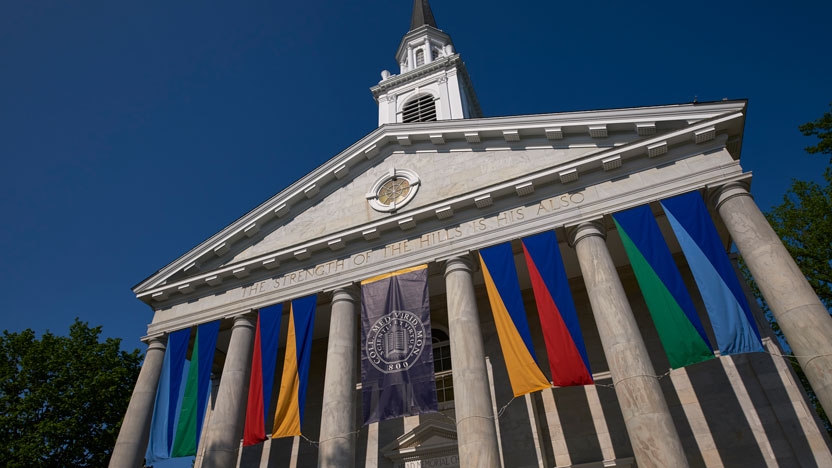
As has been the case since 2001, a committee of seniors selects a member of their class to deliver an address as part of their ceremony. This year the class chose Jeffrey King from North Andover, MA.
These remarks were delivered on February 4, 2006.
I used to be terrified of that elusive thing they called "The Real World." Each year around springtime, all the seniors would begin to whisper about this terrible place where you had to pay your own taxes and buy your own food. A social desert where there weren't parties every weekend, nobody went sledding on cafeteria trays, broomball didn't exist, and everyone worried about some kind of invisible money called "401K." I wanted nothing to do with it. I did everything I could to avoid it. I switched my major from AmCiv to Geography (with pre-med) in an attempt to fail more classes, thus prolonging my college career. I planned out a rigorous course of graduate study that would keep me in school until I was 74. I hid under my desk during discussions and cooked marshmallows on the heating vents, refusing to participate. But although my attempts were valiant, they were to no avail. Here I stand, hours away from plunging headfirst into the arctic waters of the real world. But this past semester, when it was finally me who was scaring the underclassmen with my worries about the impeding state of my health benefits, something occurred to me. Something that finally made me realize why I shouldn't be scared of the real world; I have already been there.
Before I even ask the question, you already know what it is. It's the only thing you talk about with the hundred or so other new febs during your first week. I went to Europe for six weeks, visited Puerto Rico, and then worked as a prep chef at a local restaurant. The girl next to me taught hang-gliding six days a week and wrestled professionally on the seventh. The kid with the brown hair single-handedly saved an entire tribe of Eskimo children from an Alaskan Nuclear Holocaust. You name it, and somebody did it during his or her Feb semester. I heard one girl even invented a drink that gives eternal life and then promptly discarded the recipe just to keep things interesting.
To its credit, Middlebury College pushes each and every one of its students to succeed in his or her chosen field of study. Everybody goes through the same enriching experience, from the lows of an all-nighter and the highs of thriving in a rigorous academic setting. And each year when Middlebury sends another class of young adults into the real world, you can very safely assume that each and every one of them is capable, industrious, and motivated. But for most of Middlebury's seniors, graduation day is the first time in their lives that they will venture into the horrible, scary real world. But this is where Febs are different. This is where Febs have a step or two on the rest of the college world. Because when febs are asked the inevitable question, "So, what are you going to do for the next six months?" it will be the second time they have heard it.
Now, there are some who would be so bold as to argue that hang-gliding six days a week and saving Eskimo children is not exactly the real world. That most people won't ever wrestle professionally or invent some magic drink. That although febs do take some time off to experience the globe before they begin college, they don't go anywhere near the "real world." I disagree. I think that in the six months before Febs enter Middlebury College, they see more of the real world then most people see in a lifetime. And perhaps more importantly than that, they enter college with an understanding of where it is they're heading; what they're working for. For them, history lessons on ancient China and daily ballet rehearsals and endless effort organizing AIDS awareness benefits are infinitely more tangible, more real. Because in all probability, they have been to China, they have seen Balanchine's Romeo and Juliet, and they have worked with actual AIDS patients. It's no wonder the admissions department always brags about the high number of Febs that are presidents of student organizations or captains of athletic teams; it's hard to be intimidated by the pressures of student life when you have already caught a glimpse of adulthood.
Although I'd like to, I can't give all the credit to the Febs themselves. However much I am supposed to, I don't hate "regs." There are actually a number of them sitting here today, many of whom, once you get past the feb envy, are pretty great. Most of my best friends, in fact, started school in September and graduated in May, as most of the student body in this country does. And most of my friends who have suddenly gone from being "students" to being "alumni," are doing just fine in the world. They have jobs, buy their own food, and pay for their health benefits. Some of them even have 401K. And this is where we have Middlebury College to thank. Because instead of inhibiting us from experiencing the real world, Middlebury pushes into it. Last January, I spent the month reading screenplays in the Los Angeles offices of a Golden Globe-winning production company. And got credit for it. During my sophomore year, a friend of mine on Middlebury's volunteer ambulance squad received an emergency call in the middle of an important presentation that he was giving; our professor insisted he go, offering him good luck on the way out. Last fall, the geography department's senior seminar spoke before the Middlebury Town planning commission on the subject of Wal-mart with research that was then used to help the town make its decision. I imagine college would be easier if we never had to leave the campus. If we could just sit around in sweat pants, drink coffee, and muse on the pleasance of Academia. It would be easier, and it would be no fun. It would be easier, and we would be terrified of ever leaving. Instead, while it might be sad, leaving is exhilarating. Because we finally get to put into practice that which we have spent endless hours studying. Because we finally get the chance to get a job, buy a house, and be successful if we want to. Because we finally get the chance to live in a cardboard box, eating nothing but spaghetti-o's and old shoes, and singing show tunes at pigeons all day long if we want to. Because we finally get the chance to make the decision ourselves.
Whenever I talk to someone in this room about his or her post-graduate plans, I get either a laundry list of exciting possibilities or a happy smile and an "I have no idea." Because we have been there and we know we are ready. Because we have spent four years preparing for adulthood in the knowledge that each and every one of us is capable of become anything we want, from professional wrestler to prep chef. Because the world needs Eskimo rescuers and hang-gliding teachers just as much as it needs anything else. Because in 3 hours when we ski down the snow bowl and join the rest of the adults who live and work in the "real world," they won't say welcome, but welcome back.