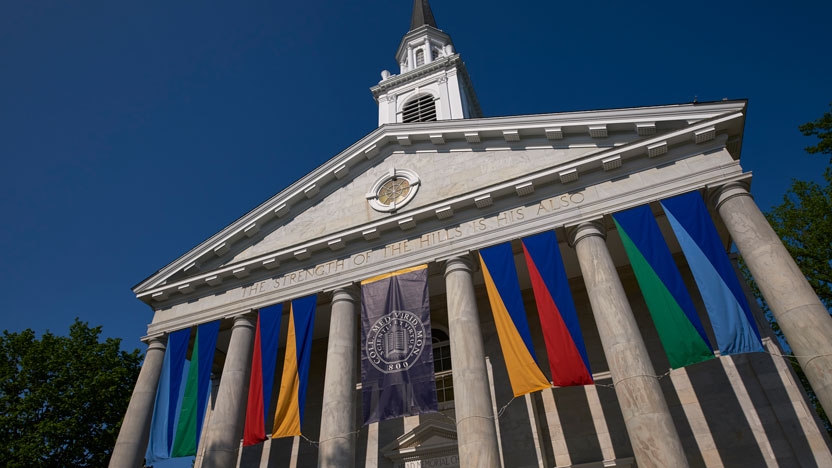
Each year the midyear graduates select a speaker to help them celebrate the completion of their studies. This year the class chose John M. McCardell, Jr., professor of history and President Emeritus.
The following remarks were delivered on February 3, 2006
Campephilus Principalis:
The "Great God Bird" Through It All
Good afternoon, and welcome to you all. It is a great pleasure, and also a great honor, to have been invited to join you today. Some of you I greeted in February of 2002, others of you in September of 2001 or 2002. On those occasions I thought it important to tell you a little bit about the history of this place where you were then beginning your academic careers. Now, you have yourselves become a part of that history, and have contributed to it, and, though you must wait a bit longer to have your graduation formally confirmed, you now find yourselves, as you take your leave, in the words of Robert Frost,
"possessing what [you] still are unpossessed by,
possessed by what [you] now no more possess."
And so I thank each of you, and the Feb committee, for this opportunity, one last time, to address you, and your families, and I invite you to think with me for a few brief moments, not about history – though that is what you might have expected – but about one of the most momentous, deeply moving, and consequential events to have occurred during your own lifetime.
No, this is not one more predictable reference to September 11. Rather, it is about something you may in fact have missed, or may not have thought much about, when it happened. But it is just such things that often, and in the long run, have more meaning than we may at first realize.
Any proper address must have a text, and so we begin with the words of the famous ornithologist, William Beebe, who observed profoundly, and exactly 100 years ago: "when the last individual of a race of living things breathes no more, another heaven and another earth must pass before such a one can be again."
The words of this remarkable man -- who at the age of 22, in 1899, became Assistant Curator for Birds at the brand new New York Zoological Park (better known as the Bronx Zoo), who had a farm in Vermont, and who for many years was arguably the great naturalist of his generation – these words speak a simple, profound truth. And they constitute the starting point for a story I'd like to tell.
It's hard to pinpoint just where the story begins, but the correct starting point is many millennia ago. Beebe is speaking about extinction, and, while this is by itself a daunting topic, it is the more daunting as scientists remind us that 99% of all species that have ever lived are now extinct. Our natural world today, in other words, is the 1% that remains. Moreover, there have been at least five waves of mass extinction in the history of the world, resulting from drought, or meteorites, or, most recently, which is to say 65 million years ago, a combination of asteroids and volcanoes, which killed off the dinosaurs and two-thirds of all animal species alive at that time. So far as we know, human beings had nothing to do with any of these moments. We hadn't come along yet. When we did, 1% was left – left to us and to a capricious natural order that might at any moment eliminate what remained, including us.
Sooo you're thinking …. This speech is going to be a depressing downer. Now comes the doomsaying and the fingerpointing. What a way to end our college careers. Who invited this guy?
Well, you're wrong – or mostly wrong. For mine is a story not of extinction but of survival, and of a discovery last spring that is, in the end, all about hope – and faith – and hubris – and tenacity – and, most of all, the glorious, imponderable mysteries of this world we inhabit. It is a story of Camphephilus Principalis. Over the years this magnificent creature has been called by many other names: the Pearly Bill, the Log-cock, the Indian Hen, the Tit-ka, the Pate, the Habenspecht, the Kent, but, most commonly, the Ivory-Billed Woodpecker. In December 1820 John James Audubon first came upon the Ivory-Bill in its native habitat, a swamp forest near the confluence of the Arkansas and Mississippi Rivers. Audubon's portrait of the Ivory-Bill (actually three Ivory-Bills) in The Birds of America captures the majestic beauty and strength of these noble creatures as they pound away on a dying tree in search of grubs.
According to Philip Hoose, author of The Race to Save the Lord God Bird, "the Ivory-Bill was indeed so wildly, stunningly beautiful, that everywhere Audubon went people seemed to want to give it a distinctive name. Audubon himself called it 'the Van Dyke' because its brilliant coloring (and especially its bright red tuft) and bold stripes reminded him of the style of the Flemish portrait artist Anthony Van Dyck. But the most telling nickname of all came from an expression of awe, and exclamation uttered by those who suddenly caught sight of an arrow-like form ripping through the forest canopy, unfolding its three-foot wide wings to the size of a flag, and then finally swooping straight up to sink its mighty claws into the thick trunk of a cypress tree. At such moments, sometimes all a dumbstruck witness could say was 'Lord God, what a bird!' And so it came to be known as the 'Lord God Bird.'"
And its distinctive "pait, pait" call extended the metaphor – residents termed it the "altar call," as was practiced in evangelical religious revivals, summoning the redeemed and regenerate to come forward, confess, and be saved.
Audubon himself offered this description of the Lord God Bird's habitat: "Would that I could describe the extent of those deep morasses, overshadowed by millions of gigantic dark cypresses, spreading their sturdy, moss-covered branches, as if to admonish intruding man to pause and reflect on the many difficulties which he must encounter, should he persist in venturing farther into their almost inaccessible recesses, extending for miles before him …."
But alas, modern technology and human desire and war combined to abbreviate the pause given Audubon, and by the 1930s, the Lord God Bird's habitat had been significantly reduced and its numbers dangerously diminished. And then came the fatal blow. The Chicago Mill and Lumber Company made wooden boxes – all kinds of boxes – and needed more wood than the pine forests around the Great Lakes could provide. The Singer Manufacturing Company, maker of sewing machines, owned 73,000 acres of mostly virgin forest in northeastern Louisiana. By 1939 Chicago Mill and Lumber had purchased this entire tract and began to produce wooden boxes, and tables, for Singer sewing machines. And once World War II began, any hope of halting, or even slowing, the clear-cutting of this forest succumbed to military necessity. The War Department needed plywood to make gasoline tanks for fighter planes, and boxes to hold artillery shells. "Even the British army had a special need for the last Ivory-Bill forest," writes Hoose. "A history of the Chicago Mill and Lumber Company says, 'The plant was so busy making tea chests for supplying the English army with its tea that they had a regular production line which ended in three box cars sitting side by side on the railroad siding tracks.'"
By 1944 the forest was gone, and with it, the Lord God Bird. Don Eckelberry, who illustrated Audubon field guides, arrived in Louisiana in April 1944 determined to sketch and paint the last Ivory-Bill before it died.
Hoose describes this final scene:
"One late afternoon … Eckelberry reached the ash tree where the female Ivory-bill had been roosting every night… At 6:25 [he] heard her rap on a tree in the distance. There was no answer. She called for about twenty minutes more, as if beckoning a mate. Finally, wrote Eckelberry, 'she came trumpeting into the roost, her big wings cleaving the air in strong, direct flight, and she alighted with one magnificent upward swoop. Looking about wildly with her hysterical pale eyes, tossing her head from side to side, her black crest erect to the point of leaning forward, she hitched up the tree at a gallop, trumpeting all the way.'
"… Eckelberry just watched, awestruck…. He felt like he was staring at eternity. This single unmated female was all that remained of the Lord God Bird that had commanded America's great swamp forests for thousands of years. She was the sole remainder of a life-form that had predated Columbus, or Christ, or even Native Americans. The arrow-like flight, the two-note whacks that echoed through gloomy forests, the ability to peel entire trees – all that was left of these ancient behaviors was now right before his eyes….
He drew, … and the great bird seemed to come to life on his pad."
Eckelberry's was the last human sighting of the Lord God Bird. When this last one died, the species became extinct, the natural order, that 1% that remained, had for all time been diminished.
And yet, some continued to hope, and to search, and to believe, in the absence of any hard evidence, that the Lord God Bird somehow, somewhere survived. Over the next 60 years there were periodic reports of sightings, all of them eventually disproven. In 1980 a small portion of the old Singer Tract, some 4,000 acres, became the Tensas River National Wildlife Refuge, where reside a small, endangered but surviving population of Bachman's warblers, red wolf, and Louisiana black bear. Over the years, and mostly in this area, the search for the Lord God Bird has gone on, likened by skeptics to the quest for the Holy Grail.
Which brings us to April of 2005 and the news of what seemed a miracle: a confirmed sighting, with both audio and photographic substantiation, of an Ivory-Bill. Not in the Singer Tract, but in an equally remote place – a swamp near the town of Brinkley, Arkansas, halfway between Memphis and Little Rock, a poor community, losing population, in the middle of nowhere. In just such places – as scripture teaches us – miracles can and do happen. Something that had been thought lost had now been found. What amazing grace had brought this about?
Last summer, some of you may have heard a remarkable, touching broadcast about the impact this discovery has had on tiny Brinkley. National Public Radio's "All Things Considered" ran a 15-minute piece, which interspersed truly moving, altogether beautifully human commentary by Brinkley residents with the haunting melody of a song composed and performed by Sufjan Stevens entitled "The Great God Bird." A Google search will quickly take you to NPR.org, where you may listen to this entire July 6 broadcast and also hear the deeply moving strains of Sufjan Stevens's composition:
In the delta sun,
Down in Arkansas,
It's the Great God Bird
With its altar call,
And the sewing machine,
The industrial god,
On the great bayou,
Where they saw it fall,
It's the Great God Bird
Down in Arkansas.
And the hunters beware,
Lest they see it fall,
And Paradise might laugh
When at last it falls,
It's the Great God Bird
With its altar call,
It's the Great God Bird
Through it all.
The Great God Bird, through it all. "When the last individual of a race of living things breathes no more, another heaven and another earth must pass before such a one can be again." What is it I hope you might take away from this tale? I will leave the theological message, which I believe is there, to those more qualified than I to expound. But there are other messages too, and no less profound, with which we conclude and with which I hope you continue to wrestle in time to come.
- The first of these is a simple admonition: allow yourself to be amazed. Never lose your sense of wonder at the splendor of creation. Cherish and protect the precious remaining 1% of all living things entrusted to our stewardship. Always be open to the possibility of discovery. And don't assume such opportunities to be limited to those places to which you are most likely to be drawn: to the big city or the big firm or the big university. Some of history's greatest moments, some of life's most satisfying experiences, some of humankind's grandest discoveries can come, have come, and will come when you least expect them and in the most improbable of places. As you travel life's interstate highways, from time to time get of at a Brinkley, Arkansas, exit. Allow yourself to be amazed.
- Remain humble. "Knowledge is proud that he has learned so much," writes William Cowper. "Wisdom is humble that he knows no more." This can be the best antidote to a hubris that otherwise might incline us to believe, if we are not careful, that we lie at the center of the universe, that our needs must prevail, that our constructs of time and cause and effect are immutable, that we and only we have the power to create, to control, or to destroy, and that anything we do is final. Resist the temptation to engage in the hopeless task of trying to create a perfect world. Seek only to make it a bit less imperfect. And begin with yourself. Remain humble.
- And yet – and finally – remember that the Lord God Bird was given up for lost. Call it what you will – perseverance, persistence, tenacity, the instinct to survive against all odds – brought this bird back to life. Its existence remains fragile, its survival problematic still, and there are still those who do not believe. But perhaps, just perhaps, the news that it yet lives can be our own altar call, summoning us to lives of wisdom, and humility – and hope.
"It's the Great God Bird – through it all."