
Nuclear Security Summit 2016

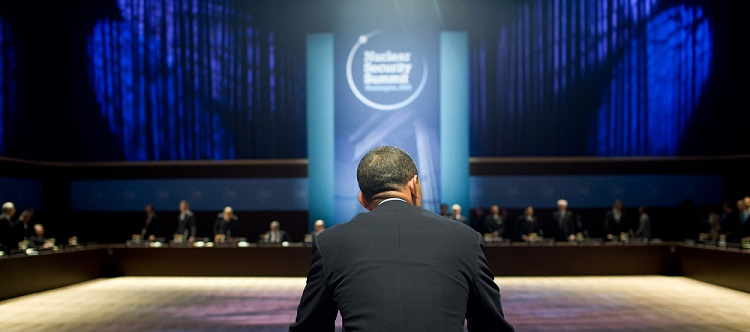
Photo credit: www.nss2016.org
Following three previous successful summits — held in Washington, DC in 2010, Seoul in 2012, and The Hague in 2014 — the final Nuclear Security Summit convened March 30-31, 2016, bringing together heads of state and other high-ranking officials to engage with each other and reinforce their commitment to securing nuclear materials worldwide.
his report on the subject.
However, the failure of the summit to fully or in some cases partly tackle some issues, looms larger given the end of the summit process and the high-level political attention it guaranteed. Some cornerstones for a nuclear security regime have been laid, but the next US president and other world leaders will need to finish building the framework for a true nuclear security regime.
resources to news makers and decision makers, prior to and during the 2016 Nuclear Security Summit.
CNS Experts in the Media
April 7, 2016: “Сарапшы: Ядролық қаруды таратпау ісіне Қазақстанның қосқан үлесі орасан,” Laura Rockwood interviewed by 24KZ (in Kazakh).
April 7, 2016: “Эксперт: Казахстан играет важную роль в деле ядерного нераспространения,” Laura Rockwood interviewed by 24KZ (in Russian).
April 7, 2016: Miles Pomper interviewed by TRT World.
April 5, 2016: “The Real Reason the US Is Giving Bomb-Grade Uranium to Europe,” Miles Pomper quoted in Wired.
April 4, 2016: “Explainer: Why Nuclear Smuggling Looms Over Washington Summit,” trafficking database cited by RadioFreeEurope.
April 1, 2016: “Nuclear summit addresses pressure from all quarters,” Laura Rockwood interviewed by Australian TV.
April 1, 2016: “Russia Doubles Its Nuclear Warheads,” Miles Pomper quoted in NewsMax.
March 31, 2016: “Nuclear Summit a Test for Obama’s Legacy,” Miles Pomper quoted in Scientific American.
March 31, 2016: “Nuclear terrorism a global threat,” Miles Pomper quoted in The National.
March 29, 2016: “Obama’s Last Chance to Bolster Nuclear Security,” Miles Pomper quoted in Voice of America.
Analysis
- “After NSS glamour, sustainability questions linger,” Miles A. Pomper in European Leadership Network
- “Nuclear Security Summit Will Leave Unfinished Work,” Miles A. Pomper in Bulletin of the Atomic Scientists
- “Replacing High-Risk Radiological Materials,” Occasional Paper by George M. Moore and Miles A. Pomper
- “Replacing HEU in Naval Reactors,” report by George M. Moore
- “Treatment, Not Terror,” report by Miles A. Pomper, Ferenc Dalnoki-Veress, and George M. Moore
- “The Case for Highly Enriched Uranium-Free Zones,” report by Andrew J. Bieniawski, Miles A. Pomper, and Elena Sokova
- “A Roadmap to Minimize and Eliminate Highly Enriched Uranium,” NTI Paper by Andrew J. Bieniawski and Miles A. Pomper
- “Could low-enriched uranium be used in naval reactors? Don’t ask the Navy,” George M. Moore
- “Is ISIL a Radioactive Threat?” by George M. Moore
Multimedia Resources
- Tutorial: Nuclear & Radiological Security
- Database: Global Nuclear & Radiological Trafficking
- Nuclear Threat Initiative’s Nuclear Security Index
- Civilian HEU Reduction and Elimination Resource Collection
Experts available for further comment:
William Potter
CNS Founder & Director ⋅ wpotter@miis.edu
Elena Sokova
Deputy Director ⋅ esokova@miis.edu ⋅ @esokova
Miles Pomper
Senior Fellow mpomper@miis.edu ⋅ @MilesPomper
George M. MooreScientist-in-Residence/Adjunct Professor ⋅ gmoore@miis.edu ⋅ @kennmoor
Bryan Lee
Director, Eurasia Nonproliferation Program (ENP) bllee@miis.edu ⋅ @semyorka
Margarita Sevcik
Senior Program Manager, Education Program ⋅ msevcik@miis.edu
Ferenc Dalnoki-Veress
Scientist-in-Residence ⋅ jdalnokiveress@miis.edu
Chen Kane
Senior Research Associate, Middle East ⋅ ckane@miis.edu ⋅ @ACRSME