
A New Roadmap to Minimize and Eliminate HEU
May 26, 2015
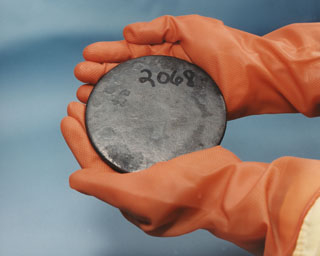
Highly enriched uranium. Courtesy Wikipedia.
Since 1992, the international community has taken important steps to reduce the risk posed by HEU—removing and eliminating thousands of kilograms of HEU, converting HEU-fueled reactors to use low-enriched uranium (LEU), and promoting the adoption of LEU alternatives for medical isotope production. Despite significant progress, the work to reduce—and ultimately eliminate—HEU is far from finished.
Today, there are approximately 61 metric tons of civilian HEU spread across more than 100 facilities in 25 states. HEU is also used in reactors on certain naval vessels in India, Russia, the United Kingdom, and the United States. Approximately 290 metric tons of HEU remain in global naval inventories—enough material for thousands of nuclear weapons.
Fissile Materials Working Group, lays out a roadmap with five pathways to ending civilian HEU use and beginning the necessary research and development to minimize and ultimately eliminate HEU for naval use. It includes specific recommendations that states can undertake prior to the 2016 Nuclear Security Summit.
Miles Pomper.