

College Community Reflects on Climate Action Past, Looks to Future
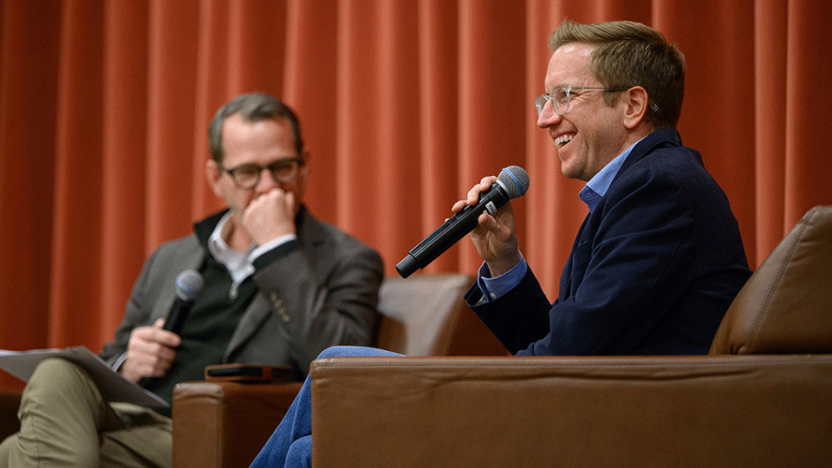
Students, faculty, and alumni gathered at the What Works Now? conference, held November 15–17 at Middlebury College, to reflect on the positive environmental outcomes sparked by the inaugural gathering 20 years ago, and to consider strategies for addressing today’s climate challenges.
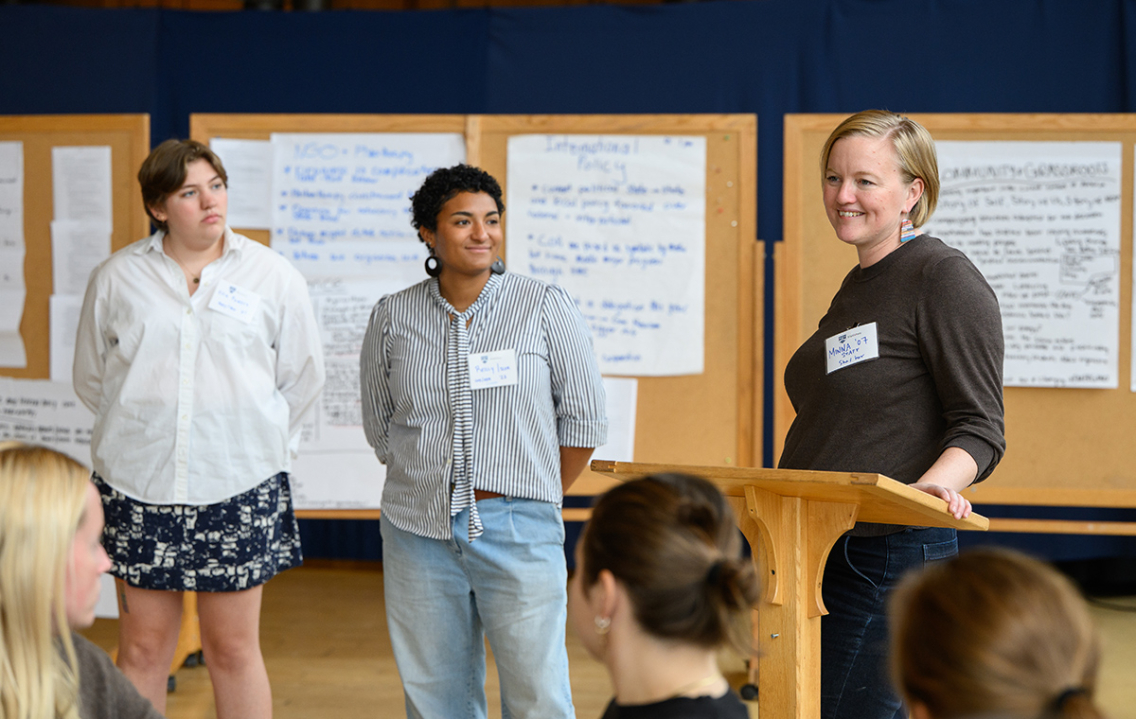
The event drew alumni from across the nation—some of whom organized the original conference as part of a winter term course taught by Jon Isham, professor of economics and environmental studies, titled What Works: Building a New Climate Movement. They spoke about the course’s transformative impact, crediting it with the creation of the Sunday Night Environmental Group (SNEG) and eventual founding of nonprofit 350.org as well as the Keystone Pipeline protests, the College’s decision to divest from fossil fuels, and other environmental milestones. These significant accomplishments were captured in a historical timeline created by Ella Powers ’27 and shared at the conference.
Keynote speaker Jamie Henn ‘07, cofounder of 350.org and executive director of Fossil Free Media, said the class and the community formed through it defined his life and career for the next 20 years “through Sunday Night Group, 350.org, my work with Bill McKibben (Schumann Distinguished Scholar), and many here in the room.”
“In many ways this feels like a homecoming, but also a continuation of being back in the same J-term class that Jon has continued on and on for the last 20 years. We’re still figuring out ‘what works.’”
Henn and other alumni who participated on panels, breakout sessions, and climate conversations emphasized the importance of empowering current students like Powers—co-organizer of the conference and treasurer of SNEG—to lead the next generation of climate action efforts at the College. “I’m so glad that Ella is looking back at history because all the work began long before 2005,” said Henn. “Coming out of that first class we really took inspiration from the generation before us. We walked out of 2005 with a real sense that there was a movement out there that we could activate.”
Powers was equally optimistic.
“We’ve done this for 20 years and looked at what’s worked and what hasn’t, and now we’re reassessing,” said Powers, who interviewed dozens of alumni for her history project. “There are really awesome, cool alums who have done things that I can’t really imagine, but it’s also really cool to be in the footsteps of that, and know that there is the potential to do something great like they did. We need to take the lessons and trials of the past, learn from them, and apply them to the fight today.”
New Era, Similar Issues
Some speakers expressed frustration at confronting many of the same climate issues that defined the original conference—issues highlighted in The New York Times front-page story “Paper Sets Off a Debate on Environmentalism’s Future,” based on a presentation at the 2005 conference by emerging environmentalists Michael Shellenberger and Ted Nordhaus titled “The Death of Environmentalism.” They also drew comparisons between the fossil-fuel–driven policies of the George W. Bush administration and current efforts to roll back clean-energy incentives and weaken foundational environmental laws such as the Clean Water Act and the Endangered Species Act.
Isham called the comparison a “fair assessment” with one major exception: the cost of clean energy. “There’s a sense that environmentalists are back on their heels like 20 years ago,” he said, “but we actually have the ace of spades in our hands, which is that clean energy is much cheaper and accounted for 90 percent of new energy sources in 2024.”
In 2005, Isham said climate activists spent their time pushing back against the exorbitant cost of clean energy by proposing things like carbon taxes to incentivize businesses and consumers to use less carbon-intensive energy products. “Today, as Bill McKibben explains in his new book, Here Comes the Sun, the opposite is true—the things that environmentalists support and know to be better for the planet, like wind, solar, and storage, are far less expensive,” he said. “Now we can say ‘yes’ to clean energy because it’s actually affordable for many people.”
McKibben expressed optimism about the clean energy revolution despite the pace not moving fast enough to offset the damaging impacts of climate change.
“Around the world, people are very worried about climate, as they should be,” he said. “But they are also very excited about the rapid progress of clean energy. The planet is getting a third more power from the sun this fall than it did last fall, so things are starting to shift. Fast enough to catch up with the physics of climate change? No—and that’s the scary part.”
The Role of the College
The timing of What Works Now? coincided with the 60th anniversary of the College’s first-in-the-nation environmental studies program, along with the completion of Energy2028 drawing near, the temporary suspension of operations by 350.org, and a Strategic Planning Initiative to guide the College over the next decade and beyond.
During the keynote conversation on November 14, President Ian Baucom asked Henn about some of these issues and whether he struggled to remain optimistic with the sometimes stark realities around climate change.
“Climate is an interesting thing because you tend to toggle between the most apocalyptic, darkest feelings of ‘nothing is going to work out,’ and then these incredible hopeful horizons of possibility of thinking that this is an issue and a lens to look at the world and rethink everything around you,” said Henn to an audience of alumni, faculty, and students in Wilson Hall. “It’s a combination of those two that makes it so emotionally powerful.”
Henn said Isham’s class provided what he called a “sense of the radical stakes that we were facing, but then the freedom that gives you to kind of rethink everything was really exciting and electrifying.”
Baucom asked Henn if the phrase “pessimism of the intellect, optimism of the will,” attributed to the Italian Marxist philosopher and politician Antonio Gramsci, resonates in the context of climate change. “There’s a certain necessary pessimism—you’ve got to face the hard facts—and yet find grounds for optimism,” said Baucom. “Where can we find optimism of the intellect and optimism of the will when it comes to climate?”
On the optimistic side, Henn pointed to the current clean-energy revolution.
“We’ve really done the job of unlocking the incredible possibility of repowering this planet without fossil fuels,” he said. Regarding the pessimism of the will, he added, “I don’t think we have to sugarcoat the threat to our democracy and especially marginalized communities in this country. At the same time, something else can be true, which is that we’re seeing incredible opportunity and momentum in the clean energy space and in the social sector. The job of the activist is to look where there might be momentum.”
What Will Work in 2045?
Toward the end of the event, participants were asked which issues they anticipated would dominate the 2045 What Works Now? conference. Isham said he hoped to see the cost of clean energy continue to decline or a new technology emerge that would make these advancements accessible to those who cannot afford them.
“I’d like to see new technologies to liberate the unliberated, the poor, and the people who are struggling now in this country and beyond to pay rent, to buy a car, to hold on to their jobs,” he said. “That would be something to celebrate—if the climate movement has further uplifted everybody.”