

New Book Examines Current American Moral Leadership Through Historic Lens
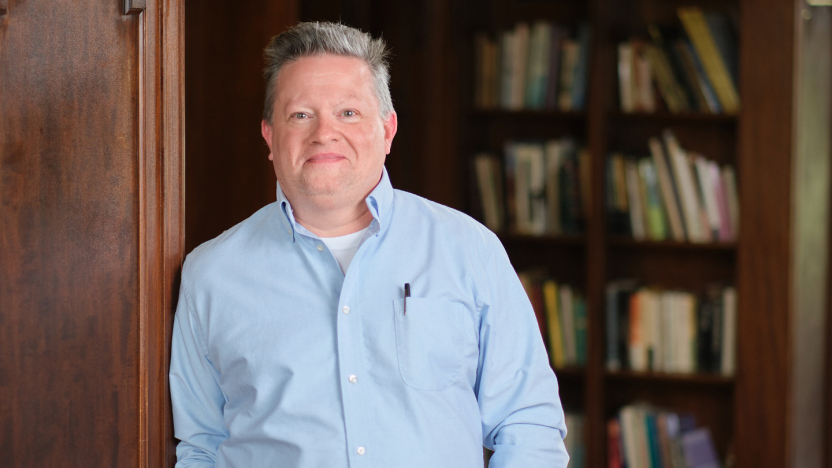
Given his own background as a minister and an academic, it’s not surprising that James Calvin Davis, George Adams Ellis Professor of Liberal Arts and professor of religion, chose to write his most recent book about John Witherspoon—a Presbyterian minister and the only college president to sign the Declaration of Independence.
Witherspoon’s reputation as an influential figure in shaping the United States’ national character—developed during his presidency at what would become Princeton University—ultimately drew Davis to write The Character of a Nation: John Witherspoon and the Moral Foundation of the United States (Bloomsbury, 2026). His complex and contradictory life—a slave owner and proponent of Christian values—also appealed to Davis, whose work in theology and public ethics examines how classical Christian texts, thinkers, and traditions connect to contemporary political discourse.
We sat down with Davis at Crossroads Café in the Davis Family Library to learn more about his new book and his motivations for writing it.
What was it that made you want to write about John Witherspoon at this time in history?
Witherspoon doesn’t get the love that Jefferson, Madison, and Adams do, but what I find fascinating about him, besides the confluence of religion and politics, is that there is a consistent thread through his writing and preaching: the idea that the good of the nation and the success of the Revolution depend on the cultivation of character among citizens and their leaders—that, to be politically healthy, you have to be morally good. It wasn’t a myopic religious conception of good—he defined good as citizens and leaders being invested in the common good, being invested in the protection of human rights, leadership with moral integrity. He hit this note over and over again, and for reasons that were at least obvious to me, I thought it was a theme worth revisiting in our own time and place, when our own politics, on both sides of the aisle, suggest that morality is naive and irrelevant in politics. It’s about power now—not about forming an ethical community—it’s about winning at any cost.
It’s interesting that even though Witherspoon held these high ideals, you also write about parts of his life that contradict this moral narrative.
The interesting thing about Witherspoon, with all this talk about moral virtues and character, and benevolence and human rights, is that he was actually complicit in slavery. When he died, they found two slaves in his will. There is a lot of uncertainty around that, but it’s hard for some of his ardent defenders to reckon with it in that way, but what I do in the book is to say that we have to take seriously the fact that this arguably really helpful and admirable vision of a moral nation is also coming from someone sullied by America’s original sin. What does it mean to look at figures from our founding who embodied both the best and worst of who we are? And that, too, is relevant to who we are now, in an age when people are saying we should white-wash that history. The most constructive thing we can do in our moment is to look back at our history and take most seriously its highest ideals and its most tragic failings, and figure out what that teaches us about the way forward in our divisive and, frankly, still racist moment.
How would you compare Witherspoon’s era in terms of acceptable political discourse with today?
I think we need to be really careful about claiming that there was once a time when we were perfectly civil. This kind of incivility today goes way back. I studied the election between John Adams and Thomas Jefferson, and that was as nasty as some of our more recent ones. But the public expectation of a certain minimal level of integrity seems to have evaporated, and I don’t think that happened overnight. I think it’s been a project for at least the last three and a half decades going back to the dynamic between President Clinton and Newt Gingrich. For me that’s where the seeds were planted. On the one hand you had conservatives saying, “This is a no-holds-barred, winner-takes-all contest”—that was the philosophy behind New Gingrich. On the other hand you had Clinton supporters saying, “Never mind his moral failings, they’re not germane to his political leadership.” Boy, that’s come back to bite those of us like myself who supported President Clinton. So that dynamic was set in the early 1990s—that this was going to be a different kind of politics, and it has just deteriorated ever since, rapidly in the last 10 years.
Have there been moral swings in the past that might bring about a return to civility?
That’s a hard call. I don’t think there’s anything inevitable about it— some kind of ebb and flow that will return us to a moral equilibrium. I do think it’s possible, but it’s not inevitable. The nastiness of the Adams-Jefferson election died down a little after it ended. Unfortunately, it can take a public crisis to bind us together. But also, besides just the personal morality of it, we’re also living in a time of obnoxious wealth disparity. We did that once before about 100 years ago, and then came New Deal programs and the Great Society, so we are capable of corrections—but they are not inevitable; they require intention. And that’s part of what I’m trying to get at in this book: we need both a popular and leadership investment in that plumb line for what is acceptable behavior and what is not. We have very few people who are willing to invest in that.
Do you think the ethical leadership lessons in your book are applicable today?
Yes, I think so. That’s why I wrote the book and timed it for this year. This isn’t the most popularly oriented book I’ve ever written, but I think the idea itself is really, really important for where we are today and can be discussed without it being simply an indictment of the current administration—there’s plenty of blame and promise to go around. So I do think it’s a kind of collective project of reclaiming some moral center.