

Middlebury Language Schools Award 71 Graduate Degrees at 112th Commencement
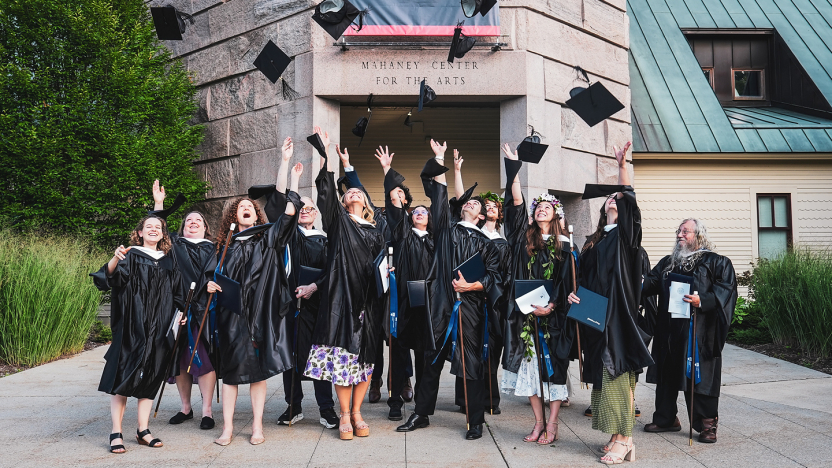
The Middlebury Language Schools held their 112th Commencement on August 7 at the Mahaney Arts Center’s Olin C. Robison Concert Hall, awarding 71 graduate degrees to students in 10 languages.
A total of 65 Master of Arts degrees and six Doctor of Modern Languages degrees were awarded at the ceremony. Eight students from the inaugural class of the Language Schools’ Master of Arts in Teaching (MAT) program, who will graduate in March after completing a student teaching placement, were also recognized.
Since the establishment of the German School in 1915, more than 58,000 students have studied in the Language Schools’ 12 immersion programs, and more than 12,150 have received advanced degrees, now offered in 10 languages.
Danielle Stillman, rabbi and associate chaplain, and Jesse Bruchac, director of the School of Abenaki, opened the ceremony with a land acknowledgment and invocation honoring the lives and sacrifices made by the Abenaki people.
President Ian Baucom recalled the founding of the Language Schools more than a century ago, emphasizing how much more connected Middlebury is to the wider world today. Despite its rural setting, he described summers in Middlebury as vibrantly cosmopolitan, with students bringing languages and cultures from around the world into classrooms, residence halls, dining facilities, and the surrounding community.
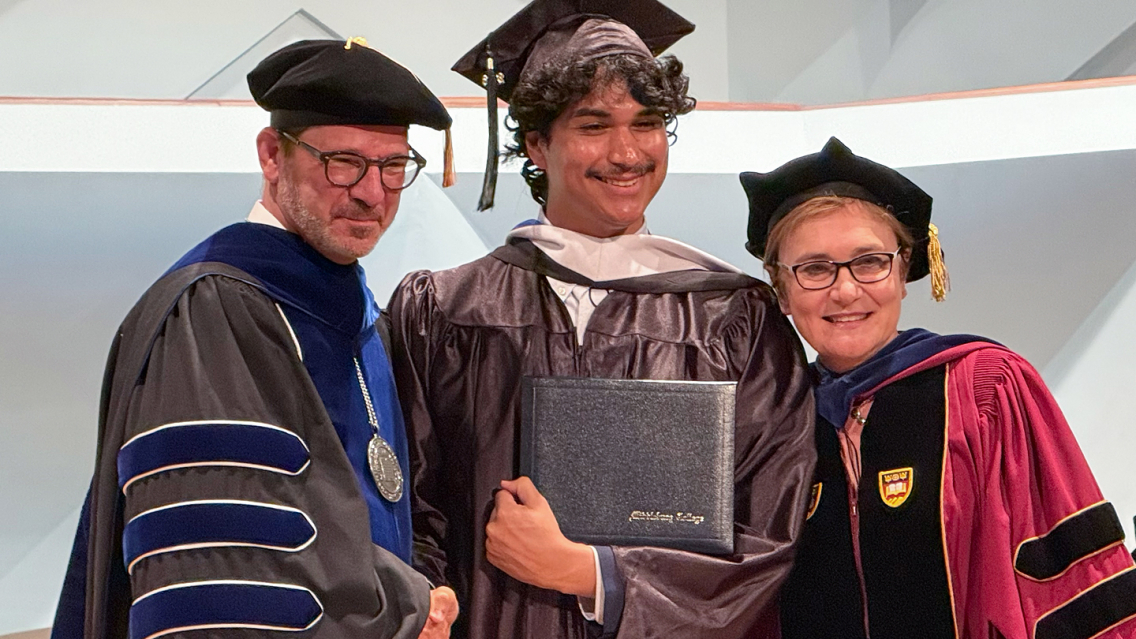
“As you prepare to graduate, I want to thank you for that—for coming to this place, for taking the Language Pledge, for immersing yourself, for committing yourself to knowing what it means to inhabit the world and take on our shared responsibility for the world, not only in the language of your first self, but in the language of another,” said Baucom.
Stephen Snyder, dean of the Language Schools, thanked graduates, their families, faculty, staff, and Timothy Page, senior associate dean, who served as acting dean of the Language Schools over the past two summers. He also recognized Jacobo Sefami, who is retiring after 18 years as director of the School of Spanish.
Snyder introduced Commencement speaker Mayumi Oka, a leader in Japanese language education, noting that she was unable to attend the ceremony and would receive an honorary doctorate in absentia. For more than 40 years, Oka has advanced Japanese language education through teaching and research at Princeton University, Columbia University, and the University of Michigan, where she serves as an assistant research scientist in the Center for Japanese Studies and directed the Japanese Language Program from 2004 to 2020.
Motoko Tabuse, director of the School of Japanese, read Oka’s Commencement address on her behalf. In her remarks, Oka reflected on her academic career including the development of the Tobira Japanese textbook series, now used in language programs around the world, including the Language Schools. Tobira means “door” in Japanese—a metaphor she used to describe how learning a language can open people to new cultures, perspectives, relationships, and other possibilities.
“Looking back, I now realize that my own life has been shaped by a series of doors—doors I opened myself, doors that opened through other people, doors that opened my mind, and doors that opened through human relationships.”
Oka also spoke about the power of language education to break down prejudice, develop empathy, and broaden perspectives—skills she said are increasingly important in an era of artificial intelligence and misinformation. While AI can be a valuable learning tool, she said it cannot replace the human connections at the heart of education.
“The degree you receive today is not a destination; it is not the end of your journey,” she said. “Life continues to present you with new doors. The work you are doing today may lead somewhere you cannot imagine. You do not know which project, conversation, or opportunity will open the next door. Today, at this moment of Commencement, I invite you to open the next door as educators, as scholars, and as citizens of a connected world.”
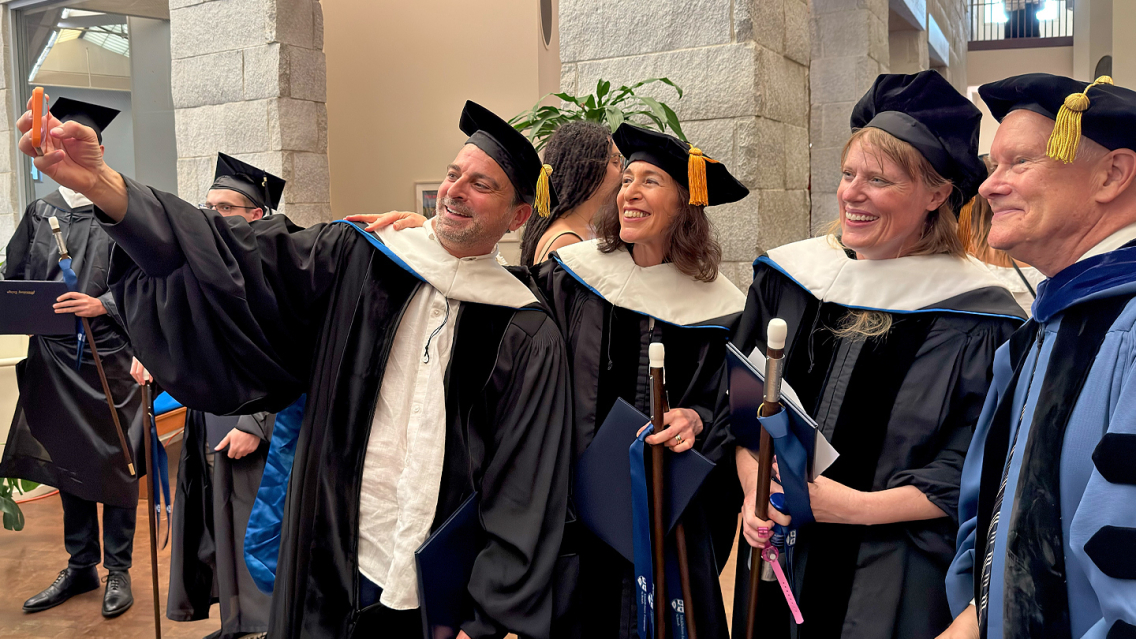
New to this year’s Commencement was the recognition of the first graduating class of the Language Schools’ Master of Arts in Teaching (MAT) program. Launched in 2025 to address a shortage of K–12 world language teachers, the program prepares participants for secondary teaching licensure in modern languages in U.S. public schools. Georgia Beatty was among this year’s graduates, who came from eight states and trained to teach six languages.
“When I saw that Middlebury had unveiled this new master’s in teaching program, it was everything I wanted—engaging with young people, pursuing my language studies, and doing it in Vermont, a state I’ve really come to call home,” said Beatty, who struggled to gain fluency while living in German-speaking countries because locals wanted to speak with her in English. “Coming to Middlebury, where everyone commits to speaking only German all the time, I felt like that’s what I needed to achieve real fluency—communicative, spoken fluency, not just written. This program offers something so remarkable in that regard.”
Kang Zhou and Ju Min Wang, instructors in the Chinese School, presented a musical selection titled “Chinese Poetry and the Guqin,” with Zhou reciting a poem and Wang playing the guqin—a traditional Chinese seven-stringed instrument—in celebration of the 60th anniversary of the Chinese School. Fredy Bonilla of the German for Singers Program led the audience in singing “Gamaliel Painter’s Cane” before the ceremony concluded.