

Christopher Klyza Explores Conflicts Shaping U.S. Environmental Policy in New Book
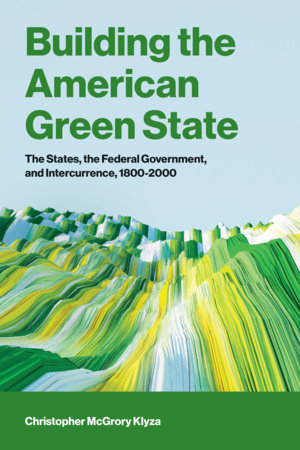
Over his 35-year career at Middlebury, Christopher Klyza, the Robert ’35 and Helen ’38 Stafford Professor in Public Policy and professor of political science and environmental studies, has written or edited six books on current topics ranging from public lands and rewilding to natural resource management and political gridlock.
Klyza’s latest book, Building the American Green State: The States, the Federal Government, and Intercurrence, 1800–2000(MIT Press, 2026), is no exception, arriving amid clashes between states and the federal government over climate policy. It examines how past laws, institutions, and federal-state conflicts continue to create roadblocks to effective policy on climate change, biodiversity, and environmental justice.
A book launch event is scheduled for October 29 at 4:00 p.m. in the Robert A. Jones ’59 Conference Room.
The following are excerpts from an interview with Klyza about what compelled him to write the book and what history can tell us about environmental policy conflicts playing out today.
What made you want to write this book?
The book I cowrote before this one, American Environmental Policy: Beyond Gridlock, was deeply informed by teaching environmental policy every year since 1988. I’m kind of a historically minded political scientist, so the class would start with things like how the U.S. Forest Service started. In that book, we coined the term “green state,” which is the collection of agencies, laws, and court cases affecting conservation and environmental policy over time.
This new book is grounded in a field of American politics called American political development, which looks at how the political system develops in layers. Laws and agencies reflect the ideas and interests of a particular time, but they don’t go away when priorities change. In environmental policy, you have a layer from around 1900 focused on the wise use of natural resources and another from the 1960s and ’70s focused more on wildlife and preserving species. When these different governing orders clash, that’s what we call “intercurrence.”
Probably the best example is the spotted owl. In the early 1900s, we created national forests in Washington and Oregon and basically said, “Hey, everybody come out here and do some logging.” Communities built their economies around those forests. Then, decades later, we came in and said, “Now we really want to protect species like the spotted owl, so you guys can’t do logging anymore.” Both sides are responding to governing systems created at different times for different purposes.
That got me thinking about how states have their own “green states” and about intercurrence between the states and the federal government. In the new book, we look at where those conflicts occur in areas such as air pollution control and the build-out of green energy.
What are some key examples in the book of these different policy clashes and how they play out?
The book opens with a little vignette where Massachusetts wants to decarbonize its grid by getting more energy from Hydro-Québec. But the transmission line has to go through Maine, and there’s a lot of opposition there. So the federal government is saying, “Yeah, this is great. We want to reduce greenhouse gas emissions,” while opponents in Maine are using state laws to put up barrier after barrier to building the power line. It eventually gets built, but it takes a long time and involves a lot of conflict.
I don’t know if you’ve followed this “abundance” argument, but part of what they’re asking is, “Why is it so hard to build stuff?” And I think some of that is intercurrence. We have all these different layers of government and laws that have built up over time, and they can clash with each other.
One of the biggest questions is what you do about it. In today’s political environment, you can’t necessarily count on Congress to resolve these things, so in some ways we’re stuck with this system. One of the interesting arguments in the book is that with these kinds of conflicts, it’s often the courts that step in—as in the spotted owl case—and decide which layer takes precedence.
You said most of the book was written before the current administration took office, but it sure seems timely.
Teaching this stuff now is challenging. Trump has essentially broken the system. He tried to do some of these things in his first term, but he went through the system. It was, “Okay, I’m going to get rid of Obama’s Clean Power Plan, and here’s how we’re going to do it.” And then the courts stopped a lot of the things his administration tried to do.
Now, we’re seeing something different, and it’s unclear how much of it the courts will allow to stand. To me, one of the big tests was the tariff case. The major questions doctrine, which was central to the Supreme Court’s decision on climate policy in West Virginia v. EPA, came up again in the tariff case. So the court has at least been consistent about applying that principle.
It sounds like it has become more difficult for states to move forward with environmental legislation given that the federal government could prevent it or even shut down something that was already approved?
Yes. One of the best examples is offshore wind. Part of our argument in the last book is that Congress is doing nothing, which has pushed policy down different pathways. States are doing more, including New York and states in New England that have taken a huge lead on climate change and offshore wind. Then Trump comes in and says, “No, we’re not going to do that anymore.”
What I don’t think we’re thinking hard enough about are the long-term ramifications. If you are a wind company, are you going to invest in projects, some of which take 15 years to build out, with the possibility of another unpredictable leader coming into office who could shut them down?
The real irony is that Republicans are the states’ rights people, and now they’re saying you all need to line up with this stuff. So there might be more of these clashes with the federal government. I’ve got a student doing a thesis on Iowa and Texas, two very Republican states with a lot of onshore wind, where it’s less about climate than economic development. A lot of Republicans are like, “Yeah, let’s have more oil, but we’ve got nothing against wind or solar. Let’s do it all.”
How do you describe your book to people who might not understand intercurrence and why it matters for environmental policy?
A lot of the conflict we have in environmental policy today is really baked into our government system. Some of it comes from conflicts between the past and the present. You can think about Act 181 in Vermont. On the one hand, people have this expectation that they should be able to do what they want on their land, and now we’re thinking about protecting forests and wildlife. How do those things intersect? You have these past expectations coming into conflict with current expectations.
Another source of conflict is between the federal government and the states. We’re seeing that now with Vermont defending its climate policies against challenges from the federal government. The state is essentially saying, “We want companies that contributed to climate change to help pay for the damages,” and the federal government is saying, “No, you can’t do that.”