

Middlebury Awarded $2.1 Million NSF Grant to Study PFAS
Middlebury College has been awarded $2.1 million from the National Science Foundation (NSF) as part of a four-year, multi-institution initiative to study PFAS contamination in Vermont, and its potential effects on community health.
The $7.9 million grant will establish the PFAS Environmental Research Network (PERN), bringing together researchers, educators, and students from Middlebury, Bennington College, the University of Vermont, and Landmark College, along with state agencies, Community College of Vermont, and other partners. The network will investigate PFAS contamination in groundwater and soil and its potential health risks for local communities.
Commonly known as “forever chemicals,” per- and polyfluoroalkyl substances (PFAS) are used in industrial and consumer products, including firefighting foam, nonstick cookware, waterproof textiles, food packaging, and ski wax, and their resistance to breakdown means they will remain in the environment for decades or longer.
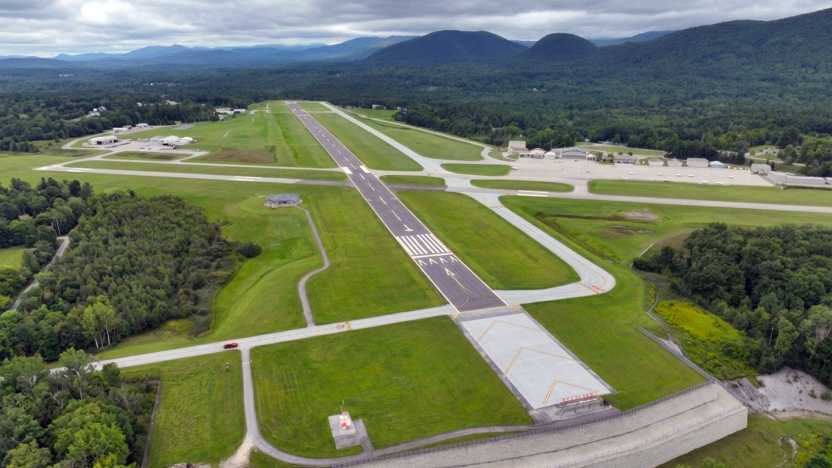
Middlebury’s interdisciplinary research team of five faculty members will focus on two prominent sites with PFAS contamination in Vermont: the Rutland–Southern Vermont Regional Airport, where firefighting foams containing the chemicals were tested in the open for years, and the greater Bennington area, where PFAS were used to manufacture fabric with waterproof coating; in both cases, their use was prior to broader understanding of their health impacts.

A main goal of the grant is to better understand the movement of PFAS in the environment after they are released. Middlebury researchers will examine how PFAS move from the original source, through groundwater and surface water and, ultimately, how they enter and bioaccumulate in aquatic ecosystems, where they may pose human health risks to people consuming seafood from impacted rivers and lakes.
Peter Ryan, professor of earth and climate sciences, is the lead investigator for Middlebury, overseeing research on PFAS in groundwater and helping coordinate the College’s work across PERN. He says the project builds on research conducted with students around the Rutland airport in 2019 and more recently in his senior seminar, where students analyzed state groundwater data that contributed to a published paper on PFAS contamination.
“It was just the coolest class and experience you can have with students,” said Ryan. “Connecting the community members, scientists from outside, bringing their knowledge, and connecting across campus. This project, to me, is a chance to dive even deeper into that. It just seems like the logical next step.”

Kate Crawford, assistant professor of environmental studies, and Sam Byrne, associate professor of biology and global health, will study PFAS in aquatic ecosystems and potential connections to human health. Byrne will help assess potential human health risks from the chemicals and communicate research findings to affected communities.
Crawford, whose work has been published extensively in top-tier journals, studies how PFAS accumulate in aquatic organisms and expose people through seafood consumption, and also how PFAS in ski and snowboard wax can lead to potential health issues.
“I look forward to bringing my expertise to the Vermont PFAS Environmental Research Network and learning from other experts around the state as we work together to better understand how PFAS move through environmental systems and the risks these toxic chemicals pose to human health,” said Crawford, adding that the widespread use of PFAS in consumer products, industry, and firefighting applications has led to widespread environmental contamination, with research linking exposure to health problems.

Eric Moody, associate professor of biology, will focus on aquatic sampling, including collecting and identifying stream organisms, and will lead the analysis and interpretation of stable isotope data to better understand PFAS in aquatic ecosystems.
Christian Stratton, assistant professor of mathematics and statistics, will develop a statewide PFAS database and statistical models to better understand the distribution and movement of PFAS across Vermont. He says the collaboration will create a unique dataset tracking how PFAS move from soil into groundwater and from groundwater into plants and animals.
“I find this work to be the perfect intersection of intellectually stimulating and impactful—a chance to both continue to grow as a researcher of statistical methodology and also solve a real, pressing problem that the state of Vermont is facing,” said Stratton.

Stratton is also excited about the creation of the Vermont Environmental Research Field School (VERFS), a three-week residential program at Bennington College that will provide students with hands-on training in PFAS research, including study design, field sampling, and data analysis. Stratton will develop a two-week course in statistical methods for spatial data as part of the program.
The grant supports paid research positions for three undergraduates during each academic year and a full-time undergraduate researcher each summer. Students will participate in field sampling and laboratory work and eventually conduct data analysis, interpretation, and preparation of research findings for potential publication.

“This type of grant is a very powerful way to address the full impact of chemicals like PFAS by leveraging expertise across multiple institutions,” said Jeremy Ward, Albert D. Mead Professor of Biology and vice president of academic affairs. “The collaboration among several Vermont colleges has the added bonus that many undergraduates will be part of the research stemming from this grant.
The PFAS Environmental Research Network (PERN) will connect researchers with state agencies, including the Department of Environmental Conservation, the Department of Health, and the Vermont Agricultural and Environmental Laboratory, to strengthen Vermont’s PFAS laboratory system, in alignment with the state’s Science and Technology Plan.
The project began September 1and runs through August 31, 2030. The funding includes approximately $4.8 million for Bennington College; $2.1 million for Middlebury; $950,000 for the University of Vermont; and $139,000 for Landmark College.