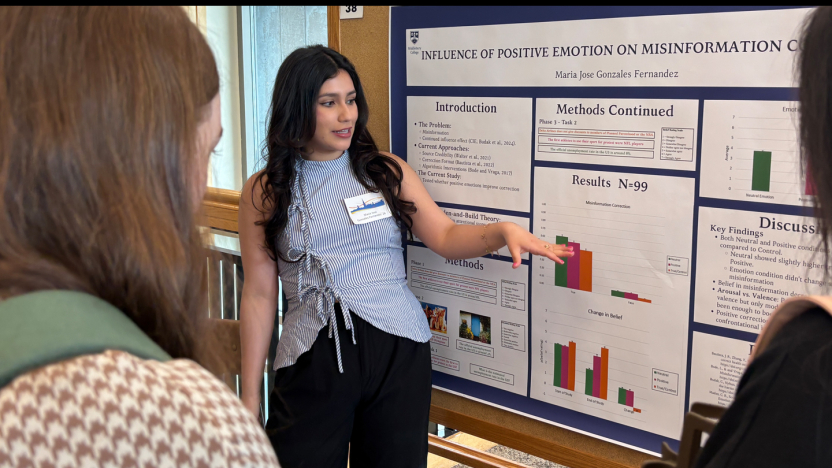
Maria Jose Gonzales Fernandez ’26, working with Professor of Psychology Jason Arndt, explored whether positive emotions, which are known to broaden attention and strengthen associative memory, could be effective in correcting misinformation, which often persists even after accurate information has been provided.
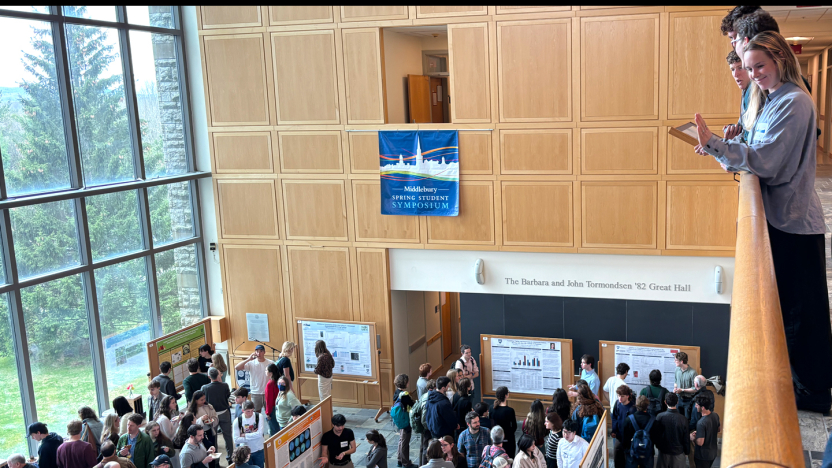
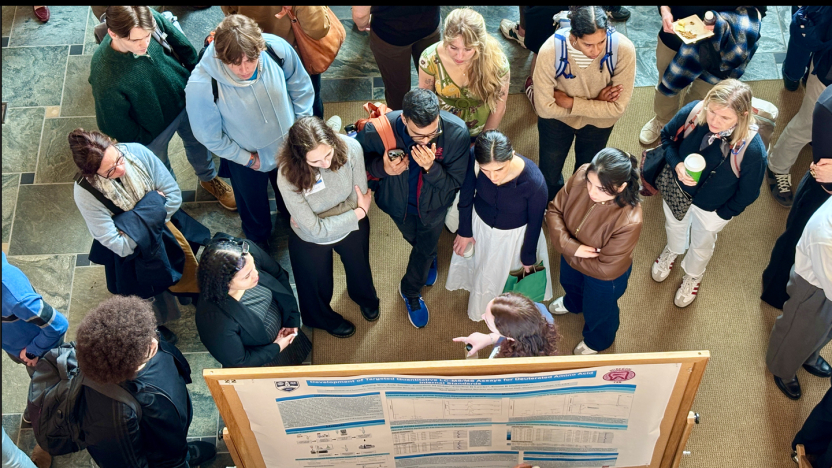
The Great Hall and adjoining Quantitative Lab were packed with visitors during the two poster sessions at the Spring Symposium.
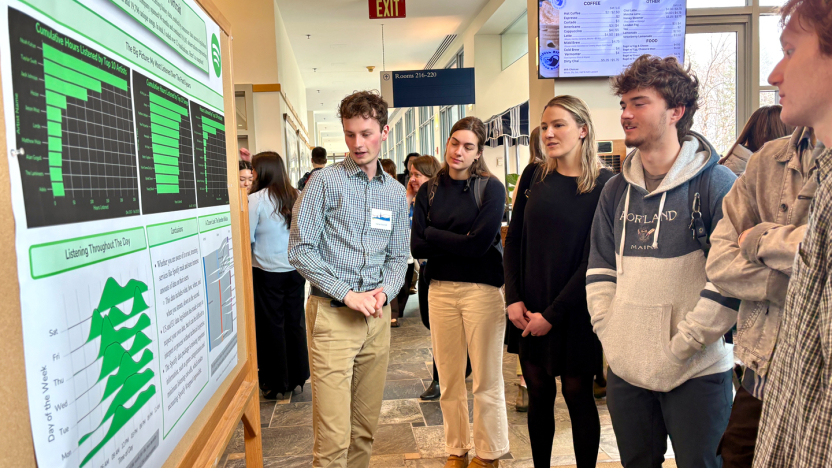
Nathan Klonel ’28, working with Assistant Professor of Sociology Isabelle Langrock, describes his research as creating a “Spotify data self-portrait.” Klonel requested and analyzed a decade’s worth of his own data from Spotify. He used his analysis to consider what his Spotify data could tell him about himself, Spotify as an organization, and data privacy and data rights in general.
Members of the Dance Company of Middlebury, under the direction of Professor Christal Brown, opened the annual Spring Symposium with a performance in the Great Hall. Performers included Eloise Kennedy ’28.5, Francesca Pelosi ’28.5, Monique Pond ’28, Michael Sanjurjo Jr. ’28, Avery Swett ’28, Liefe Temple ’25.5, and Yuzhuo Wang ’28.
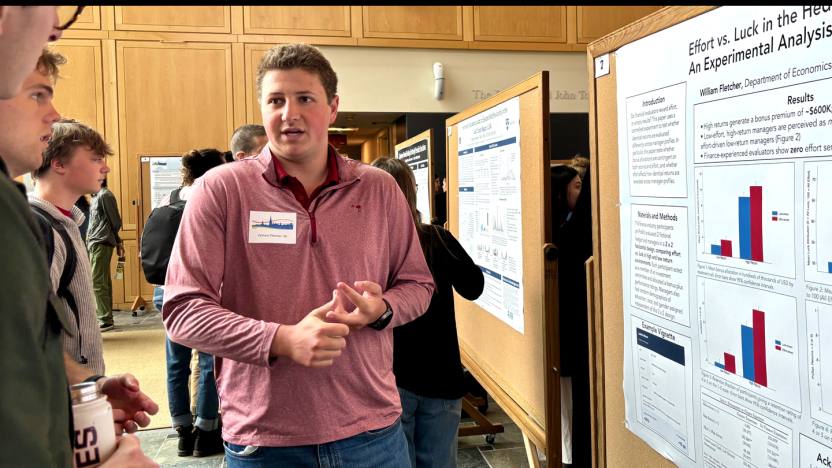
Economics major William Fletcher ’26 ran an experiment to see whether effort or luck was more likely to pay off for financial managers. Given equal returns, high-effort managers were likely to be better compensated, he found, but overall his data suggested that performance evaluation more broadly may reward results over process regardless of the setting. Fletcher was sponsored by Assistant Professor of Economics Germán Reyes.
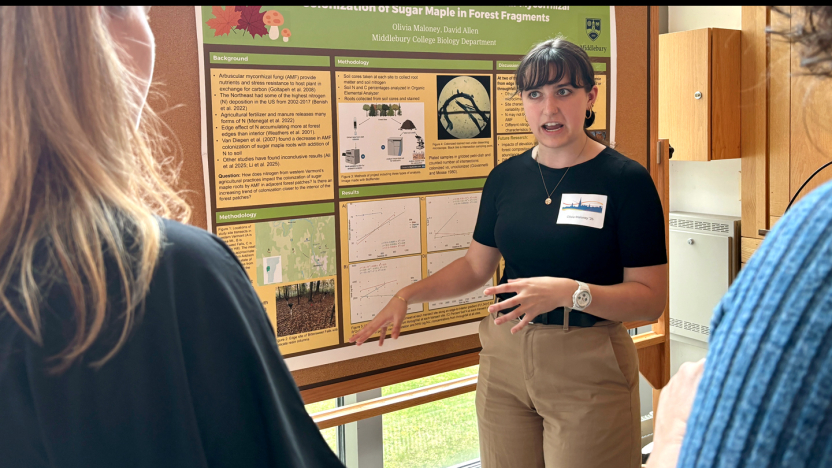
Olivia Maloney ’26, working with Associate Professor of Biology David Allen, conducted research on the impacts of agricultural nitrogen on sugar maple trees (and forested ecosystems more broadly) through its interaction with the important subterranean arbuscular mycorrhizal fungi.
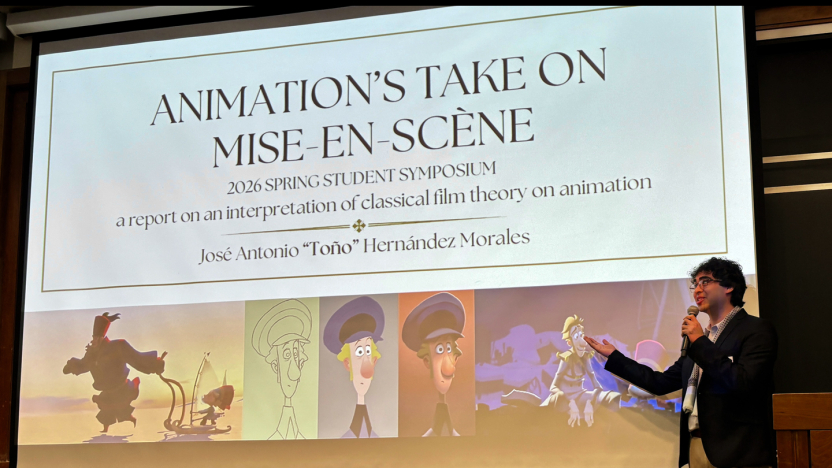
Can animation be cinema? This is the question Jose Antonio Hernandez Morales ’26 explored, working with Professor Chris Keathley. As part of his presentation, Morales shared his videographic essay comparing Michael Mann’s 1981 film Thief with the 2023 rotoscoped hand-painted film Peasants.
Students discussed their independent research with friends, faculty, staff, and visitors from the community during poster sessions and oral presentations.
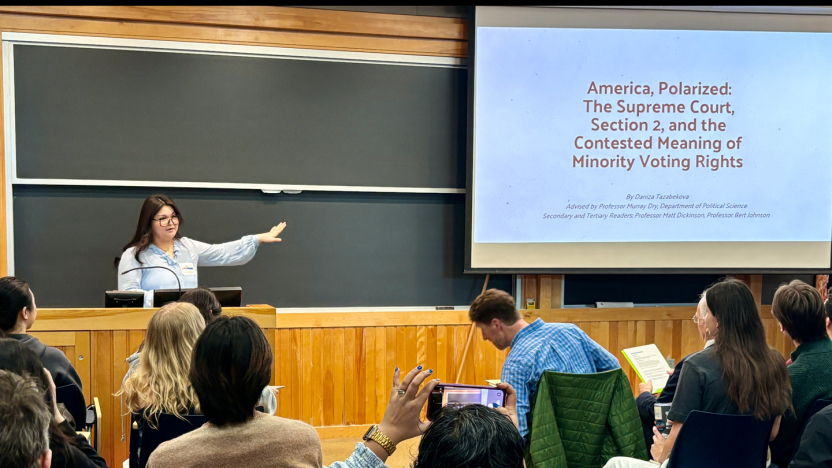
In her oral presentation, Daniza Tazabekova ’26 examined how the U.S. Supreme Court has interpreted the Voting Rights Act in several cases decided since 1980, with a focus on whether the court has maintained a “consistent line of constitutional reasoning across decades of jurisprudence.” Tazabekova’s research was sponsored by Professor Murray Dry.
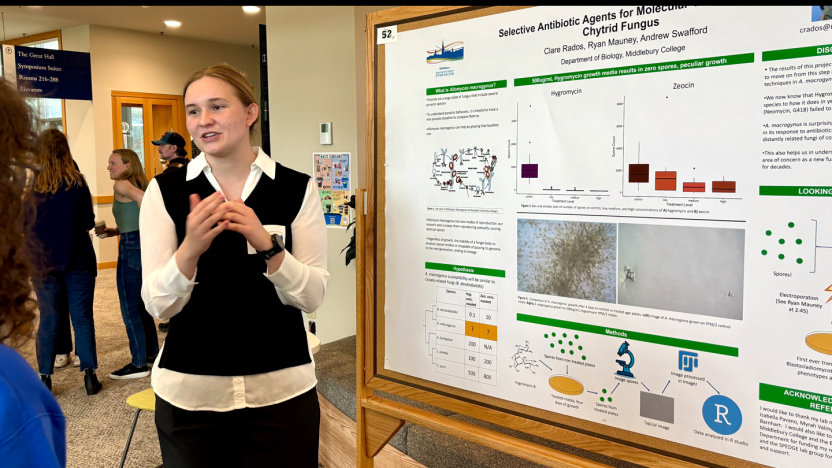
Clare Rados ’27, working with Assistant Professor Andrew Swafford, has been researching and developing foundational tools to help understand chytrids—an important and understudied group of fungi—for pathogenicity, physiology, motility, and behaviors.