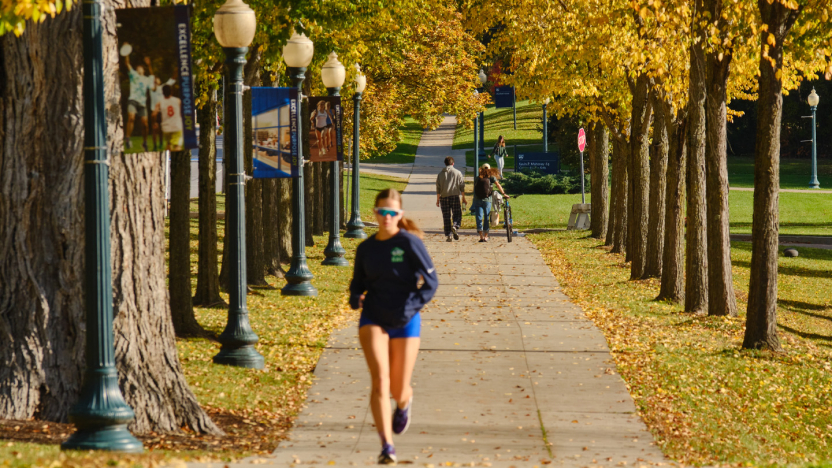
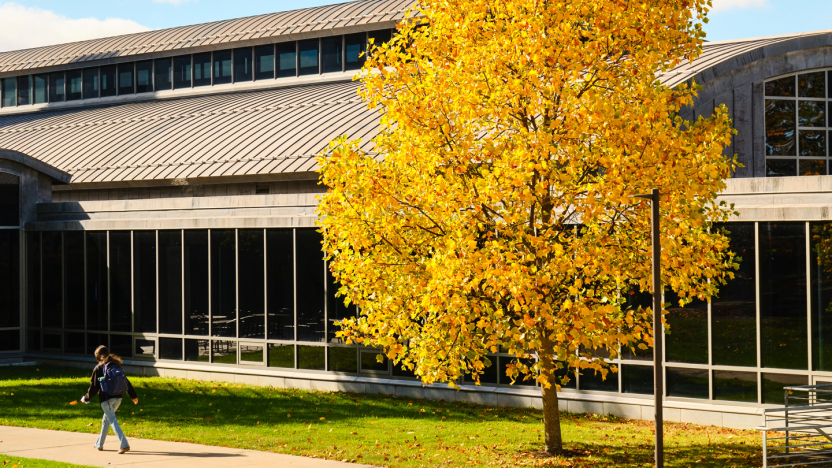
Tim Parsons: “When I say this is one of the best foliage seasons I’ve seen in years, my bellwether species is the elm. Most years they struggle to turn anything but a muted brown, but in excellent growing years they turn a vibrant yellow. This is a row of disease-resistant elms lining the pathway to Virtue Field House, chosen to form a cathedral ceiling along the walk. Look closer, though, at the giant tree trunk on the left next to the runner. It’s one of our heritage American elms, one of 27 we maintain. This one is probably my favorite, in no small part to being (officially!) the largest American elm in Vermont. Ask any of my tree friends, I brag about her incessantly. We have four record-breaking trees. View the map of all the Big Trees in Vermont at https://vtcommunityforestry.org/projects/vermont-big-tree-program.”
(Credit: Paul Dahm
)
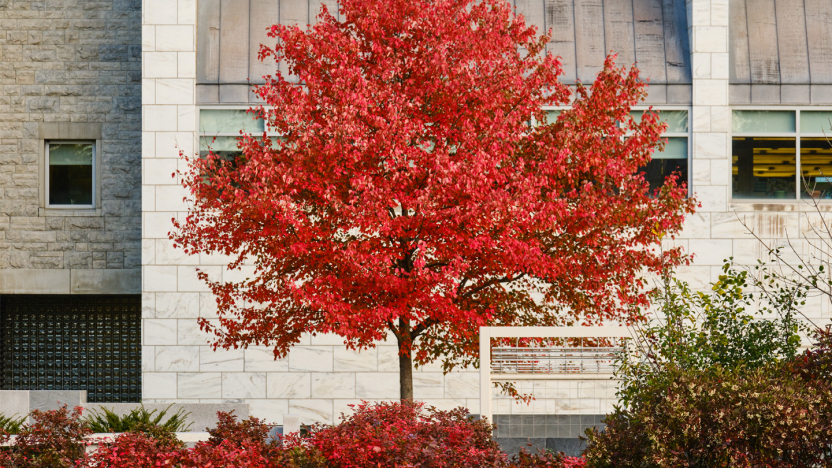
Tim Parsons: “The Garden of the Seasons is one of my favorite public art pieces on campus. This cute red maple is certainly living up to its common name. A native tree in Vermont, it’s also known as “soft maple” by loggers, or “swamp maple” by people tromping through the woods. Looking up at the Green Mountains in October, those splashes of red you see amongst the sugar maple golds and oranges are probably red maples, indicating streams, ponds, or swamps, where they thrive considerably better than sugars. They are also better suited to our yards and gardens than sugars, and many selections in the landscape trade are available, mostly chosen for this fall show.”
(Credit: Paul Dahm
)
Tim Parsons: “While the star magnolia in the main quad is our most photographed tree in the spring, this American smoketree in front of the Davis Family Library is starting to top its popularity, just in the fall. Many people have the related but smaller European smokebush shrubs planted in their gardens, but this native tree is perhaps the finest fall color of any other. Drop everything and go visit her, trust me.”
(Credit: Paul Dahm
)
Tim Parsons: “Our amazing Communications Department publishes many stunning photos of campus, and I enjoy identifying the location and age of the photo by the trees in them. This one almost got me. The center tree is a katsura, its leaves turning various shades of yellow, sometimes beautiful apricot colors. The tree in the background is the aptly named Autumn Blaze maple, a red/silver hybrid becoming very popular in the landscape trade. The katsura, for some people but not me, smells like cotton candy when the leaves turn color. These two trees are downhill from Warner Hall.”
(Credit: Paul Dahm
)
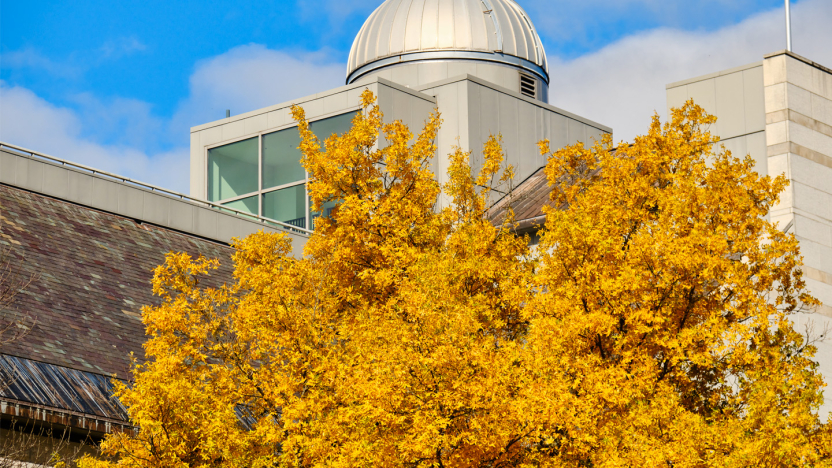
Tim Parsons: “Bitternut hickory, in front of McCardell Bicentennial Hall. Hikers on nearby Snake Mountain will recognize this stunning gold fall color. It’s a native tree and well adapted to our soils and geology here on campus. We don’t have a lot of them, sadly, as they are incredibly difficult to transplant when young, with a taproot that can’t be easily dug and moved once the seedling is a couple years old. The easiest way to plant one in your yard would be to find a seed and plant now. Good luck finding one here—they’re bitter but still eaten by our many squirrel friends (shoutout to one of my favorite Instagram accounts, @squirrelsofmidd).”
(Credit: Paul Dahm
)
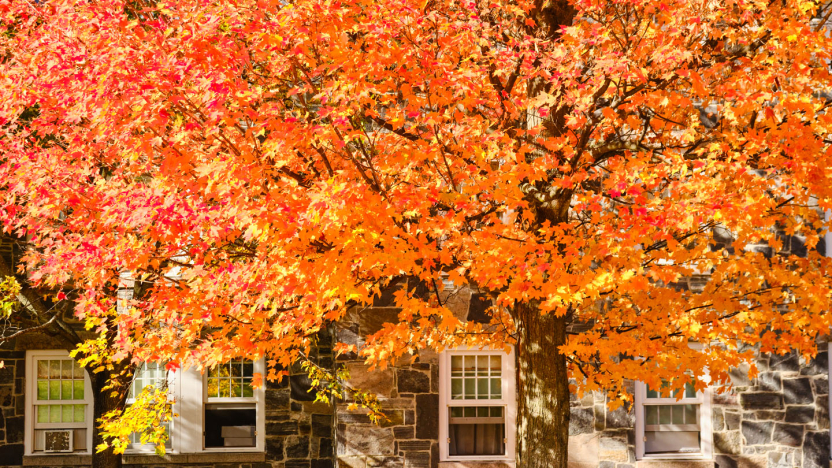
Tim Parsons: “Our lovely state is known for, among other things, our sugar maples, and this one has clearly read the textbook. The foliage color in the species ranges from bright reds to yellows, and this one at Ralph Myhre has it all. Leaves don’t turn color, they lose it, green to be exact. As the nights become longer, chlorophyll production in the leaf is slowed down, and eventually the chlorophyll is destroyed. The stars have seemingly aligned this year for some of the most spectacular colors in years. Weather does affect leaf color, but only in intensity, and a little bit in timing. Cool but not freezing nights and warm sunny days speed the destruction of chlorophyll, making the colors more intense. Our good growing year with adequate moisture meant healthy leaves going into the fall.”
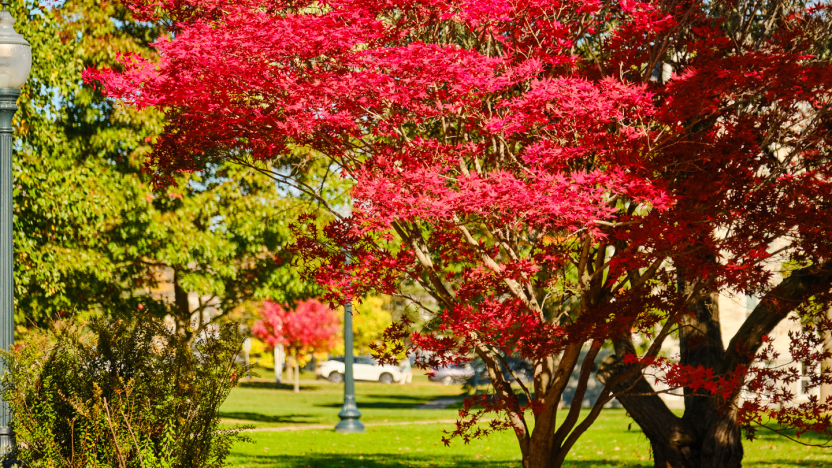
Tim Parsons: “This Japanese maple was planted many years ago in front of the Christian A. Johnson Memorial Building where it centered the flower bed. Construction almost necessitated its removal, but instead we dug it up and drove it down the road with a payloader to this location north of the McCullough Plaza. The leaves are red all year, but a deep burgundy red during the growing season, turning this electric red for fall.”
(Credit: Paul Dahm
)
Tim Parsons: “Tuliptree in the fall is described as “spellbinding” in my woody plant textbook from my undergrad days, and the author certainly used the right word. The electric yellow is about as bright as any tree we have here on campus. Native a little further south, this species is the tallest tree on the East Coast, with some nearing 200 feet in height. I planted this little dude in front of Ross Dining Hall, and it is actually a variegated cultivar with bright gold margins around the green leaf all summer. It’s so spectacular I even planted one at my house.”
(Credit: Paul Dahm
)
Tim Parsons: “Another sugar maple, this one a brighter orange with less red, in front of HMKL. I’ll confess we’re no longer planting as many sugars as in past decades. We worry now about climate change, and sugars in Vermont are poorly adapted for hotter summers.”
(Credit: Paul Dahm
)