

Students Present Climate Policy Options to Vermont State Treasurer
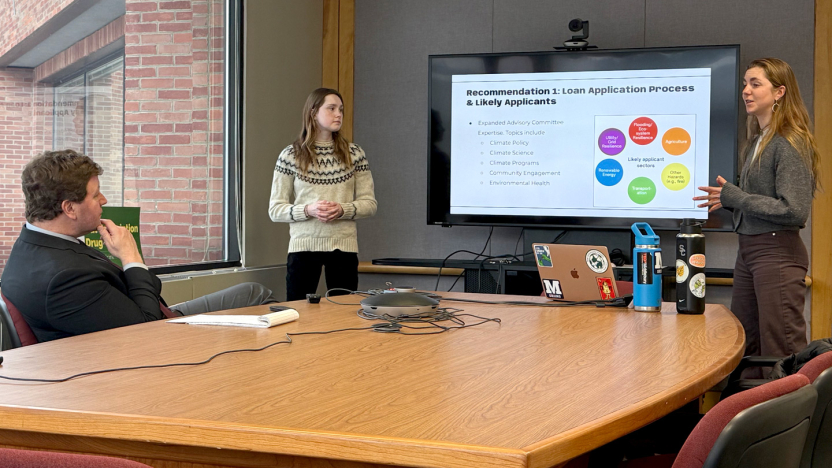
As Vermont communities confront increasingly costly climate-related disasters, state officials are seeking ways to reduce future impacts. Among them is State Treasurer Mike Pieciak, who recently turned to four Middlebury students researching how a statewide revolving loan fund could help reduce climate risks across the state.
On February 27, at the Pavilion Building of the Vermont Statehouse, the students presented policy recommendations from a 70-page report they produced for their Community-Engaged Practicum course. The presentation capped a semesterlong project by environmental policy majors Ben Rosmarin ’25.5 and Shea Brams ’26, conservation biology major Maggie Harper ’26, and study abroad student Louisa Bacon.
In Montpelier, Brams and Harper delivered the group’s report, Designing and Deploying the Climate Resilience Revolving Loan Fund, to Pieciak. “Presenting to the Treasurer’s Office was a really special opportunity to bring our research to life,” said Brams. “Treasurer Pieciak was incredibly kind, engaged, and excited to discuss our findings. We look forward to seeing the future development of the fund and celebrating the Treasurer’s Office leadership in strengthening climate resilience for Vermont communities.”
Created in 2024, the Climate Resilience Revolving Loan Fund helps Vermont communities invest in infrastructure and other projects to reduce the risks of flooding and other natural disasters. The fund allows the Treasurer’s Office to lend up to 2.5 percent of the state’s average daily cash balance—about $50 million to date—for climate infrastructure and resilience projects. The Middlebury students hope their research will help provide a framework for the decision-making process on which projects to fund.
“It feels empowering to be part of the larger movement to say yes—yes to climate action, to collaboration, to possibility, and to the work, research, and relationship building that will get us there,” said Harper. “It was meaningful to present and discuss our findings with Treasurer Pieciak, who expressed great interest and support. This experience reflects what climate resilience is all about: building community so that many voices and areas of expertise can contribute to identifying needs and turning ideas into action.”
In their report, students analyzed losses from climate disasters in Vermont over a 10-year period and proposed preemptive, cost-effective ways to deploy the fund. Their recommendations drew on interviews with experts in finance, climate resilience, and public policy, including leaders from Vermont state agencies, financial institutions, the Connecticut Treasurer’s Office, and Middlebury faculty.
“The students’ report was very thorough and impressive,” said Peter Trombley, director of legislative affairs and senior advisor in the Treasurer’s Office. “It will certainly be helpful in framing our initial thinking as we approach drafting an investment policy for the fund.”
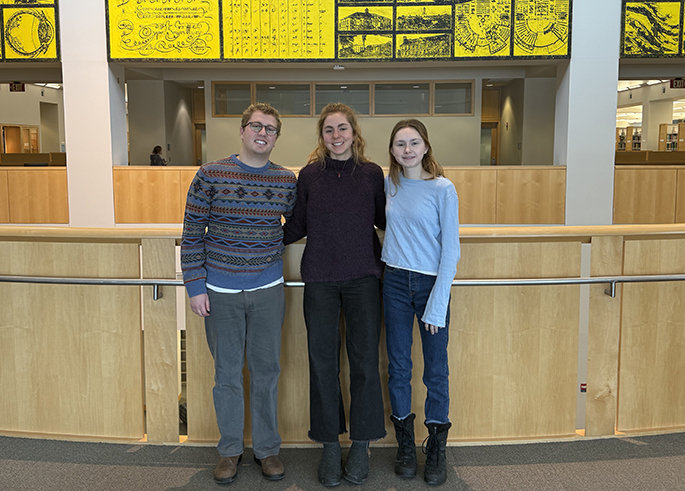
Students emphasized community engagement, diversification, accessibility, and a holistic approach to climate resilience as key priorities for the loan fund. They also identified potential projects in energy, land management, thermal, agriculture, and transportation.
“These projects were prioritized based on hazard risk reduction, co-benefits for communities and ecosystems, and financial viability,” they wrote, concluding that the fund’s greatest strength lies in its flexibility to support holistic, community-driven solutions that transcend traditional sector boundaries.
“The feedback we received throughout the process was positive and that it was helpful to the Treasurer’s Office,” said Rosmarin. “Because they have limited capacity to conduct this type of research, I think it will help inform their decisions. I feel like being at Middlebury, located in a small state like Vermont, makes rare opportunities like this possible.”
Pieciak engaged with students throughout the presentation, including having an in-depth discussion about inequity. “In Vermont, the worst flooding occurs in communities that are already economically behind. When those communities are hit, they fall even further back, which is why the economic and equity dimensions are so important,” said Pieciak.
Jon Isham, professor of economics and environmental studies, said that having students work with leading experts to produce meaningful outcomes has been a central component of the course he has taught for 25 years.
“The Environmental Studies’ Community-Engaged Practicum has been a bellwether for Middlebury’s engagement in Vermont and beyond,” said Isham. “This project illustrates the power of experiential learning, broadly defined, which is emerging as a priority in the strategic planning process. The results of this project show why.”