

Alexis Mychajliw Receives National Science Foundation's CAREER Award
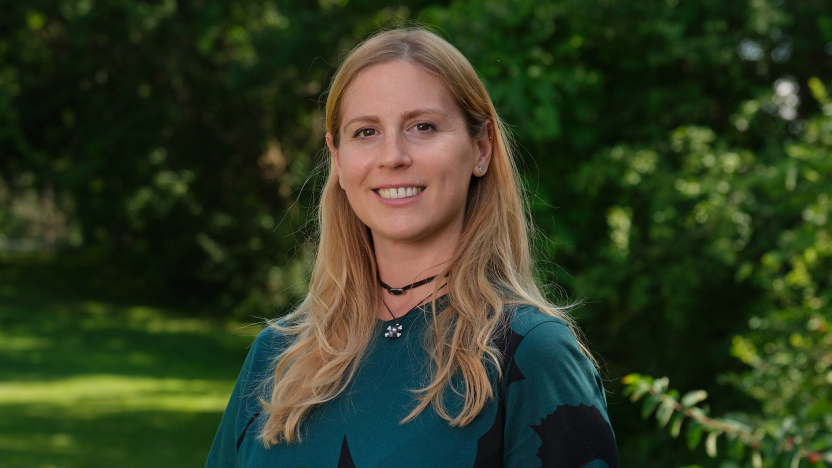
Alexis Mychajliw, assistant professor of biology and environmental studies, has received a Faculty Early Career Development (CAREER) Award from the National Science Foundation (NSF) to conduct research on the biodiversity of islands in the Gulf of Maine.
The NSF’s most prestigious award in support of early-career faculty recognizes outstanding teachers and researchers with the potential to become leaders in scholarship, education, and their fields.
Mychajliw will use the $1.2 million grant to explore the environmental and human factors shaping mammal communities across the region’s islands—an ecosystem known for its fisheries and nature-based tourism and that includes Acadia National Park and U.S. Fish and Wildlife National Wildlife Refuges for breeding birds such as puffins.
“Island systems serve as natural laboratories for studying the processes that govern the evolution and distribution of biodiversity on our planet, yet the long-term legacies of human activities are not traditionally integrated into biogeographic assessments,” writes Mychajliw in her proposal that combines natural history, biological surveys, and community-engaged camera trapping to examine changes in mammal diversity since the retreat of glaciers.
Jeremy Ward, vice president for Academic Affairs and Albert D. Mead Professor of Biology, was the last faculty member to receive the CAREER award in 2013 for his research project “Toward the Genetics of Meiosis: Integration of Meiotic Molecular Biology and Public School Science Outreach.”
“Receiving an NSF CAREER award is a major achievement that recognizes both scholarly excellence and a commitment to teaching and mentorship,” said Ward. “I know how meaningful this kind of support can be for building a research program that involves undergraduates. Alexis already has an exceptionally strong and collaborative research agenda in place, and this award will help expand opportunities for students to participate in important scientific work.”
Mychajliw’s research project, “Empirical Tests of Biogeographic Theory: Island Mammals in the Gulf of Maine,” will help inform conservation decisions and strengthen partnerships among rural communities, wildlife managers, and other stakeholders. The grant will also support research opportunities for Middlebury undergraduates and high school students in Maine and Vermont, including at the Shoals Marine Laboratory. “I am eager to see Middlebury students spend time in the field with wild mammals as well as in the lab learning genomic techniques,” said Mychajliw. “I hope this grant generates data that form the basis for numerous Middlebury student theses but also genuinely improve our appreciation and management of wildlife in the Gulf of Maine.”
Max Zeltsar ’24.5 says working with Mychajliw on his undergraduate thesis was one of his fondest memories from Middlebury. Now a graduate student in the Armstrong Lab at the University of California, Riverside, he coauthored the paper Muskrat Island: Behavioral Shifts of an Insular Muskrat (Ondatra zibethicus) Population in the Gulf of Maine with Mychajliw, research that laid the foundation for her NSF CAREER award.
“Dr. Mychajliw’s abilities as a researcher, educator, and mentor are truly incredible and inspirational,” said Zeltsar. “The mentorship and support I received from Dr. Mychajliw have been invaluable as I’ve continued my journey as a student and scientist. With support from the NSF CAREER award, Dr. Mychajliw will continue to inspire students like me, conduct exceptional research, and be a force for good in every community she is part of.”
A conservation biologist and paleontologist, Mychajliw says the five-year grant builds on her previous research in archipelagos around the world, including the Caribbean and Japan. It will also expand her work at Middlebury by engaging local communities in wildlife research through motion-activated cameras and temporary pop-up exhibits featuring animal specimens and natural history collections in partnership with Cosplay for Science.
Ellie Armstrong, assistant professor of evolutionary genomics at the University of California, Riverside, and a collaborator on the NSF CAREER grant, said Middlebury students will have networking opportunities while working with graduate students from multiple institutions and representatives from nonprofit organizations and federal agencies.
“Alexis has an incredible talent for bringing together diverse stakeholders, researchers, and the public around a shared appreciation for biodiversity,” said Armstrong, who has taught a J-term course on conservation genomics at Middlebury. “The integrated use of ecological and genomic data, combined with historic information from museum collections, will provide important context for ongoing conservation efforts, particularly for understudied taxa.”
Mychajliw, who joined Middlebury in 2021 as an assistant professor of biology and environmental studies, has coauthored more than 40 scientific articles. She is a National Geographic Explorer and a research associate at the Samuel Oschin Global Center for Ice Age Research at the La Brea Tar Pits. She also serves as deputy chair of the International Union for Conservation of Nature (IUCN) Small Mammal Specialist Group, where she guides the conservation of shrews, hedgehogs, and moles worldwide.