

Middlebury Welcomes One of Largest New Faculty Cohorts for 2026–27
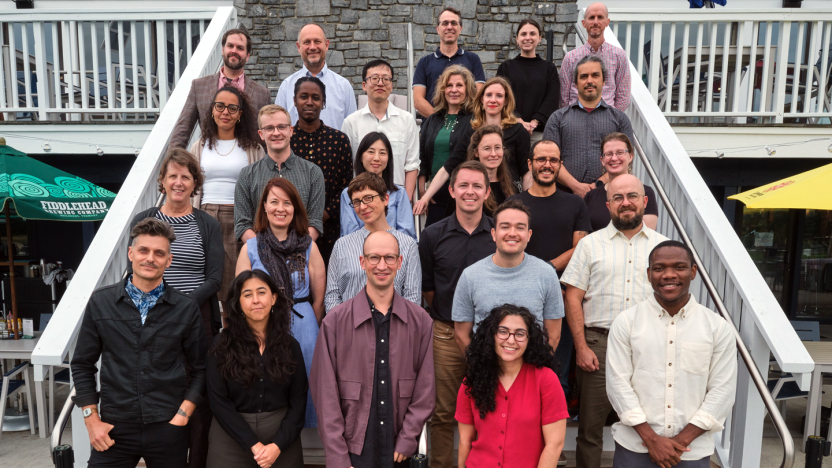
Middlebury College welcomed a diverse group of new faculty members for the 2026–27 academic year, bringing expertise across a broad range of disciplines, including sociology, geology, mathematics and statistics, English, psychology, music, and political science. The College also appointed 10 visiting assistant professors and nine language teaching assistants in German, French, Russian, Spanish, Italian, Arabic, Portuguese, Chinese, and Japanese.
“This is one of the largest groups of new faculty we’ve welcomed in some time, and what stands out is how enthusiastic and engaged they already are,” said Roberto Lint Sagarena, dean of the faculty and professor of American Studies. “Their arrival marks the annual start of the next iteration of our faculty community. They’re stepping into teaching at a moment when higher education is confronting difficult issues that deeply affect us all. After spending a solid amount of time getting to know them, I’m confident they’ll engage those challenges directly and meaningfully strengthen our students’ educational experience.”
Following are short profiles of new Middlebury faculty members in tenure-track positions:
Thomas Anderson, assistant professor of chemistry, has served as a visiting assistant professor of chemistry and biochemistry at Middlebury since 2025. His research has focused on chemical oxidation reactions and their potential use in developing new methods for synthesizing compounds. He has also studied the properties and reactions of highly reactive molecules called carbenes and methods for creating and capturing highly strained molecular structures. He holds a PhD in chemistry and an MS in biology from New York University and a BA in biology from Bard College.
“I am most excited about creating a vibrant research laboratory that provides students with the opportunity to explore questions in organic chemistry.”
Alexander Arroyo, assistant professor of geography, explores the relationships between space, nature, technology, and power. With a background in landscape architecture and environmental design, he plans to connect mapping with Middlebury students’ engagement in social, environmental, and climate justice, the focus of his public scholarship and creative practice. He has a PhD in geography from the University of California, Berkeley, an MLA in landscape architecture from Harvard University, and a BA in human rights and philosophy from Columbia University.
“I’m very much looking forward to meeting the diverse students, faculty, and others engaged in collective inquiry. Based on the values expressed by students I’ve met, my colleagues, and the broader institution, we need more than ever to create and sustain spaces of inquiry that explore how we might build a more just, joyful, and vibrant world amid geopolitical, technological, and climatic turbulence. When thinking through complex questions of landscape, environment, and geography, it helps to have so many beautiful places to clear my head while climbing a mountain, running through the woods, or plunging into a river.”
Cameron de Wet, assistant professor of earth and climate sciences, uses model simulations, geochemical data, and numerical proxy system modeling to explore how hydroclimate dynamics evolve over time. He is especially interested in the intersection of hydroclimate and wildfire and is passionate about earth science education, with a commitment to centering undergraduate research in his scholarship.
“I am excited to join a place where curiosity about the natural world runs deep, and I look forward to working with students to explore how Earth’s climate system has changed in the past—and what that means for where we’re heading in the future.”
Nathan Dow, assistant professor of chemistry, is an organic chemist whose research focuses on developing new methods for building complex molecules. His work uses photochemistry and catalysis to enable challenging chemical reactions, with an emphasis on creating new approaches to chemical synthesis. He has a PhD in catalysis and organic synthesis from Princeton University and BA in chemistry from Swarthmore College.
“I’m excited to meet all the students that make up this community. I was lucky enough to attend this year’s Summer Research Symposium shortly after moving to Vermont, and I was so impressed by the presenters I met there. It’s clear that Middlebury students are curious, passionate, and eager to use what they’ve learned to affect positive change in the world. It’s an ethos that inspires you as an educator and makes you look forward to getting back in the classroom.”
Evan Fernandez, assistant professor of history, is a historian of Latin America whose work focuses on international relations, political economy, and migration. He teaches courses on Latin American history from the precolonial period to the present. His first book project, The Promise of the Pacific: Chile, Japan, and Building Nations and Orders with Nitrate, examines changes in the international order in the Americas through trans-Pacific trade in Chilean nitrate from the 1890s to the 1940s. He has a PhD in history from the University of California, Berkeley, and a BA in history from the University of Colorado Boulder.
“I am most excited about working with Middlebury’s excellent students and to discuss the magic, complexity, and urgency that is Latin American history. Midd is an exceptionally globally oriented institution, making it the perfect place to learn about the world and its past. I also look forward to continuing work on my book project about Latin American international relations.”
David Franco Arabia, assistant professor of French and Francophone studies, is a multicultural scholar specializing in 17th-century French drama, whose research and teaching focus on modern literature, film, and performance studies. He has taught French and Spanish at all levels, as well as literature and film courses across multiple periods and genres. He has a PhD and an MA in French language and literature from Rutgers University, an MA in Hispanic and Latin American languages, literatures, and linguistics from Villanova University, and a BA in journalism from Pontificia Universidad Javeriana.
“I most look forward to working with students who are known for their investment in and enthusiasm for language learning. It is a precious opportunity, not to be taken for granted, to be able to share one’s passion with a group of people, let alone young adults, who are eager to learn about it. I tell myself that in such an environment, where both teacher and students share a passion for the subject, the old cliché that professors learn as much from their students as their students learn from them can only prove to be true.”
Dana Hogan, assistant professor of history of art and architecture, focuses on early modern women, the Renaissance Mediterranean, and digital humanities. Her research interests include women in early modern art, cross-cultural exchange, and self-fashioning strategies in literature and art. She holds a PhD in art history, criticism, and conservation from Duke University, an MA in Renaissance art history from Syracuse University, an MA in Italian Renaissance art from Syracuse University Florence, and a BA in art history and comparative literature from Williams College.
“I am most excited to get to know members of the Middlebury community—colleagues, students, and neighbors alike. One reason I pursued this career is the desire to pay forward the investment my own professors made through their dedicated, warm, and lasting mentorship, which has often grown into lifelong friendship. In the short time I’ve been at Middlebury, it’s become clear that my new colleagues share this commitment, and I feel very fortunate to have this opportunity to work with such generous and brilliant people.”
Daniel Keliher, assistant professor of mathematics and statistics, studies number theory and arithmetic statistics, with a particular focus on elliptic curves, Selmer groups, and counting number fields. His research also explores prime number races, special values of L-functions, effective estimates, and related topics in combinatorics. He holds a PhD and MS in mathematics from Tufts University and a BS in mathematics from Brown University.
“In just my first few weeks on campus, it has been really energizing to meet a lot of enthusiastic students and faculty wrapping up summer projects. I am eager to join them and tap into that same energy. There are a lot of exciting things happening in number theory—and mathematics more broadly right now—that I’m excited to share and explore with students.”
Mendel Kranz, assistant professor of religion, researches and teaches modern Jewish history and thought, philosophy of religion, postcolonial studies, race and racialization, antisemitism, Islamophobia, Jews in the Muslim world, secularism, diaspora, continental philosophy, and critical theory. He holds a PhD and MA from the University of Chicago Divinity School and a BHL and rabbinic ordination from the Chaim Yaakov Shlomo College of Jewish Studies.
“Having lived in big cities, I’m excited to become part of a small, tight-knit intellectual community where I’ll actually get to know my colleagues and students really well. I’ve already had the chance to meet so many new people doing amazing things. The excitement for the start of the semester is ramping up and I can’t wait for all the good conversations to come!”
Jacob Madrid, assistant professor of mathematics and statistics, researches mathematical biology, stochastic processes, asymptotic methods, and probability theory. More specifically, he studies the limitations of mean-field approximations, extreme first passage times, and stochastic extinction in population models. He holds a PhD and BS in mathematics from the University of Utah.
“I am most excited to meet and interact with Middlebury students. Everywhere I have been, students have impressed me in different ways, and I’m eager to see what makes the students here unique. I have heard so many great things about the Middlebury student body, and I look forward to working with them directly.”
Agueda Ortega, assistant professor of sociology, studies food politics, bureaucracy and the state, economic sociology, and environmental sociology, with a particular focus on the role of the state in promoting agroecology in Argentina. She holds a PhD and MA in sociology from the University of Texas at Austin and a BA in sociology and Latin American studies from Wesleyan University.
“As I begin my first semester at Middlebury, I am most excited to meet students and together delve into the world of sociology. I look forward to introducing students to sociological perspectives on pressing global issues and to fostering the imagination and critical thinking skills needed to address them. I am also very excited to see the beautiful fall foliage!”
Sophie Pangle, assistant professor of political science, researches and teaches modern political philosophy, with a focus on 18th-century French thought, ancient political philosophy, liberalism and its critics, and American and African political thought. She holds a PhD in government from Harvard University and a BA in Fundamentals: Issues and Texts from the University of Chicago.
Nicholas Shea, assistant professor of music, researches performance kinesthetics, style transmission and genre analysis, music perception and cognition, and networked music theory, including how global communities of musicians understand musical organization through performance practices, bodily cognition, and crowdsourced digital artifacts such as tablature, often outside academia. He holds a PhD in music theory from The Ohio State University, an MM in music theory from the University of Massachusetts Amherst, and a BEd in music from the University of Missouri–St. Louis.
“I am eager to hit the ground running with my teaching and research thanks to the robust support system Middlebury has provided me as I come from Arizona State University. Students are eager to learn and my fellow faculty are deeply committed to my success—all the more impressive that the semester hasn’t even started yet! I’m very much looking forward to collaborating with others across disciplines.”
Nadia Vossoughi, assistant professor of psychology, is an intergroup relations researcher who studies the processes that contribute to and the consequences of intergroup inequality, as well as the formation of alliances that challenge existing systems and lead to collective action. She holds a PhD and MS in psychology from the University of Michigan and a BA in psychology and sociology from the University of Kansas.
“I’m most excited to explore psychological science with Middlebury students in the classroom as a way to better understand the social worlds we inhabit. I’m also looking forward to collaborating with students on research about intergroup relations and social change. The beautiful mountains and fall colors are a wonderful bonus.”
Visiting Assistant Professors
Jeremy Horowitz, PhD, University of California, San Diego, visiting assistant professor of political science
Chukwuebuka Ibeh, MFA, Washington University, visiting assistant professor of English
Lucy Ives, PhD, New York University, visiting assistant professor of English
Christian Obst, PhD, Brown University, visiting assistant professor of German
Natalia Plagmann, PhD, Princeton University, visiting assistant professor of Russian
Daniel Schar, PhD, Université libre de Bruxelles, visiting assistant professor of global health
Samantha Stelnicki, PhD, Ohio State University, visiting assistant professor of economics
Shakir Stephen, PhD, University of California, Santa Barbara, visiting assistant professor of religion
Kristina Talbert-Slagle, PhD, Yale University, visiting assistant professor of global health
Xinhao Wang, PhD, Rutgers University, visiting assistant professor of economics
Visiting Instructors
Salma Shaaban, MA, SOAS University of London, visiting instructor of Arabic
Professors
Emily Chan, PhD, University of Michigan, professor of psychology, executive vice president and provost
Associate Professors
Miro Kummel, PhD, University of Michigan, visiting associate professor
Lecturers
Samson Akanni, PhD, Bowling Green State University, lecturer, artist-in-residence in dance
Susan Baker, MA, Harvard University, professor of the practice
Charles Bush, MBA, University of Pennsylvania, professor of the practice
Anya Domlesky, MA, Harvard University, professor of the practice
Graydon Hanson, BA, Middlebury College, assistant in instruction in film and media culture
Stephen Herzog, PhD, Yale University, professor of the practice
Midori Iwamoto, MA, University of Wisconsin–Madison, lecturer in Japanese studies
Libby Jewett, PhD, University of Maryland, professor of the practice
Meghan Leathers, MFA, Brown University, artist-in-residence in theatre
Virginia Mazzoni, BA, University of Florence, lecturer in Italian
Casey Schine, PhD, Stanford University, lecturer in mathematics and statistics
Michelle Steele, MA, School of International Training, lecturer in education studies
Michaela Taylor, MA, Middlebury College, lecturer in Italian
Teaching Assistants
Amneh Afaneh, MA, University of Jordan, teaching assistant in Arabic
Giulia Benincasa, MA, Federal University of Rio de Janeiro, teaching assistant in Portuguese
Donovan Compton, BA, Middlebury College, teaching assistant in Chinese
Ginto Ito, BA, International Christian University, teaching assistant in Japanese
Zhaniya Murat, BA, Nazarbayev University, teaching assistant in Russian
Elsa Rohaut, MA, Université Paris Cité, teaching assistant in French and Francophone studies
Margherita Rossi, BA, University of Bologna, teaching assistant in Italian
Maria Rupp, BA, Johannes Gutenberg University Mainz, teaching assistant in German
Ketevan Tchelidze, MA, University of Cordoba, teaching assistant in Spanish