

Clifford Symposium Explores Academic Freedom and Free Expression

The 2026 Clifford Symposium brought students, faculty, and higher education leaders to Middlebury September 24–25 for a two-day program focused on academic freedom and free expression, including a presidential conversation, faculty panel, and student debate. It marked the beginning of a yearlong discussion that will include additional symposium events.
President Ian Baucom moderated the keynote presidential conversation, “Why Academic Freedom Matters at a Liberal Arts College,” with Dartmouth President Sian Leah Beilock and Sarah Guyer, dean of arts and humanities at the University of California, Berkeley. He opened by distinguishing free expression, which he described as the circulation and debate of ideas, from academic freedom, which he defined as the advancement of knowledge.
If you accept that the vibrancy of a higher educational enterprise is predicated on the protection of free expression, that means that we need to be a place where we understand there is going to be a circulation of ideas or opinions that we don’t necessarily agree with and whose validity we might seriously question.
“If you accept that the vibrancy of a higher educational enterprise is predicated on the protection of free expression, that means that we need to be a place where we understand there is going to be a circulation of ideas or opinions that we don’t necessarily agree with and whose validity we might seriously question,” said Baucom. “But we allow them to circulate.… Academic freedom is about the advancement of knowledge. And it’s about the advancement of expert disciplinary knowledge.”
The presidential panel touched on multiple topics but focused on the symposium’s central question: “Can the liberal arts still teach us how to disagree well?” The panelists also discussed intellectual disagreement, free expression on campus, access to higher education, and the value of a liberal arts education in an age of rapidly advancing artificial intelligence.
“What we’re trying to do is teach students how to think, not what to think,” Beilock said. “You actually learn and stretch when you’re put in a situation where you have to think differently or take something to the next level.… I think a lot of what we’re trying to create—and what faculty create in their classrooms—are desirable difficulties, where students are seeing things or being approached with ideas from a different idea or perspective.”
Guyer said educators should try to teach students how to “disagree about an object in common and walk out and still be friends, or go get coffee, and come back to class the next day not as enemies, but as peers.” She also emphasized that academic freedom allows students and scholars to challenge assumptions and make mistakes in the pursuit of knowledge. “It’s not freedom just to say anything. It’s actually freedom to be wrong,” she said. “Freedom to test out ideas, and test out ideas in a community that is committed to truth and to discovery.”
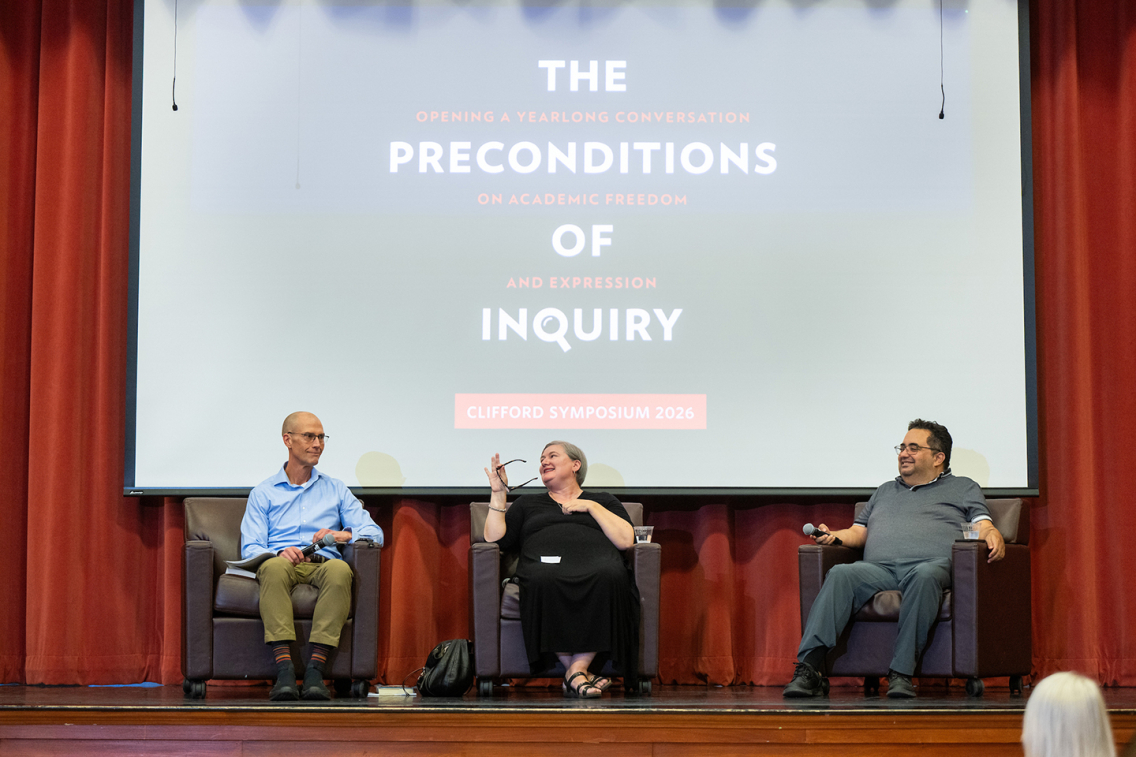
Roberto Lint Sagarena, dean of the faculty and professor of American studies, opened the symposium with a welcome and introduced the panelists for an event titled “Faculty Colloquium: What Academic Freedom Is and What It Is Not.” “We’re here to think about the conditions that make learning, teaching, research, and creative work possible, and about a question that sits at the heart of the liberal arts: How can we best learn to disagree well and productively?” he said.
Bert Johnson, professor of political science, outlined four principles based on the history and established standards of academic freedom. He emphasized its purpose of serving the common good, the professional responsibilities that accompany faculty rights, the importance of free expression throughout the campus community, and the need for institutions to adapt as threats to academic freedom change over time.
Enrique García, professor of Luso-Hispanic studies, focused on how academic freedom protects academic disciplines as they evolve and establish their own professional standards. He also discussed the potential influence of outside funding on faculty appointments and research. Ioana Uricaru, professor of film and media culture, highlighted the relationship between academic freedom and politics, arguing that protecting intellectual inquiry and pursuing truth are core responsibilities of academic institutions.
Johnson also spoke about the value of modeling constructive disagreement for students. “It should be joyful to disagree in that way, and to see other people do so, who are modeling a really skilled, intelligent disagreement,” he said.
On Friday, the Middlebury College Debate Society held a plenary debate focused on the question “Should a liberal arts college protect all lawful expression?” The proposition argued that broad protections are essential because restricting lawful expression can discourage intellectual inquiry, criticism, and protest. The opposition argued that colleges should balance free expression with their educational mission and responsibility to maintain an inclusive residential community.
The Clifford Symposium is named after Professor Emeritus of History Nicholas R. Clifford (1930–2019), who taught history at Middlebury College from 1966 to 1993 and who, in his many years as a member of the faculty and administration, cultivated critical inquiry.
Additional events will be held throughout the year with dates to be posted on the Clifford Symposium website.