
Michelangelo Lovelace: Art Saved My Life
–
When Michelangelo Lovelace (1960–2021) spoke about his life and career as an artist, he almost always began with this story: As a teenager growing up in Cleveland’s King Kennedy public housing complex, he dropped out of school to support his family. He found a variety of means to do so, some legal and some illegal. When he was nineteen, he was arrested for selling marijuana and appeared before a judge. In Lovelace’s own telling, “the judge said, ‘What can you do?’ So, I told him I could draw. He said, ‘Well, you come back down here again, I’m sending you to prison. You’d better stick to drawing.’”
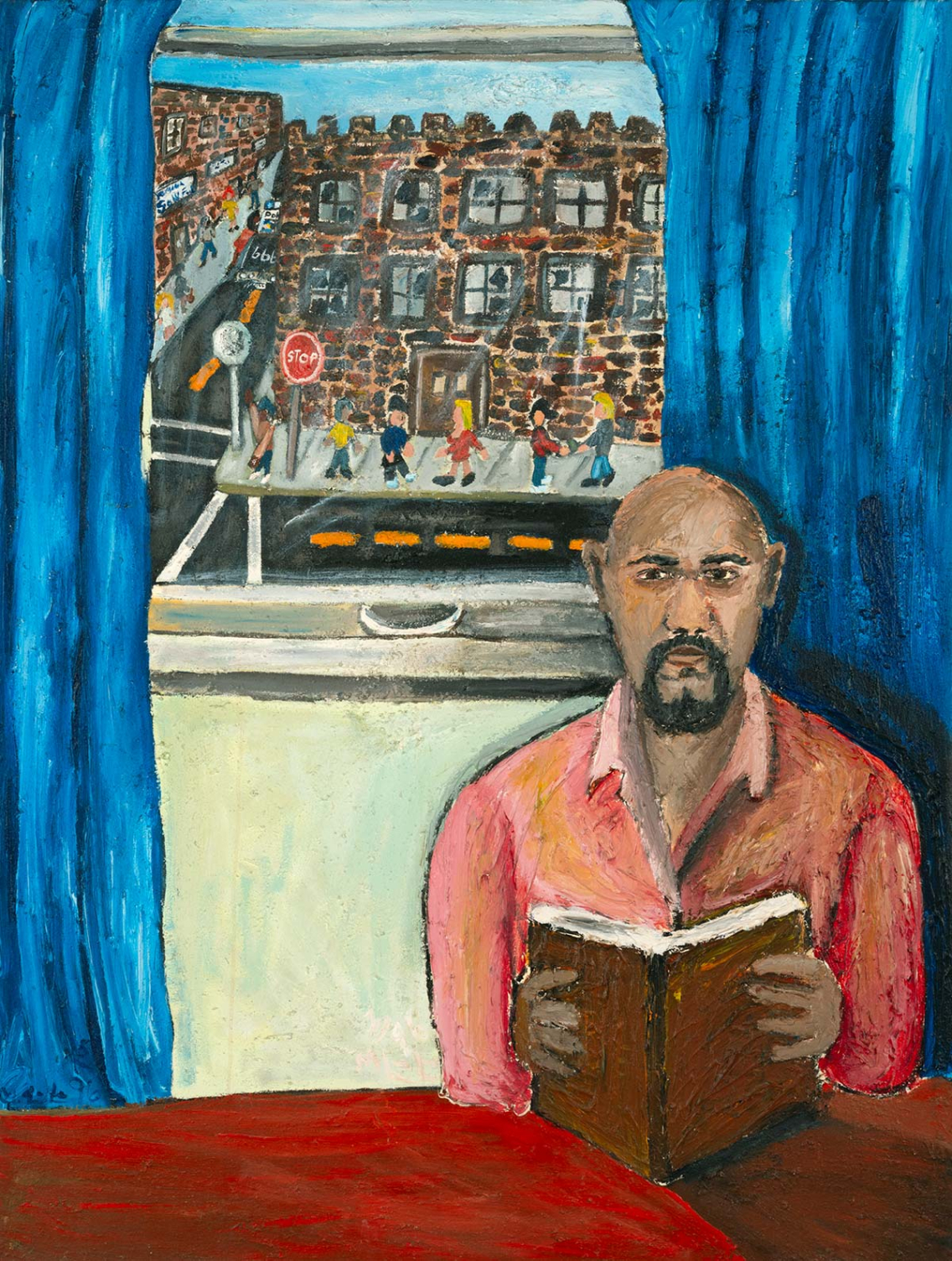
Lovelace took the advice to heart. In his twenties, he studied art at Cuyahoga Community College and the Cleveland Institute of Art. He dropped out of school again, this time to make a living for his own children, and he faced poverty, addiction, and the loss of loved ones. Nevertheless, he maintained his dedication to art and crafted a unique style, seeking energy and directness.
After receiving technical training and gaining knowledge of art history, Lovelace chose to paint in an intentionally simplified manner because it allowed him to show what he called “the raw power of life in the inner cities of America.” He depicted crime, drugs, poverty, and sin, but also community, compassion, progress, and salvation. He portrayed the environment he knew—the bricks of public housing, advertising billboards, familiar intersections—as well as political events, social allegories, and scenes from his career in art.
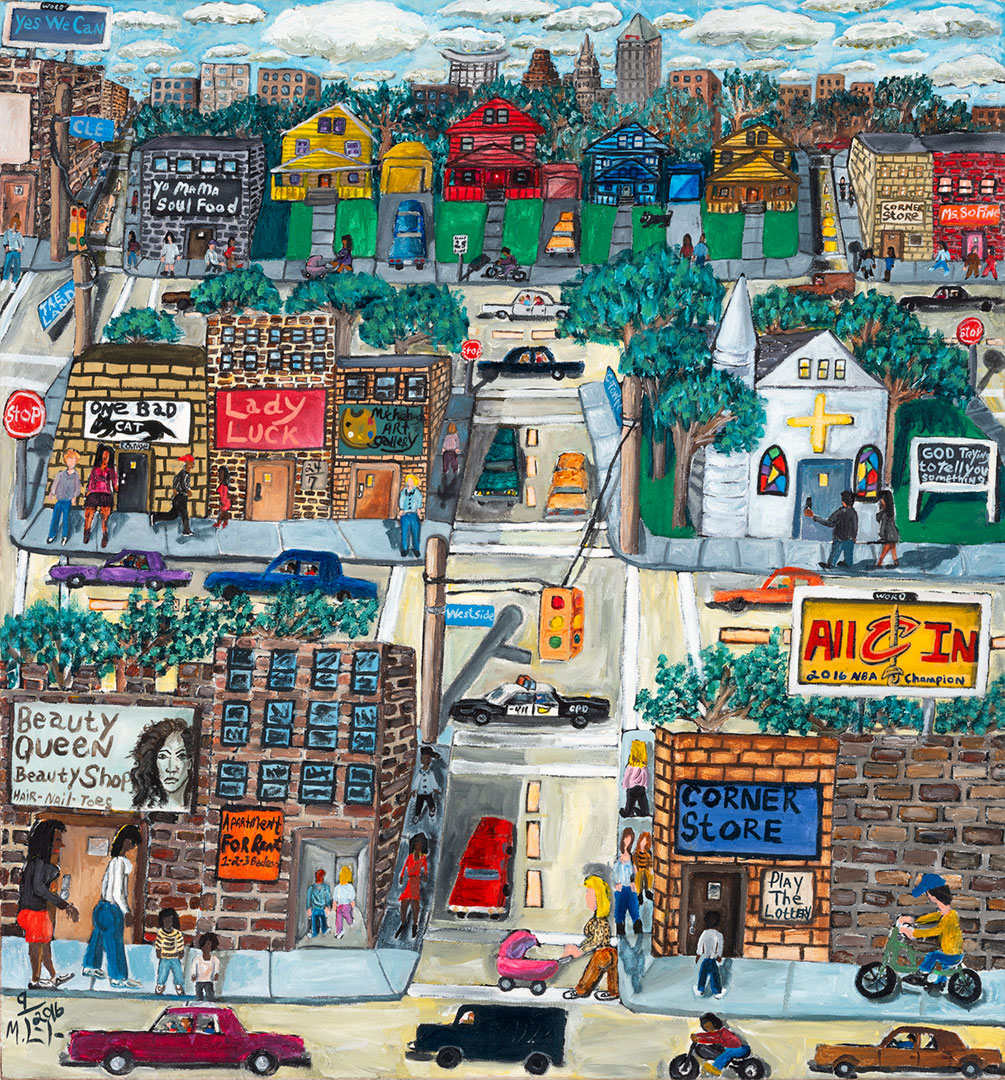
Lovelace hoped for ideas and experiences to flow straight from his mind to the canvas, as honestly and forthrightly as he could manage. This allowed him to process and contend with harsh experiences, and to express himself to others. Before his life was cut short by pancreatic cancer, he had shown his work from New York to Los Angles and was thrilled with what he had achieved. Taking stock of his personal journey and the sense of purpose that he found in creativity, he remarked “I’m one of those people who say ‘art saved my life,’ and it truly did.”
Michelangelo Lovelace: In Context
A collection of videos offering insight into the artist and his work.



Related Events
Opening Reception—Michelangelo Lovelace: Art Saved My Life
Thursday, September 17, 2026 | 5:00–6:30pm
Mahaney Arts Center, Lower Lobby and Museum
Join us for an evening of celebration as we preview our major fall exhibition focused on the art of Michelangelo Lovelace, and introduce our new Museum Director Deborah Barkun along with Middlebury’s new Associate Dean for the Arts Michole Biancosino.
Museum Lecture + Lunch Series: Geographies of Race and Urban Space
Friday, October 2, 2026 | 12:00—2:00pm
Mahaney Arts Center, Room 125 and Lower Lobby
Join us for a lecture and lunch with Peter Nelson, Tamar Meyer Professor of Geography, who will explore the ways in which notions of race have shaped material constructions of urban spaces, their lived experiences, and the lasting impacts on populations of color.
This lecture sits at the confluence of constructions of race, space, and place by drawing on both historical and contemporary examples. Nelson will begin with the creation of ‘Chinatowns’ in the late 19th Century and continue through the rise of the Eugenics movement in the early 20th Century, before arriving at more recent racialized practices surrounding policing and mortgage lending. Much of the material is drawn from Urban Geography, a popular elective course in the Geography Department, so attendees will get a unique taste of a Middlebury classroom.
This event is free and open to all, but $5 donations are welcome.
Lecture—Brick by Brick: The Life and Career of Michelangelo Lovelace
Thursday, October 8, 2026 | 4:30pm
Mahaney Arts Center, Room 125
Dr. Jeffrey Katzin, Senior Curator of the Akron Art Museum, will discuss Lovelace’s intensively dedicated fusion of art and life, his simplified but powerful style, and his resonant approaches to politics and Black identity.

Michelangelo Lovelace: Art Saved My Life is organized by the Akron Art Museum, Akron, Ohio, with support from the John S. and James L. Knight, Lehner Family, and John P. Murphy Foundations; the Mary and Dr. George L. Demetros and Kenneth L. Calhoun Charitable Trusts; and the Ohio Arts Council.

Generous support provided by Art Bridges