

Marna O. Davis Museum to Open in 2029
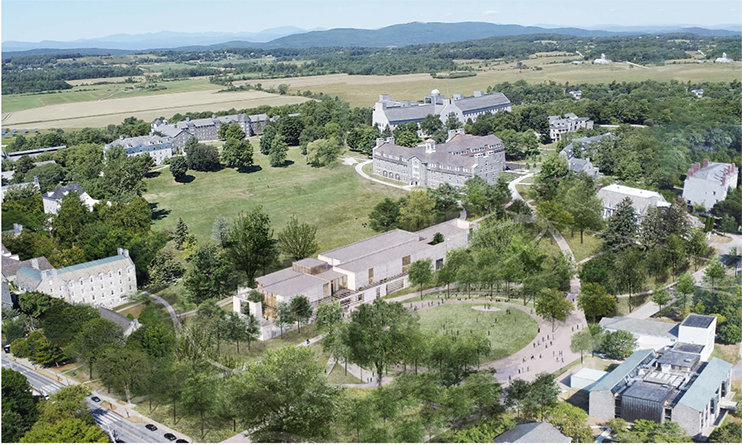
A new art museum envisioned only a few years ago is on track to open in 2029, with broad support including a $20 million gift from Marna O. and Charles A. Davis. The project will create a vibrant indoor and outdoor space for teaching, research, exhibitions, and public engagement serving the entire Middlebury community, Vermont, and beyond.
The gift from the Chuck and Marna Davis Foundation advances construction of the 35,000-square-foot museum, to be located near the current site of Battell Hall—scheduled for removal later this year—across from Johnson Memorial Building. The Marna O. Davis Museum, anchoring a new arts quad, will house the College’s 7,000-object art collection and newly acquired world-class works and include multipurpose classrooms and event space.
“A teaching museum is integral to a liberal arts education, and the Marna O. Davis Museum reflects our deep commitment to teaching and learning through the arts,” said President Ian Baucom. “We are grateful to the donors and supporters who share our belief in the transformative power of the arts and their enduring impact on our students. I look forward to seeing this world-class art museum emerge as a place the entire community can enjoy.”

Chuck Davis, founder, chairman, and co–chief executive officer of Stone Point Capital, an investment firm based in Greenwich, Connecticut, delivered the 2025 Commencement address at Middlebury. A native Vermonter, he attended Middlebury for two years, eventually graduating from the University of Vermont.
Davis hadn’t returned to the College in more than 50 years until a visit to the A&W on Route 7 in Middlebury a few years ago turned into a nostalgic drive around campus. “All the wonderful feelings about my time here came flooding back that afternoon walking around with Marna,” recalled Davis at Commencement, where he was the graduation speaker in 2025. “I am very grateful for what Middlebury gave me. I learned a ton from my coaches, teachers, and classmates. I love Middlebury and am proud to be back.”
Since Commencement, Davis said he’s been thinking a lot about ways to give back to the College, which he says had a major impact on his life.
“I wanted to support Middlebury in a way that reflects the love I have for this very special place and for my wife, Marna, while also making a meaningful difference in the lives of students, faculty, staff, and the people of Vermont,” said Davis, who affectionately refers to the museum as “the Marna”—a name he hopes will be embraced by the Middlebury community and beyond.
The transformative gift from the Davises, coupled with other contributions from a wide array of donors, helped For Every Future: The Campaign for Middlebury reach its goal of $600 million two and a half years early. Fundraising for the museum and larger campaign will continue through June 2026.

A Vision for the New Museum
The Marna O. Davis Museum and arts quad are in the design development phase. Allied Works, an architecture and design practice based in Portland, Oregon, and New York, is leading the design process in collaboration with Reed Hilderbrand, the project’s landscape architect. Vermont-based Naylor & Breen is serving as preconstruction manager. The project will create a new arts quadrangle comprising the museum, Johnson Memorial Building, Wright Memorial Theatre, the Sunderland Language Center, and le Château.
The quad will include a central open space designed to support outdoor exhibitions, musical performances, sculptural experimentation, and theatrical productions, reshaping the College’s concept of a public square. Located along a heavily traveled pedestrian route, the space sits where many students pass between classes and return to their residence halls.
Katy Smith Abbott, interim director of the Middlebury College Museum of Art, envisions the new museum as a “physical and metaphorical crossroads on our campus and for the broader region.” On any given day, she imagines visitors viewing works on loan from Special Collections, a new video installation in the media gallery, faculty members working with students to curate a teaching gallery, presentations by artists, and spaces for quiet reflection.
“For our campus and the broader community, the new museum promises to embody all the best qualities of a third space, characterized by lively conversation, intellectual engagement across disciplines, and a strong sense of community,” said Smith Abbott.
The museum’s collection—spanning the fourth millennium BCE to the present—continues to expand, said Smith Abbott. The current holdings feature permanent installations of antiquities, Asian art, and American, Latin American, African, and European painting and sculpture from the Renaissance through the early 21st century. The museum’s 20th-century and contemporary collection encompasses works in all media, with particular strength in prints and photographs.
Student-focused programming will remain central to the new museum’s mission, including the Museum Ambassadors Program, which features interns working in curation, engagement, design, publicity, administration, and visitor services. Alumni of the program have gone on to leadership roles at national institutions, including the Art Institute of Chicago, the Whitney Museum of American Art, and the High Museum of Art, as well as at prominent galleries and Sotheby’s.