

Student Podcaster, Poet Explores Big Ideas with Faculty Experts
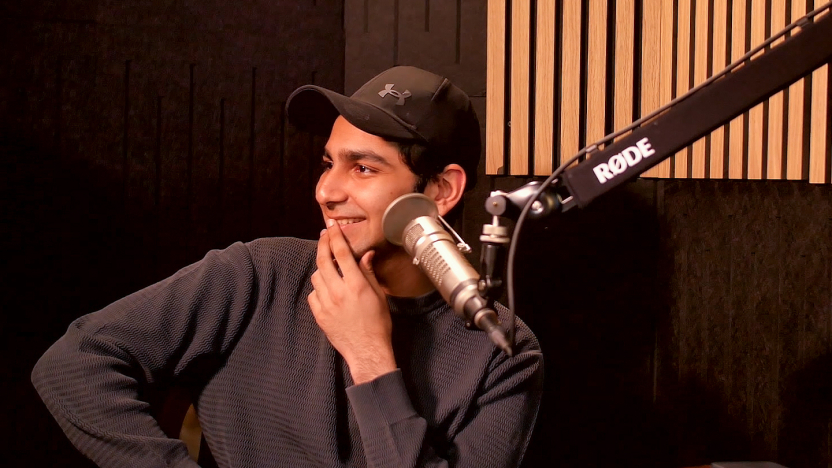
Long before Abhir Suri ’28 arrived on campus in fall 2025, he was already exploring ways to express ideas about social and cultural issues through writing, art, and other creative outlets. His debut poetry collection, Sunglasses and Duct Tape, earned him a place on Delhi Wire’s Top 50 Most Influential Indian Authors of 2024—the same year his artwork was exhibited at Saffronart in his hometown of Mumbai.
Once on campus, Suri’s passion for exploring new ideas took on a global dimension, shaped by his participation in the Rohatyn Global Scholars program and by professors who challenged him to rethink topics he thought he understood, including his own religion, Hinduism. “Everything I thought I knew about my religion was uprooted in a week,” said Suri of a Hindu ethics course taught by Jennifer Ortegren, associate professor of religion. “It was fascinating. I was learning more about my own country by being in the U.S. than I ever did in India.”
As he did in high school, Suri sought creative ways to explore new ideas. The result was The Monkey Mind Lab podcast—a widely followed series featuring in-depth conversations with Middlebury faculty. He has grown his audience on RSS.com, Spotify, Apple Podcasts, and other streaming platforms to more than 150,000 subscribers and viewers across 26 countries, including India, the United States, Ghana, Brazil, Egypt, Mexico, Madagascar, and the United Arab Emirates, as well as countries throughout Europe.
“At its core, the podcast is for anyone who is curious,” said Suri, who promotes it on Instagram and other social media platforms, including through targeted ad buys in select countries based on topics. “I like to think I’m a very inquisitive person who wants to know a little bit about everything. The goal is to explore complex topics and make them more accessible to listeners.”
For each episode, Suri interviews Middlebury faculty whose teaching and research align with topics he wants to explore. He works with them to develop questions and records conversations with technical support from the College’s Media Services department. “I try to make it more of a conversation that can go in different directions depending on what is most interesting in the moment, even if slightly off topic,” said Suri, who edits interviews to 30–45 minutes.
“I want to leave the world better than I found it, and I’m on my own mission to do that in whatever way I can.”
— Abhir Suri
The first episode of Season One featured Nadia Horning, professor of international and global studies, in a discussion about the difference between an international education and a global education. “Abhir’s excitement was palpable as he embarked on a new venture aimed at inviting people to think beyond disciplinary boundaries,” said Horning. “His enthusiasm was infectious.”
Suri interviewed Amit Prakash, visiting assistant professor of global studies and director of the Rohatyn Global Fellows program, for an episode titled “If You Decolonise the Mind, What Happens to the Culture It Carries?” Gloria González Zenteno, Jean Thompson Fulton Professor of Modern Languages and Literature, explored “Can the Arts Be a Form of Resistance?” with a focus on Latin American literature. Suri also spoke with James Fitzsimmons, professor of anthropology, about the ancient Maya world, “where death was not an end, but a tool used to legitimize power, construct identity, and anchor entire political systems.”
“My goal has been to talk to experts about complex topics in a way that makes them more accessible and easier to understand for anyone listening,” said Suri. “The biggest takeaway from earlier episodes has been learning how to ask more of the right questions until you get to the ones that help people understand these complex topics.”
Suri credits his experience as an intern at the Rohatyn Center for Global Affairs—and the support he received there from staff such as Margaret DeFoor, operations manager, who involved him in producing the center’s podcast, New Frontiers—with inspiring him not only to launch his own show but also to explore topics outside his comfort zone.
“The Rohatyn Center, especially the Global Scholars program, is perhaps the best thing that has happened to me at Middlebury,” said Suri. “It’s an absolute must for any first-year student because you get to experience the best of Middlebury with access to professors, thinkers, resources, and opportunities you just can’t get anywhere else.”

Watch episode six of “The Monkey Mind Lab” podcast featuring Amit Prakash, visiting assistant professor of Global Studies, and director of the Rohatyn Global Fellows program.
In addition to his podcast, Suri is partnering with Dana Yeaton, associate professor emeritus of theater and playwriting, and former faculty director of Oratory Now—a center for training and research in oral expression—to bring the Oratory Method to India. Suri interviewed Yeaton on a podcast episode titled “Is Oratory the Liberal Art That Will Save the Liberal Arts?”
Suri credits his participation in MiddCORE Summer Lab—a mentor-driven, experiential learning program that builds skills, creates opportunities, and expands networks—with his initial contact with Yeaton to pitch the idea of bringing the Oratory Method to India. “They challenged us to see what happens when you take risks,” said Suri.
Suri plans to continue helping others through writing, poetry, art, advocacy, and other forms of expression, much of which is featured on his website. He cites feedback from readers of his poetry collection—which explores topics such as bullying, self-discovery, resilience, and misunderstood identity—as motivation for his work.
“I had a lot of people tell me certain poems really resonated with them because they reflected difficult situations they were going through,” said Suri. “It meant a lot to know the work touched people’s hearts. I want to leave the world better than I found it, and I’m on my own mission to do that in whatever way I can.”