Physics PHYS

Robert Pappalardo, Europa Mission Project Lecture

Jupiter’s moon Europa may be a habitable world. Galileo spacecraft data suggest that an ocean lurks beneath its frozen ice surface. A paucity of large craters argues for a young surface and recent geological activity, and magnetic measurements imply that a salty ocean persists today. Europa’s ocean and surface are inherently linked. This presentation will summarize both our state of knowledge about Europa and the science potential of NASA’s mission to explore Europa and investigate its habitability.

McCardell Bicentennial Hall 104

Closed to the Public

Fingerprints of the First Stars: Searching for Population III

Sponsored by:
Physics
Our current story for the origin of the heavy elements has at its core a recycling program on the grandest of scales.  Using the largest telescopes on the ground and in space, we have traced atoms as they flow from the intergalactic medium into galaxies, where they are incorporated into stars, undergo fusion, and are returned in supernovae and other types of stellar death.  The process can repeat many times, raising the total amount of heavy elements in the universe over time.

McCardell Bicentennial Hall 216

Open to the Public

Open House Night at College Observatory

Sponsored by:
Physics
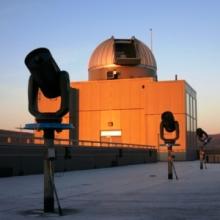
The Physics Department at Middlebury College will again host Open House nights at the College Observatory this spring. The observatory, located atop McCardell Bicentennial Hall, will be open to the public for viewing the heavens on Friday evenings, April 29 and May 6, from 9:00 PM until 10:30 PM, provided the skies are mostly clear. Jupiter will be in the evening sky on both of these dates. Also visible through our telescopes will be a number of interesting stars, star clusters, and nebulae.

Mittelman Observatory (McCardell Bicentennial Hall)

Free
Open to the Public

Open House Night at College Observatory

Sponsored by:
Physics
The Physics Department at Middlebury College will again host Open House nights at the College Observatory this spring. The observatory, located atop McCardell Bicentennial Hall, will be open to the public for viewing the heavens on Friday evenings, April 29 and May 6, from 9:00 PM until 10:30 PM, provided the skies are mostly clear. Jupiter will be in the evening sky on both of these dates. Also visible through our telescopes will be a number of interesting stars, star clusters, and nebulae.

Mittelman Observatory (McCardell Bicentennial Hall)

Free
Open to the Public

Open House Night at College Observatory

Sponsored by:
Physics
The Physics Department at Middlebury College will again host an Open House night at the College Observatory this autumn. The observatory, located atop McCardell Bicentennial Hall, will be open to the public for viewing the heavens on Friday evening, October 9, from 8:00 PM until 9:30 PM, provided the skies are mostly clear. Visible through our telescopes will be a number of interesting stars, star clusters, and nebulae.

Mittelman Observatory (McCardell Bicentennial Hall)

Free
Open to the Public

Observatory Open House Night

Sponsored by:
Physics
Middlebury College Observatory and Middlebury Physics will again host stargazing open house nights this spring. These Observatory events are scheduled for Friday evenings, April 28 and May 5, from 9:00 PM until 10:30 PM and are weather permitting. Jupiter will be in the evening sky on these dates. A variety of interesting stars, star clusters, and nebulae will also be visible through the Observatory’s telescopes.

Mittelman Observatory (McCardell Bicentennial Hall)

Free
Open to the Public