

The Science and Practice of Peace: How a Hudson Valley Museum Is Reimagining Peacemaking as a Daily Verb
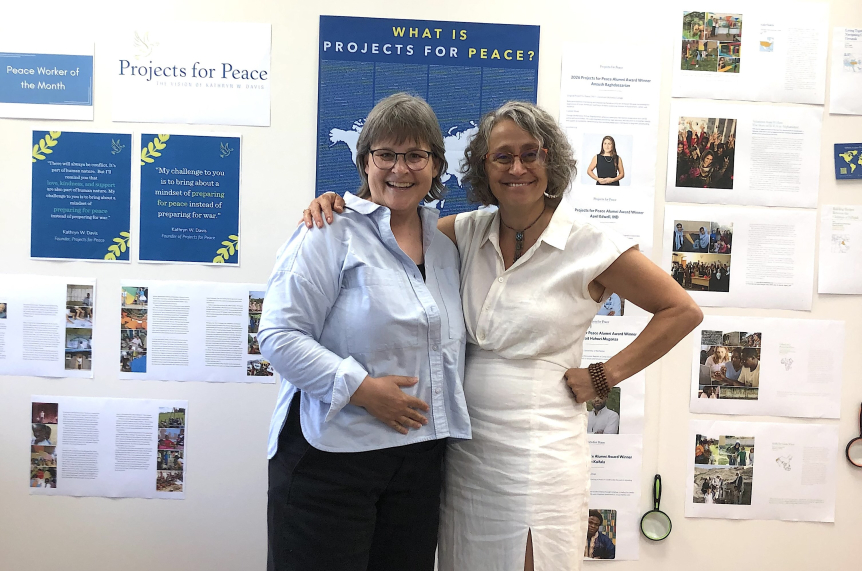
At 730 Broadway in Kingston, New York, inside a light-filled third space, sits the Peace Education Center of the Hudson Valley—one of only two dedicated peace museums in the United States. Unlike traditional institutions that preserve history behind glass cases or memorialize past conflicts in quiet lament, this living community sanctuary was built with an active purpose: to transform peace from an abstract, passive ideal into a daily, collective discipline. Here, in a welcoming space designed for families, educators, and curious citizens of all ages, peace is approached not as the mere absence of conflict, but as a practice of justice, ecological care, and active relationship.
The museum’s expansive work is rooted in the belief that local community efforts and broader global networks naturally reinforce one another. That philosophy was on full display this past June when campus liaisons who work with Projects for Peace grantees gathered at nearby Vassar College for a Projects for Peace convening. Serving as the keynote speaker, the museum’s founder, The Rev. Dr. Leonisa Ardizzone, addressed an audience engaged in youth-led peacebuilding. She urged those in attendance to reject isolated approaches to social reform, emphasizing that lasting change relies on solidarity and shared effort. “There are many paths to get there, as long as we remember that we have to get there together,” Ardizzone noted during her address. “We can each do our part, but we need to imagine ourselves as interlocking circles of change so we can share ideas and find support.”
Following that June gathering, the museum hosted a modest, temporary exhibit dedicated to Projects for Peace. Displayed quietly along a gallery wall, the temporary installation featured annual reports, project maps, and brief case studies of student-led conflict transformation across the globe. Rather than acting as a central focal point, the exhibit served as a subtle accent to the museum’s broader work, offering visitors a quiet, real-world glimpse of young people putting peace education into practice. Addressing the formidable headwinds facing these young changemakers in a fragmented world, Ardizzone offered a message of steadfast encouragement that echoed through both her keynote and the gallery display: “Don’t let others convince you to do otherwise. You all have beautiful work to do, and I for one will leave here tonight with even more hope that our world will be transformed.”
At the heart of the institution is Ardizzone herself, known affectionately to many as “Dr. A.” Ardizzone brings a remarkably rich, multidisciplinary background to the center. Holding a doctorate in International Educational Development with a concentration in Peace Education from Columbia University—earned under Dr. Betty Reardon, a pioneer in the field—Ardizzone has spent more than thirty years teaching at every level, from Pre-K classrooms to university seminars. An ordained Unitarian Universalist eco-minister, Visiting Assistant Professor at Vassar College, author, jazz vocalist, and commissioner on the Ulster County Human Rights Commission, her life’s work operates at the intersection of critical pedagogy, environmental stewardship, and human rights.
Inside the museum’s permanent galleries, that grounded vision is translated into everyday learning. The exhibits are designed as an open invitation to reflect and question. In the introductory display examining the nature of peace, visitors are invited to unpack direct, structural, and cultural forms of violence in order to build an affirmative definition of peace. Nearby, an exhibit centered on the Universal Declaration of Human Rights encourages guests to consider both their individual rights and their civic responsibilities to others. Other spaces highlight historical peacemakers who stood against tyranny, while displays on human migration—featuring original artwork by Kunio Izuka—explore resilience and refuge. Rotating exhibitions continuously address modern, systemic challenges, ranging from climate action and environmental justice to military funding and gender-based violence.
Beyond the exhibition walls, the museum functions as an active educational hub through its Learning Lab. Here, theoretical ideas are transformed into civic infrastructure. The lab hosts after-school programs, weekend youth gatherings, public film screenings, and community dialogues. Recognizing the pivotal role educators play in shaping future generations, the center offers accredited professional development workshops for teachers, providing them with practical tools to bring peace pedagogy and conflict resolution directly into public school classrooms.
Underpinning all of these programs are three core values: Holistic Earth Care, Relational Existence, and Global Consciousness. The center treats ecological health and social justice as inseparable, drawing from Indigenous knowledge systems to cultivate climate action rooted in reciprocity rather than extraction. By framing peace as a relational reality, the museum teaches that justice begins in deep connection—with ourselves, our neighbors, and the natural world.
In a cultural moment often marked by division and cynicism, the Peace Education Center of the Hudson Valley provides a quiet, tangible alternative. By placing historical struggles, temporary glimpses of global youth initiatives, and everyday community programs under one roof, the museum demonstrates that peacemaking is neither an impossible dream nor a relic of history. It is an ongoing craft—learned through study, sustained through community, and practiced every single day. As Dr. Ardizzone often reminds all who pass through the center’s doors, “For me, Peace is not a lofty ideal. It is a verb, it is a practice, it is a habit of mind.”