

PSYC/NSCI/RELI Mindfulness Lecture: Dr. Catherine Kerr
–
McCardell Bicentennial Hall 216276 Bicentennial Way
Middlebury, VT 05753 View in Campus Map
Open to the Public
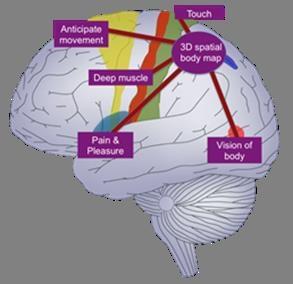
Body feelings: Investigating neural mechanisms underlying embodiment and contemplative practice
Lecturer: Catherine Kerr, PhD, Assistant Professor, Department of Family Medicine, Director of Translational Neuroscience Contemplative Studies Initiative, Brown University
This presentation describes recent investigations into two body perception networks in the brain. First, work by our lab and others shows how the mind rapidly shapes perception of body sensations by influencing oscillatory mechanisms (e.g., thalamocortical alpha) that modulate neurons responsible for perceiving simple touch and body feelings. In parallel with these basic science discoveries, our work also suggests mindfulness practice enhances the mind’s ability to modulate oscillatory mechanisms that control the “volume” of neuronal signals that encode touch and body sensation. The second half of the lecture describes a higher-order body perception network in the brain that integrates touch, sensations from joints and muscles, as well as visual inputs from looking at the body, resulting in a 3-dimensional spatial body representation. To examine this phenomenon, scientists have created bodily illusions such as the rubber hand illusion that probe body perception mechanisms. Dr. Kerr will discuss research using the rubber hand illusion suggesting that the perception of body sensations, and the experience of body ownership, are related to higher-order self-processing as well as basic physiological mechanisms related to temperature regulation. The talk concludes by considering a contemplative hypothesis related to somatic contemplative practices (such as Tai Chi, Qigong, Yoga and Tantric Tibetan practice) as engaging higher-order body perception networks and exerting possible effects on temperature regulation.
- Sponsored by:
- Neuroscience, Psychology, and Religion
Contact Organizer
Zz Perkins, Susan
perkins@middlebury.edu
(802) 443-3112