Mathematics MATH

Senior Mathematics Thesis Presentations II

Sponsored by:
Mathematics
Senior mathematics majors will speak about their theses: 3:00 pm: Kate Stewart: “Modeling Vermont’s Heroin Epidemic” 3:30 pm: Jillian Green: “A Technology Based Rumor Spreading Model for College Campuses” 4:00 pm; Jordan DuBeau: “Inaccessible Cardinals: How Big Can Infinity Be?”

(Private)

Open to the Public

Mathematics Senior Thesis Presentations I

Sponsored by:
Mathematics
Senior mathematics majors will speak on the topics of their theses. 3;00 pm: Calvin Kim “The Four Color Theorem” 3:30 pm: Eliot Van Valkenberg “Nonperiodic Tilings of the Plane” 4:00 pm: Tiffany Hau “The AKS Primality Test” There will be a second round of presentations on Thursday, May 12

(Private)

Open to the Public

Mathematics Seminar: Using Mathematical Modeling To Understand Diverse Behaviors

Sponsored by:
Mathematics
Lecture by Kathryn Montovan of Bennington College . Mathematical modeling, simulation, and analysis are valuable tools for answering biological questions about evolution, self-organization, and complex ecosystem interactions. For each biological question the appropriate mathematical tools must be carefully employed in order to produce meaningful results. This talk will present several recent projects to illustrate the process of taking a biological problem and making it into a mathematical one, the mathematics used to answer the question, and the biological meaning of the results.

(Private)

Open to the Public

Mathematics Seminar: Connecting Forensics and Linear Algebra

Sponsored by:
Mathematics
Lecture by Donna Beers of Simmons College Just as you can alter pictures to make yourself look more attractive, so, too, politicians, advertisers, and others with particular agendas are using digital imaging tools to manipulate photos to create false impressions. Determining whether a photo has been doctored is just one of the many questions that photo forensics tries to answer. The good news is that linear algebra offers powerful tools for carrying out digital photo forensics.

(Private)

Open to the Public

Mathematics Seminar Talk - Pete Clark

Sponsored by:
Mathematics
A New Proof of the Generalized Wilson’s Theorem Wilson’s Theorem is a staple of elementary number theory: for a prime number p, (p-1)! is congruent to -1 modulo p. Suppose we would like to generalize Wilson’s theorem. Why? Well, the title says so: in fact it is, verbatim, the title of a 1903 paper by the American group theorist G.A. Miller. But more fundamentally: why not? Shouldn’t we be trying to generalize all the theorems we meet? I think so. In this talk we will contemplate several possible generalizations and then hit upon two that are discussed in Miller’s paper.

(Private)

Open to the Public

Mathematics Seminar Talk

Sponsored by:
Mathematics
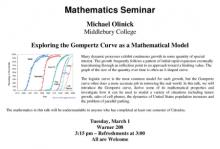
Exploring the Gompertz Curve as a Mathematical Model Michael Olinick Many dynamic processes exhibit continuous growth in some quantity of special interest. The growth frequently follows a pattern of initial rapid expansion eventually transitioning through an inflection point to an approach toward a limiting value. The graph of the size of the quantity over time is often an S-shaped curve. The logistic curve is the most common model for such growth, but the Gompertz curve often does a more accurate job in mirroring the real world.

(Private)

Open to the Public

Mathematics Seminar Talk

Sponsored by:
Mathematics
Navajo Math Circles is a one-hour film that documents the meeting of two worlds: that of some of the country’s most accomplished mathematicians and mathematics educators, with the children and teachers in the underserved, largely rural Navajo educational system. Hundreds of Navajo children in recent years have found themselves at the center of a lively collaboration with mathematicians from around the world.

(Private)

Free

Mathematics Seminar Talk

Sponsored by:
Mathematics
Pierre de Fermat and the Method of Infinite Descent Peter Schumer, Middlebury College Pierre de Fermat (1601 – 1665) is known as the “prince of amateurs” for his many important independent contributions to mathematics including his creation of analytic geometry, the beginnings of probability theory, and many key concepts and techniques that led to the development of calculus. We will discuss some of his imaginative number-theoretic observations and suggest how he may have discovered them. In particular, we will focus mainly on his method of infinite descent.

(Private)

Free
Open to the Public

“A (not so) Random Sample of Lessons & Mathematical & Statistical Applications” in honor of John Emerson

Sponsored by:
Mathematics
The Department of Mathematics presents a special lecture by Katherine Bell Krystinik, ’77 of the United States Coast Guard Academy. Professor Bell will discuss a selection of lessons imparted by Professor Emerson and how those lessons are represented in applied Coast Guard projects. Kathy was the first of Professor Emerson’s senior thesis advisees to continue on for a Ph. D. in statistics. She worked at Bell Labs and the U. S. Geological Survey before joining the faculty of the Coast Guard Academy.

Mahaney Arts Center 221

Free
Open to the Public

MATH Thesis Presentations

Sponsored by:
Mathematics
Mathematics Seminar: SENIOR THESIS PRESENTATIONS I

3:00 PM – Jeremy Stratton-Smith

Homogeneous Spaces & Their Symmetries: There’s More to That Doughnut (Hole) Than You Think

 3:30   PM – Jingyi Wu

The Geometry of Spacetime: feat. Galilean Spacetime and Minkowski Spacetime using Affine Space

 4:00 PM – James Burke

Baseball as a Markov Chain: A Bayesian Approach

 All Are Welcome!

(Private)

Open to the Public