Mathematics MATH

“A (not so) Random Sample of Lessons & Mathematical & Statistical Applications” in honor of John Emerson

Sponsored by:
Mathematics
The Department of Mathematics presents a special lecture by Katherine Bell Krystinik, ’77 of the United States Coast Guard Academy. Professor Bell will discuss a selection of lessons imparted by Professor Emerson and how those lessons are represented in applied Coast Guard projects. Kathy was the first of Professor Emerson’s senior thesis advisees to continue on for a Ph. D. in statistics. She worked at Bell Labs and the U. S. Geological Survey before joining the faculty of the Coast Guard Academy.

Mahaney Arts Center 221

Free
Open to the Public

MATH Thesis Presentations

Sponsored by:
Mathematics
Mathematics Seminar: SENIOR THESIS PRESENTATIONS I

3:00 PM – Jeremy Stratton-Smith

Homogeneous Spaces & Their Symmetries: There’s More to That Doughnut (Hole) Than You Think

 3:30   PM – Jingyi Wu

The Geometry of Spacetime: feat. Galilean Spacetime and Minkowski Spacetime using Affine Space

 4:00 PM – James Burke

Baseball as a Markov Chain: A Bayesian Approach

 All Are Welcome!

(Private)

Open to the Public

MATH Thesis Presentations

Sponsored by:
Mathematics
Mathematics Seminar; SENIOR THESIS PRESENTATIONS I

4:30 PM – Caroline Trowbridge

Partial Differential Equations of Pollutant Transport: The Weak Formulation

5:00   PM – Luis Echeverria

The Brouwer Fixed Point Theorem in Proving Equilibrium for Game Theory

 5:30 PM – Will Clewley

Properties and Applications of Continued Fractions

All Are Welcome!

(Private)

MATH Thesis Presentations

Sponsored by:
Mathematics
Mathematics Seminar: SENIOR THESIS PRESENTATIONS I

3:00 PM - Andrew Bridgers

Ed isn’t so bad after all

3:30   PM - Noel Antonisse

Construction and Solvability: The Power and Beauty of Fields

 4:00 PM - Nimrod Saleh

Benford’s Leading Digit Law: from Statistical Curiosity to Proof

 4:30 PM - Kyra Gray

An Exploration of the Poisson Approximation

 All Are Welcome!

(Private)

Open to the Public

Math Chats: The Statistical Modeling Of Interspecies Competition On The Growth Of Trees

Sponsored by:
Mathematics
Professors Albert Y. Kim will discuss research with Professor David Allen on a statistical model of a tree’s growth as a function of current size and the competition it feels.
Prof. Allen conducted censuses in a Michigan reserve, recording the location, species, and size of all trees in both 2008 and 2014. They seek a statistical model that incorporates notions of the numbers, the sizes, the spatial density, and the species of the competitor trees

(Private)

Open to the Public

Math Chats: The Geometry of Numbers

Sponsored by:
Mathematics
The Mathematics Departments presents Duncan Levear, ‘15 (Brandeis University) who will discuss “The Geometry of Numbers”.

(Private)

Free
Open to the Public

MATH CHATS: The Fundamental Theorem of Algebra: A Visual Approach

Sponsored by:
Mathematics
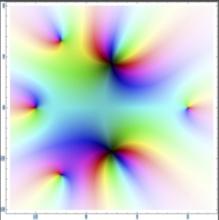
Daniel Velleman (Amherst College) is our speaker. The Fundamental Theorem of Algebra says that for every nonconstant polynomial p there is a complex number z such that p(z) = 0.  In this talk he will present a method of visualizing functions on the complex plane, and use this method to illustrate why the Fundamental Theorem of Algebra is true.  He will also discuss the history of the Fundamental Theorem of Algebra and its proofs.

(Private)

Open to the Public

Math Chats: My Favorite 5 Minute Proof

Sponsored by:
Mathematics
The Department of Mathematics invites everyone to meet our faculty members and hear favorite short self-contained gems of elegant argument. Some highlights include: Why does the harmonic series converge? Why isn’t the square root of two a rational number? How did President Garfield prove the Pythagorean Theorem? Everyone is welcome. Pizza lunch will be available at 12:15.

(Private)

Free
Open to the Public

MATH CHATS: Math and Music: The Greatest Hits

Sponsored by:
Mathematics
Professor Gareth Roberts (College of the Holy Cross) discusses how the connections between mathematics and music are numerous, deep, and fun to investigate. Early educational traditions (e.g., Plato and Boethius) grouped music with arithmetic and geometry. A “music first” approach will reveal hidden connections, encouraging a greater appreciation and desire for mathematical thinking. For example, many composers use transpositions, retrogrades, and inversions in their compositions to develop a short theme or motif into a longer, more intricate section of music.

(Private)

Open to the Public