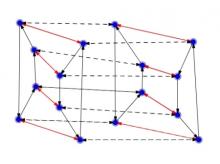
Graham will discuss “Branching and Bounding Through the Knapsack Problem.” The classic Knapsack Problem asks how to choose among a set of items, each with a given weight and value, so that the total weight is less than or equal to a given capacity and the total value is as large as possible. This talk will contain an overview of some algorithms available that can help us intelligently enumerate a solution space for variations of the Knapsack Problem.
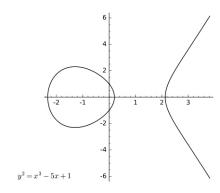
Caitlin will speak about “Rational Points on Elliptic Curves.” Elliptic curves are projective algebraic curves whose rational points have the unique property of forming an additive abelian group. We will build a basic understanding of elliptic curves including background on projective geometry and algebraic curves. We investigate the structure and function of the group law that allows us to move among the rational points on an elliptic curve.
Brenda will discuss “Extreme Value Theory: Tears, Earthquakes and Puppet Shows.” Extreme Value Theory (EVT) is a branch of probability and statistics concerned with the probability of rare events. From biology and engineering, to information technology and finance, EVT is used in a variety of real-world applications. She will examine the Fisher-Tippet-Gnedenko Theorem, exploring examples of the theorem in use and overview the Block Maxima method, a statistical approach used to apply EVT to sets of observed data. She will use EVT and earthquake data collected between 1
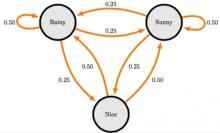
“Markov Chain Monte Carol Methods”: MCMC methods offer a solution to simulating from intractable probability distributions. By constructing a positive recurrent Markov chain that converges to the desired probability distribution, this method allows us to sample from the distribution. We examine why MCMC works, and how long it takes to converge. We start by exploring the Strong Law of Large Numbers for Markov chains, which explains how a constructed Markov chain can allow resampling from the desired probability distribution.
“The Sleeping Beauty Controversy: The Puzzle that Sparked 100 Philosophy Papers”
Proposed 16 years ago by philosopher Adam Elga, “Sleeping Beauty” seems to be a simple problem in discrete probability. Is it? If so, Why does it incite such passion? Dartmouth Mathematics Professor Winkler will describe the various “camps” in the controversy, and attack or defend their arguments. In the end, you’ll have to decide for yourself where you stand!