Office of College Advancement COLLEGE ADVANCEMENT

Faculty at Home Lecture Series: Antonia Losano

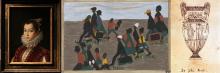
Ekphrastic poetry—poetry that describes a work of art, real or imagined—has been around since Homer described the complex decorations on the shield of Achilles in the Iliad, and countless poets since then have tried to translate visual artworks into words. How are we to understand this cross-media genre? Professor Antonia Losano will talk about a few notable examples of ekphrastic poets, including Keats, Browning, Auden, Sexton, Komunyakaa, and Trethewey. You’ll also look at the artworks they describe and explore the complex relationship of word and image.

Virtual Middlebury
Open to the Public

Faculty at Home Lecture Series: Emily Proctor - Algebra and Geometry: A Beautiful Relationship

Many of us first encountered algebra and geometry as two separate and very different areas of mathematics, but the two fields are intricately interconnected. Starting from the basics of Euclidean geometry and elementary algebra, award-winning teacher Emily Proctor highlights the relationship between these fields and shows how algebra is one of our strongest tools for understanding geometric objects and the world around us.

Virtual Middlebury

Open to the Public

Bostwick Family Squash Center Dedication

Sponsored by:
Office of Advancement
Join us for a reception and acknowledgements as Middlebury formally dedicates the “Bostwick Family Squash Center.”

Admission is free, however this event does require an advance RSVP by Friday, October 26, 2018. Please contact us at middevents@middlebury.edu if you would like to register to attend.

Bostwick Family Squash Center Courts

Open to the Public

Sleuthing from Home: How To Use Technology to Monitor Nuclear Weapons Programs Around the World Without Leaving Monterey

The James Martin Center for Nonproliferation Studies at the Institute uses technologies such as computer models and commercial satellite photographs to study nuclear weapons programs around the world. The results look like the work of an intelligence agency, but they are done entirely by faculty, staff and students using open information.

Virtual Middlebury

Free
Open to the Public

When Galaxies Collide

The galaxies we see in the universe today formed through a hierarchical process of smaller galaxies merging together, often multiple times, over billions of years. During these mergers, the supermassive black holes residing in the galaxies’ centers also merge. In 2015, the LIGO experiment detected, for the first time, gravitational waves from the mergers of small black holes – but what about the supermassive ones in the centers of merging galaxies? How will we detect those? And where should we look to find these events?

Virtual Middlebury

Free
Open to the Public

The US Gender Gap: Past, Present, and Future

You may have seen gender gap described in the media this way: “Women are only paid 82 cents for every dollar paid to men.” We will talk about where that measure comes from and how it relates to gender discrimination. Professor Byker will discuss how the gender gap has evolved since the 1980s and where it may be going particularly in light of the Covid pandemic.

Virtual Middlebury

Free
Open to the Public

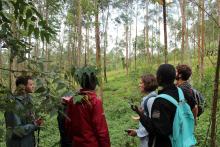
The Forest, The Trees, and How We See Them: Perspectives on a tree planting boom in Uganda

“Help the planet – plant a tree” campaigns are a common environmental initiative. Particularly in the tropics, tree-planting promises to tackle dual challenges of deforestation and climate change. The validity and equity of these types of initiatives depends on who plants the trees, what they replace, and how they impact the communities around them, but local views are often missing from slogans and headlines.

Virtual Middlebury

Free
Open to the Public

A Woman In Charge: Magic, Politics, and Discrimination in the Classic Maya Lowlands

The kingdoms and other principalities that dotted the Yucatan in the seventh century were, in terms of everyday governance, patriarchal. Consequently, female rulers existed but were rare. This talk explores the life of one such rare individual: Wak Chanil, a woman who once ruled what is today the archaeological site of Naranjo, Guatemala. Like many powerful women in antiquity, Wak Chanil was a politically ambiguous figure: she was a ruler, but not formally invested as a king or a queen. Unlike most people in her position, however, she was also a usurper and an unapologetic sorcerer.

Virtual Middlebury

Free
Open to the Public