Physics PHYS

Stargazing at Mittelman Observatory

Sponsored by:
Physics
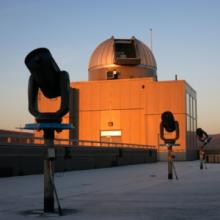
Mittelman Observatory and Middlebury Physics will again host stargazing open house nights this spring. These Observatory events are scheduled for Friday evenings, April 27 and May 4, from 9:00 PM until 10:30 PM, weather permitting.

A variety of interesting stars, star clusters, and nebulae will also be visible through the Observatory’s telescopes. The Observatory includes a 24-inch telescope in a dome and smaller telescopes on the roof.

Mittelman Observatory (McCardell Bicentennial Hall)
FREE
Open to the Public

Stargazing at Mittelman Observatory

Sponsored by:
Physics
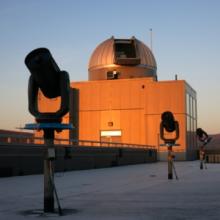
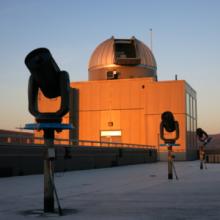
Mittelman Observatory and Middlebury Physics will again host stargazing open house nights this spring. These Observatory events are scheduled for Friday evenings, April 27 and May 4, from 9:00 PM until 10:30 PM, weather permitting.

A variety of interesting stars, star clusters, and nebulae will also be visible through the Observatory’s telescopes. The Observatory includes a 24-inch telescope in a dome and smaller telescopes on the roof.

Mittelman Observatory (McCardell Bicentennial Hall)
FREE
Open to the Public

Dr. Jon Habif Guest Lecture: Quantum limits to sensing our world: Hearing Mother Nature's quietest whispers

Sponsored by:
Physics
Measurement of the faintest signals has become a vital part of disciplines as diverse as medicine, astronomy, interplanetary communications and intelligence gathering.  While our curiosity has driven us to probe ever-weaker signals in Nature, the framework and philosophy for our measurement tools has remained largely unchanged for centuries, entrenched in a classical interpretation of our world – which we know to be incomplete. In this talk I will present a holistic approach to sensing which combines quantum mechanics, information theory and measurement.

McCardell Bicentennial Hall 216

Closed to the Public

Mittelman Astronomy Lecture Series: What the Outer Edges of Our Solar System Tell Us About Its Beginnings

Sponsored by:
Physics
The far extent of our solar system — the Kuiper Belt and beyond — is a largely unaltered relic, frozen shortly after the formation of the planets. Exploring the small bodies that inhabit this region leads to a better understanding of the composition of our proto-planetary nebula, motions within the solar system before the planets acquired their current locations, and allows us to compare our solar system to those found around other stars.

Virtual Middlebury

Free
Open to the Public

Mittelman Astronomy Lecture Series: The Cassini Mission to Saturn: An Insider's View of an Intl. Journey of Discovery

Sponsored by:
Physics
NASA’s Cassini spacecraft orbited Saturn for thirteen years, transforming our understanding of this beautiful ringed planet and its entourage of moons. From giant atmospheric storms on Saturn and methane seas on Titan, to icy plumes on Enceladus and density waves in Saturn’s rings created by the planet itself, the mission was filled with surprises and delights.

Virtual Middlebury

Free
Open to the Public

Stargazing at Mittelman Observatory

Sponsored by:
Physics
Mittelman Observatory and Middlebury Physics will again host stargazing open house nights this autumn. These Observatory events are scheduled for Friday evenings, September 13 and September 20, from 8:30 PM until 10:00 PM, weather permitting.

Jupiter and Saturn will be in the evening sky on these dates. A variety of interesting stars, star clusters, and nebulae will also be visible through the Observatory’s telescopes. The Observatory includes a 24-inch telescope in a dome and smaller telescopes on the roof.

Mittelman Observatory (McCardell Bicentennial Hall)

Free
Open to the Public