Environmental Affairs ENVIRONMENTAL AFFAIRS

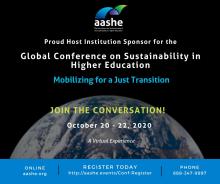
Mobilizing for a Just Transition - Global Conf. on Sustainability in Higher Ed: Keynote by Ibram X. Kendi

Middlebury is a Host Institution for the virtual three-day conference offered by AASHE (Association for Advancement of Sustainability in Higher Ed), October 20-22.

How to Be an Antiracist

In this keynote address, Ibram X. Kendi will give a new frame for understanding racism and provide guidance on how to be an antiracist.

Virtual Middlebury
Clifford Symposium: Extreme Weather on the Rise, Arctic Ice on the Decline: How Are They Connected?

Does it seem as though the weather gods have gone crazy lately? It is not your imagination. The question on everyone’s minds is, why? And is it related to climate change? In this presentation, Francis will explain new research that links increasing extreme weather events with the rapidly warming and melting Arctic during recent decades. Evidence suggests that Arctic warming is causing weather patterns to become more persistent, which can lead to extremes such as droughts, cold spells, heat waves, unusually snowy winters, and some flooding events.

Franklin Environmental Center, The Orchard-Hillcrest 103

Open to the Public

Clifford Symposium: Liberal Arts and the Global Ocean

A panel discussion with faculty and students from the BIOL 371 Advanced Field Biology: Place-based Global Biology Education W’19. Students in this course conducted field-based scientific observation, sample and data collection, and interpretation of biological phenomena in coral reef environments on Abaco Island, Bahamas. The course deeply engaged in off-campus, place-based learning practicing population genetics, ecology, genomics, biogeochemistry, and site mapping via Rapid Ecological Assessment (REA) protocols.

Franklin Environmental Center, The Orchard-Hillcrest 103

Open to the Public

Clifford Symposium Keynote: Reflections of an Ocean Plastics Scientist

Plastic debris was first documented in the ocean more than 45 years ago, when global plastics production was only about 10 percent of its current levels. Today we use these materials in virtually all aspects of our daily lives, yet we are appalled when faced with images of our plastic waste in the ocean and in the stomachs of marine wildlife. This presentation will focus on the most current scientific evidence of environmental impacts of ocean plastics, as well as the role of science and environmental scientists in advancing solutions.

Wilson Hall, McCullough Student Center

Open to the Public