

Duncan Vujic Profeta ’27 Reflects on Public Service and the Many Paths to Capitol Hill
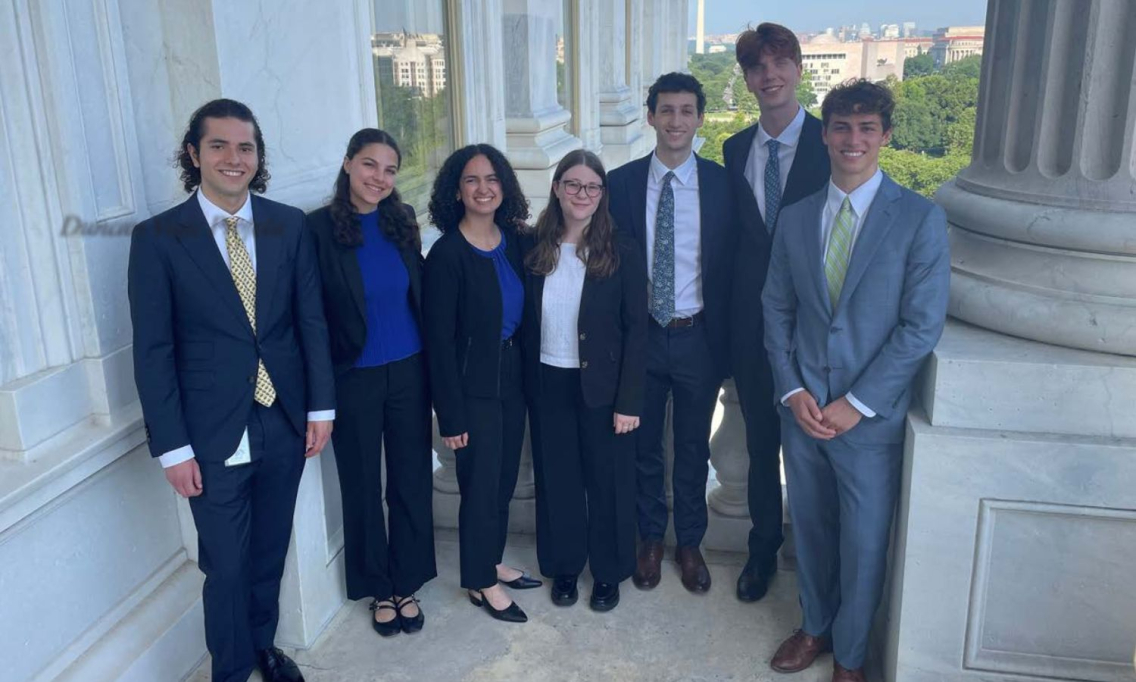
When Duncan Vujic Profeta ’27 arrived in Washington, D.C. for the summer of 2025, he wasn’t just thinking about policy. He was thinking about purpose.
Profeta, an environmental policy major with minors in biology and French, spent the summer interning with the U.S. Senate Committee on Environment and Public Works under the leadership of Senator Sheldon Whitehouse of Rhode Island. Selected as a participant in the Stennis Program for Congressional Interns, Profeta joined a competitive, bipartisan cohort of students from across the country committed to public service and civic leadership.
That experience, and the questions it raised about careers in government, became the focus of Profeta’s reflection, recently published in the Fall 2025 edition of the Public Service Review, a national quarterly magazine produced by the Stennis Center for Public Service.
Rethinking the “Default Path” to Public Service
In his essay, Profeta takes on a question many aspiring public servants wrestle with early in their careers: Do you need a law degree to work on Capitol Hill?
Drawing from conversations with lawyers working in Congress, Profeta offers a candid and nuanced answer, “It depends.” While acknowledging the prestige and influence of legal training, he urges students not to treat law school as an automatic next step.
Instead, Profeta emphasizes the value of time, reflection, and real-world experience, particularly in government settings, before committing to a demanding and expensive path.
Take some time; try out legal work and other fields of work. Once you take that time and can articulate why you want to attend law school, then go to law school. It will mean that much more, because you have approached it with the thought and consideration the commitment deserves.

Throughout the reflection, Profeta highlights the importance of soft skills; communication, negotiation, compromise, and notes that many entry-level congressional roles do not require a law degree at all. For students interested in public service, he argues, clarity of purpose matters more than credentials alone.
From Middlebury to the U.S. Senate
Originally from Durham, North Carolina, Profeta is engaged in campus life here at Middlebury. He serves as director of the Environmental Sustainability Committee in Middlebury College Student Government and is involved in the Debate Club, the Research in Investment and Sustainable Equity Club, and Club Soccer.
His academic and extracurricular interests converge around climate action and energy transition, priorities that aligned closely with his work on the Senate Committee on Environment and Public Works.
“Duncan’s reflection captures exactly what experiential learning in public service can offer,” said representatives from the Stennis Center. “It’s not just about understanding how Congress works, but about helping students ask better questions about their futures.”
About the Stennis Program for Congressional Interns and the Public Service Review
The Stennis Program for Congressional Interns is a nationally recognized, competitive program that selects about 35 students each cycle from offices across the U.S. House and Senate. The program is bipartisan and bicameral and is designed to complement a student’s full-time internship in a Member or Committee office on Capitol Hill, giving them a deeper understanding of Congress as an institution and its role in American democracy.
In addition to their day-to-day work on Capitol Hill, participants take part in structured discussion sessions with current and former senior congressional staff, gain insight into how Congress works, and build connections with interns from across the country. At the end of the program, interns receive a certificate of recognition.
A key component of the program is the opportunity to write an article for the Public Service Review (PSR), reflecting on their public service experience and the lessons they learned during their internship. This gives students professional exposure, a published writing sample, and a chance to share their insights with a national audience.
The Stennis Center for Public Service, a federal legislative branch agency, runs the program and also produces the PSR, a quarterly magazine featuring student essays and reflections on public service experiences. While Stennis Program interns contribute articles as part of their experience, any student can also submit to the PSR, making it an open opportunity for all students who want to share their public service stories. Past editions are available for free on their website: https://stennis.gov/public-service-review/.
Looking Ahead
Profeta aspires to use public policy as a tool to address climate change and advance the transition to cleaner forms of energy production. Whether that path eventually includes law school or another route, his message to fellow students is clear: meaningful public service careers are rarely linear, and that’s not a flaw, but a strength.
“Growing up is not just about figuring out what you want to do,” Profeta writes. “It is probably more about figuring out what you do not.”