

Cultural Fabrics
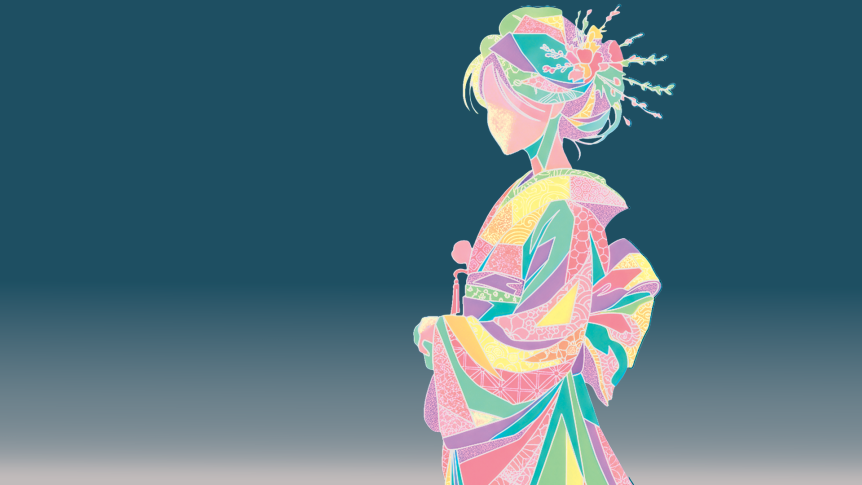
The Kimono Through Literary, Cross-Cultural, and Practical Lenses
February 9–March 19, 2026
Johnson Gallery, Johnson Memorial Building
Monday–Friday, 1:00–7:00 p.m.
Free and open to the public.
This multidisciplinary exhibit explores the kimono in dialogue with Japanese literature, Western aesthetics, fashion, and fiber crafts.
“Recognizable by its T-shaped outline, fluttering sleeves and flowing vertical panels draped from the wearer’s shoulders, the kimono embodies Japan, real and romanticized, familiar and foreign. In the popular imagination, the kimono often represents an unchanging, tradition-oriented, eternal Japan.”
Terry Satsuki Milhaupt, Kimono: A Modern History.
Workshops & Demos
Wednesday, February 25
Johnson Building - Gallery
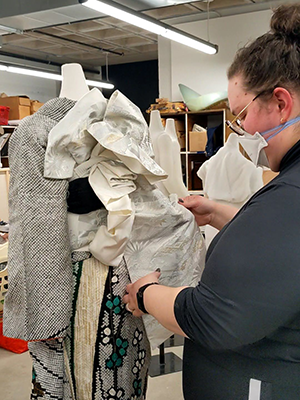
Kimono Dressing Demonstration
Shannon Palmer will demonstrate how a kimono and its components are layered, tied, and worn for different occasions. Palmer has studied the intricacies of wearing kimono for many years and worked in a formal kimono rental shop during her time in Japan. Dressing model: Josie Coan ’29.
Thursday, February 19
Makerspace, Johnson Building
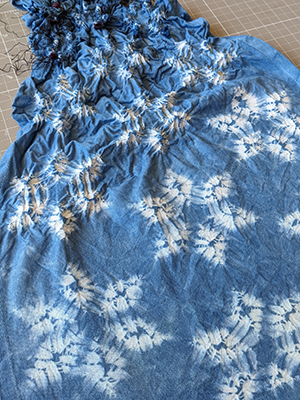
Shibori & Indigo Dye Demonstration
HaQuyen Pham gives an overview of shibori techniques and leads a demonstration in dyeing with an organic indigo vat. All are welcome to attend; a limited number of participants will also be able to create their own honeycomb shibori piece.
Did you visit the exhibit or attend a demonstration? Share your thoughts in this short feedback form.
A Short History of the Kimono
Known as Japan’s last era of isolation, the Edo Period spanned from 1615 to 1858 and is named for the country’s busiest city, now known as Tokyo. During this historical period, the Tokugawa family established strict rule over Japan as military governors (shōgun) and the country experienced its longest period of peace, enabling its citizens to focus more on art and fashion.
One of Japan’s most famous items of clothing was popularized and developed during this era: the kosode, known as the kimono today. The kosode evolved from a garment that was created during the Heian Period (794-1185), a large piece of fabric sewn to drape across the body and worn as an undergarment by members of the aristocracy. In the Edo Period, it transformed into a unisex garment with small arm holes and elaborate prints worn by all social classes. The design changed very little during the isolationism of this period.
The garment is made from twelve to fifteen yards of fourteen-inch-wide fabric and is cut as minimally as possible, which allows it to be deconstructed and redyed or repurposed into another garment. During the Edo period, the kosode was made with hemp, lighter linen, and ramie, with higher class individuals using fine silk, damask, and crepe. The kosode had a collar (eri), sleeves with small arm openings (sode), and a hem guard (fuki). It also had a thin sash across the waist that eventually evolved into the obi, or belt, around kimono today.
The Tokugawa shōgunate passed sumptuary laws dictating what people of each class could and could not wear. The government separated all citizens into classes: samurai, farmer, artisan, and merchant, with designated fabrics, colors, and designs for each. Clothing not only distinguished people by wealth, but also by age and gender.
Through strict social order, isolationist policies, and refined craftsmanship, the Edo Period transformed the kosode into a richly symbolic garment and laid the foundation for the kimono’s continued evolution in the eras that followed.
Josie Coan ’29
The Kimono in Literature
Heian Period Culture and The Tale of Genji
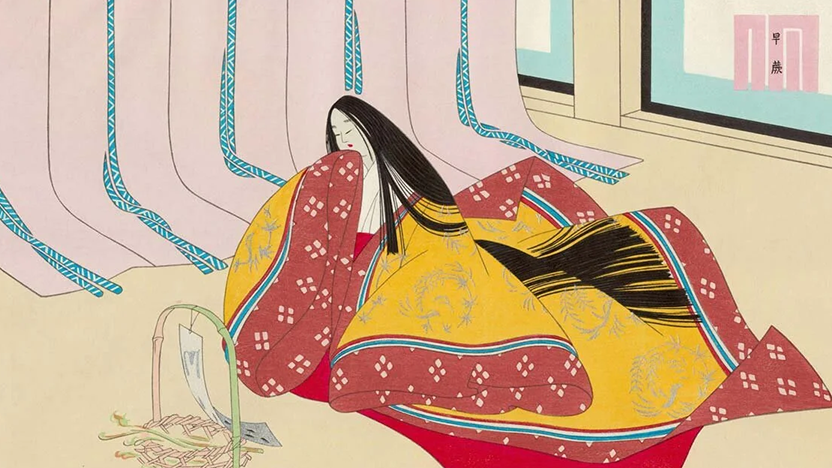
“Genji chose for Murasaki a superb formal spring robe in an up-to-date color scheme—purple with vividly woven patterns in crimson on the outside, crimson with designs in purple for the lining. For his daughter, the Akashi Princess, he selected a long robe in the cherry-blossom style—white lined with a deep reddish-purple—to which he added an under robe of soft, glossy silk. For Hanachirusato, he selected a summer robe in light blue woven with figures from the seashore—waves, shells, sea plants—clean and lovely without being too showy. To this, he added a dark red under robe of gauzy silk. Finally, for his Tamakazura, living now in the west hall of the northeast residence, he provided a cloak of pure red to which he added a long robe of fallen-leaf tan lined with yellow.” (D. Washburn, trans., Murasaki Shikibu, The Tale of Genji, 2015).
The Heian period (794-1185) is often referred to as the golden age of Japanese classical culture. During that time, art and culture reached an unprecedented pinnacle; literature by women, written in Japanese, eclipsed for the first time the writings in Chinese that characterized previous historical periods. The most representative is The Tale of Genji (1008) by Murasaki Shikibu, arguably the world’s first novel. In the world of the tale, as in the world of the Heian imperial court, garments played an essential role: they defined rank and status (sartorial roles strictly determined what color someone could wear), they indicated one’s education and refinement, and they constituted a fundamental currency in social relationships (sovereigns would gift courtiers robes at the time of promotions, messengers would be rewarded with robes when bearing important news, Buddhist priests would receive robes when performing various ceremonies, and one of the most important roles a wife would have was to prepare and present robes to her husband). The quotation accompanying this section reverses the custom and features Genji gifting new robes to the important women in his household.
The later popularity of the tale as a classical masterpiece also led to a significant impact in fashion: kimono and obi often feature scenes and visual motifs from The Tale of Genji, granting the wearer beauty and refinement by association.
Taishō Chic and the Moga (Modern Girl)
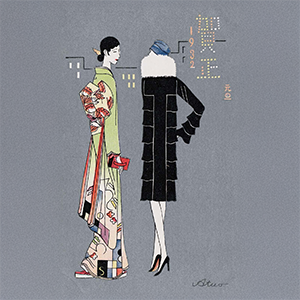
“Most of the designs were so outrageous that she could wear only about half of them outside the house. Her favorite, which she often wore when we went out, was a lined, cotton-padded satin kimono with a matching jacket. Both the jacket and the kimono were a solid, reddish brown, as were the things on her sandals and the cord on her jacket. Everything else—the neckpiece, the sash fastener, the lining of the underkimono, the sleeve ends, and the trim at the bottom—was pale blue. The narrow sash, too, was made of thinly padded satin; she wound it tightly, high on her chest. She wore this outfit most often when we went to the theater in the evening. Everyone turned to look as she walked through the lobby of the Yūrakuza or the Imperial Theater in that glistening fabric.” (A. H. Chambers, trans., Tanizaki Jun’inchirō, Naomi, 2001, 38-39)
The Taishō period (1912-1926) is Japan’s equivalent of the Roaring Twenties. After a long period of isolation (sakoku), Japan opened its doors to the West and enthusiastically embraced modernity. Young Japanese women refashioned themselves as moga (“modern girls”), cut their hair into stylish bobs, and started wearing Western clothing, going out dancing, and flirting. But the kimono was never abandoned: it, too, absorbed Western influences and flourished into a riot of colors and patterns. Chijin no ai (A Fool’s Love, translated into English as Naomi, 1924) by Tanizaki Jun’ichirō, tells the story of a hapless young man madly in love with such a modern girl, the eponymous Naomi. He takes her out dancing and partying, has her study English and, most importantly, indulges her love of fashion, as the accompanying quotation illustrates.
The Kimono in Everyday Life
The 1940s and 50s marked a pivotal moment in the history of the kimono. As the Japanese began to regard Western-style garments as more suitable for an active lifestyle, the kimono of the early 1940s came to symbolise an ostentatious and luxurious way of life that was frowned upon during the times of deprivation and war. During the Allied Occupation of Japan, when the production and availability of cloth was severely limited, the Japanese learned to unstitch their kimono and remake them into “Western style” clothing that closely mimicked western styles while still retaining their Japanese flavor.
The kimono saw a shift in its function from its original use as an everyday garment to its new status as an object of veneration—not only revered as a national costume but also elevated as a “traditional” Japanese artform. Thus the kimono enjoys an elevated status, not simply as a garment, or even a national costume, but also as an object of Japanese artistry and craftsmanship worthy of museum display.
The Kimono in the West
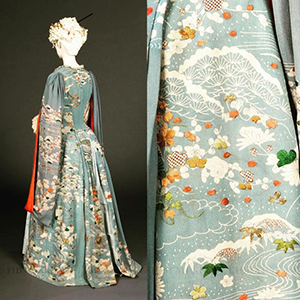
Japan’s isolation had a large impact on Western dress at the turn of the 20th century, making anything Japanese in high demand because of its rarity and perceived exoticism. In 1853, the U.S. forcibly opened Japan to trade. It then engaged with the Netherlands and thus spread its influence sparingly to Western Europe.
The first piece of clothing to pervade European fashion was the men’s dressing gown. Inspired by the kimono, a dressing gown from the late 1800s would incorporate the loose-fitting T silhouette and kimono fabrics like silk or damask, often paired with brocade embroidery.
Japonism, the West’s obsession with Japanese motifs, fabrics, and fashion, was an important influence on impressionist art. The kimono increasingly transformed in new markets in the West as loungewear. Women started wearing garments made from broken-down kimono, often using the fabric to decorate the front of their tea gowns. The kimono became a collectible item and modified versions of the T-shaped kimono were produced exclusively for export by American, British, Chinese, and Japanese companies, which altered the meaning and shape of the garment.
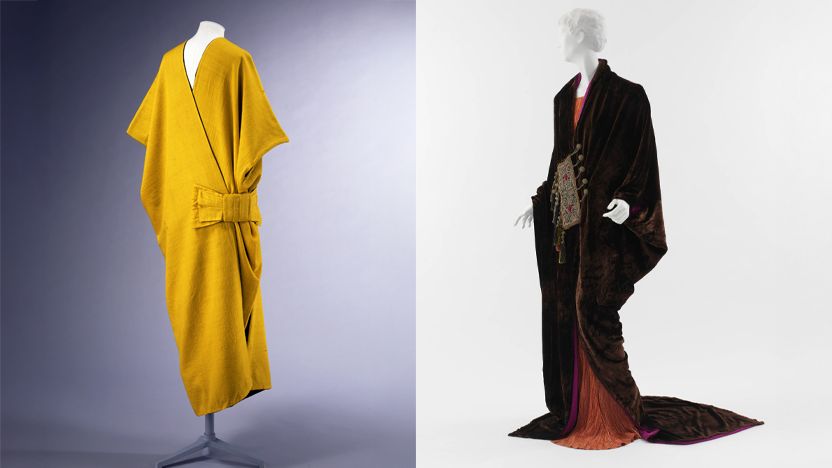
Modern fashion has the kimono to thank for freeing women of the corset. In 1906, the pioneering French fashion designer Paul Poiret, nicknamed “the King of Fashion,” incorporated his interest in Eastern clothing by designing new dresses with loose waists. His abandonment of the traditional tightly-cinched waistline of the Edwardian Period (1901–1914) and embrace of the Japanese silhouette moved Western fashion towards the androgynous “flapper” styles of the 1920s.
Josie Coan ’29
Crafting Kimono: しぼり (Shibori) Dyeing
The term shibori (しぼり) encompasses an array of techniques to manipulate and bind textiles before dyeing. From the root verb shiboru (しぼる), “to wring, to squeeze, to constrict,” shibori includes twisting, pleating, wrapping, stitching, knotting, and clamping cloth to create intricate patterns where the cloth “resists” being penetrated by the dye.
The oldest examples of resist-dyed cloth in Japan date back to the 8th century. Throughout Japanese history, shibori-patterned textiles have been used in garments worn by all classes of society as well as in religious ceremonies, imperial banners, and storefronts. Arimatsu in Nagoya is the historical center of shibori craftsmanship, where some families have specialized in particular techniques for as many as 400 years.
In the most elaborate and labor-intensive kimono, shibori fabrics are further embellished with sumi-e paintings and embroidery. Such kimono can take months or even years to create, with highly-skilled artisans working on each stage of the process, from design, to binding, to dyeing, to painting, to stitching, to assembly.

Meet the Team
| Sponsors | Organizers | Collaborators |
| Axinn Center for the Humanities | Summer Jack (Theatre) | Colin Boyd |
| Center for Community Engagement | Otilia Milutin (Japanese) | Douglas Brooks |
| Committee on the Arts | Shannon Palmer (Admissions) | Mihai Lazar |
| Department of Japanese Studies | HaQuyen Pham (Advancement) |
Student Collaborators
Exhibit Researcher: Josie Coan ’29
| Maya Alexander ’26 Tenzin Ingsey ’28 Karina Lea ’27 Sofia Marcktell ’27 |
Mark McGoey ’26 Eliot Nebolsine ’25.5 Skiles Roberts-Salvador ’26 |