History of Arts and Architecture HARC

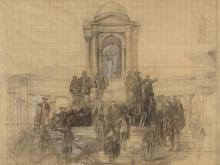
Edwin Austin Abbey’s (1852–1911) drawings at Yale University.

Edwin Austin Abbey’s Mural Painting: Context and Conservation

Theresa Fairbanks Harris, Senior Conservator of Works on Paper at the Yale University Art Gallery and the Yale Center for British Art, and Josephine Rodgers, Curator of Collections and Director of Engagement at the Middlebury College Art Museum, will lead a discussion on the conservation treatment and history of Edwin Austin Abbey’s (1852–1911) drawings at Yale University. The treatment was completed in preparation for the ‘The Dance of Life: Figure and Imagination in American Art, 1876–1917’ exhibition now on view at the Yale University Art Gallery.

Johnson Classroom 204

Open to the Public

Ancient Beacons Long for Notice: a conversation with Dario Robleto

In his prints, sculptures, and films, multi-disciplinary artist Dario Robleto incorporates a deep fascination with science, history, sound, medicine, and human empathy. His 2024 film, “Ancient Beacons Long for Notice,” is currently installed at the Middlebury College Museum of Art in the exhibit, “An Invitation to Awe.” He will join Guest Curator Katy Smith Abbott in conversation, as they explore Robleto’s conviction that “awe is a courtship with the unknown.”

Mahaney Arts Center, Olin C. Robison Concert Hall

Open to the Public
Photo credit: Millicent Harvey, the photographer (vlack & white photo of city street & sidewalk and person walking)

Consequential: Towards an Activist Practice

Professor Hilderbrand will discuss the origins and contemporary implications of an activist practice of landscape architecture, facing head-on the twin crises of our time: climate and justice. Co-Sponsored by the Cameron Visiting Artist Fund.

Johnson Classroom 204

Open to the Public
the main street (cardo maximus) in Apamea, Syria

Lecture-Dr. Hendrik Day (Middlebury ’99) Professor of Art History, Hunter College, CUNY

“Colonnaded Streets and Urban Theater in the Later Roman Empire”

Grand, colonnaded avenues proliferated as never before in leading cities of the later Roman Empire. These new urban thoroughfares were costly and complex investments that transformed the appearance and the experience of the cityscapes they adorned. Usually willed into existence by the ruling regime, they lent themselves to new forms of political theater intended to project and promote the more autocratic style of rule adopted by emperors from the third century CE.

Johnson Classroom 204

Open to the Public