

Dean of the Faculty
Carol Rifelj Lecture Series, Jessica Teets
- Sponsored by:
- Dean of the Faculty
Liberated Minds? How Chinese International Students Interpret Democracy
Do youth who were raised and educated in authoritarian states become socialized to embrace democratic values when attending college in a democracy? Or do they retain or even deepen their commitments to authoritarian values and norms?
Franklin Environmental Center, The Orchard-Hillcrest 103
Carol Rifelj Lecture Series, Jay Parini
- Sponsored by:
- Dean of the Faculty
Jay Parini has worked on turning his books into films for nearly fifty years, with three major films having been made, including The Last Station and Borges and Me. In this talk, Parini will talk about his work in the film industry, as writer and producer, with clips from his films.
Click here for more information on the lecture series.
Franklin Environmental Center, The Orchard-Hillcrest 103
Carol Rifelj Lecture Series - The Palindromes of Sidonius Apollinaris
- Sponsored by:
- Dean of the Faculty
Mark Saltviet, Davis Family Library
The Palindromes of Sidonius Apollinaris
The only palindromes found in a book from Roman antiquity are those found in the letters of Sidonius Apollinaris. However, different palindromes appear in different ancient manuscripts. Mark Saltveit relates his new research into which of these were original, and who may have written them.
Franklin Environmental Center, The Orchard-Hillcrest 103

Carol Rifelj Lecture Series - Recycling the Apocalypse: Resurrection, Adaption, and Sacred Fragments on Medieval Iceland
- Sponsored by:
- Dean of the Faculty
Robyn Barrow, History of Art & Architecture
Recycling the Apocalypse: Resurrection, Adaption, and Sacred Fragments on Medieval Iceland
On medieval Iceland, which visitors conceptualized as the very mouth of hell, drastic environmental change and resource scarcity was not a sign of apocalypse, but a daily lived experience. The island is subject to extreme weather and geothermal activity that renders any material production, particularly architecture, deeply unstable.
Franklin Environmental Center, The Orchard-Hillcrest 103
Carol Rifelj Lecture Series - AI in Higher Education: Who Uses It, How, and Does It Hurt Learning?
- Sponsored by:
- Dean of the Faculty
German Reyes, Economics
AI in Higher Education: Who Uses It, How, and Does It Hurt Learning?
Generative AI has swept through college campuses with unprecedented speed, but what do we actually know about its impact on student learning? Drawing on two studies at Middlebury College, this talk presents systematic evidence on how students are using AI tools and whether these tools deliver on their educational promise.
Franklin Environmental Center, The Orchard-Hillcrest 103
Carol Rifelj Lecture Series - Past Rainfall and Wildfire Patterns in the Western US
- Sponsored by:
- Dean of the Faculty
Cameron de Wet, Earth & Climate Science
Past Rainfall and Wildfire Patterns in the Western US: New Perspectives from Caves and Climate Models
Anthropogenic activities are pushing the climate system toward a new, warmer state that is outside the bounds of what human societies have experienced. The warming climate is driving changes in rainfall and wildfire patterns across the western US, but how these dynamics will continue to evolve remains uncertain.
Franklin Environmental Center, The Orchard-Hillcrest 103
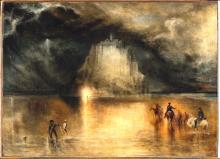
Carol Rifelj Lecture Series - J. M. W. Turner, Saint Michael's Mount, and Mont Saint-Michel
- Sponsored by:
- Dean of the Faculty
Pieter Broucke, History of Art & Architecture
J. M. W. Turner, Saint Michael’s Mount, and Mont Saint-Michel
In 1811 J. M. W. Turner sketched Saint Michael’s Mount, a tidal island in Cornwall, England. Fifteen years later, he sketched Mont Saint-Michel, a tidal island in Normandy, France. In his London studio, Turner then made studies of both, a process that resulted in an oil painting of the former and a finished watercolor of the latter.
Franklin Environmental Center, The Orchard-Hillcrest 103
Carol Rifelj Lecture Series - Culture War Politics: How the United States and Europe got "Woke"
- Sponsored by:
- Dean of the Faculty
Erik Bleich, Political Science
Culture War Politics: How the United States and Europe got “Woke”
Over the past decade, the culture wars have become a core component of political struggles in the United States and in many European countries.
Franklin Environmental Center, The Orchard-Hillcrest 103
Carol Rifelj Lecture Series - The Invisible Mask: Tales of Latin American Ingenuity and Grace
- Sponsored by:
- Dean of the Faculty
Gloria Gonzalez Zenteno, Luso-Hispanic Studies
The Invisible Mask: Tales of Latin American Ingenuity and Grace
What is a mask good for? Concealing, of course. And, in Gloria Estela González Zenteno’s new book of fiction, a mask reveals and empowers. Her stories recreate moments of grace in places spanning our continent such as Valparaíso, Tegucigalpa, Guadalajara, Sinaola, Bridport, or the Champlain Islands.
Franklin Environmental Center, The Orchard-Hillcrest 103