Mathematics MATH

Mathematics Seminar Talk - Pete Clark

Sponsored by:
Mathematics
A New Proof of the Generalized Wilson’s Theorem Wilson’s Theorem is a staple of elementary number theory: for a prime number p, (p-1)! is congruent to -1 modulo p. Suppose we would like to generalize Wilson’s theorem. Why? Well, the title says so: in fact it is, verbatim, the title of a 1903 paper by the American group theorist G.A. Miller. But more fundamentally: why not? Shouldn’t we be trying to generalize all the theorems we meet? I think so. In this talk we will contemplate several possible generalizations and then hit upon two that are discussed in Miller’s paper.

(Private)
Open to the Public

Mathematics Seminar Talk

Sponsored by:
Mathematics
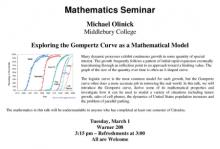
Exploring the Gompertz Curve as a Mathematical Model Michael Olinick Many dynamic processes exhibit continuous growth in some quantity of special interest. The growth frequently follows a pattern of initial rapid expansion eventually transitioning through an inflection point to an approach toward a limiting value. The graph of the size of the quantity over time is often an S-shaped curve. The logistic curve is the most common model for such growth, but the Gompertz curve often does a more accurate job in mirroring the real world.

(Private)

Open to the Public

Mathematics Seminar Talk

Sponsored by:
Mathematics
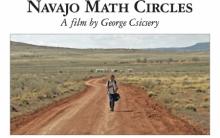
Navajo Math Circles is a one-hour film that documents the meeting of two worlds: that of some of the country’s most accomplished mathematicians and mathematics educators, with the children and teachers in the underserved, largely rural Navajo educational system. Hundreds of Navajo children in recent years have found themselves at the center of a lively collaboration with mathematicians from around the world.

(Private)

Free

Mathematics Seminar Talk

Sponsored by:
Mathematics
Pierre de Fermat and the Method of Infinite Descent Peter Schumer, Middlebury College Pierre de Fermat (1601 – 1665) is known as the “prince of amateurs” for his many important independent contributions to mathematics including his creation of analytic geometry, the beginnings of probability theory, and many key concepts and techniques that led to the development of calculus. We will discuss some of his imaginative number-theoretic observations and suggest how he may have discovered them. In particular, we will focus mainly on his method of infinite descent.

(Private)

Free
Open to the Public

“A (not so) Random Sample of Lessons & Mathematical & Statistical Applications” in honor of John Emerson

Sponsored by:
Mathematics
The Department of Mathematics presents a special lecture by Katherine Bell Krystinik, ’77 of the United States Coast Guard Academy. Professor Bell will discuss a selection of lessons imparted by Professor Emerson and how those lessons are represented in applied Coast Guard projects. Kathy was the first of Professor Emerson’s senior thesis advisees to continue on for a Ph. D. in statistics. She worked at Bell Labs and the U. S. Geological Survey before joining the faculty of the Coast Guard Academy.

Mahaney Arts Center 221

Free
Open to the Public

MATH Thesis Presentations

Sponsored by:
Mathematics
Mathematics Seminar: SENIOR THESIS PRESENTATIONS I

3:00 PM – Jeremy Stratton-Smith

Homogeneous Spaces & Their Symmetries: There’s More to That Doughnut (Hole) Than You Think

 3:30   PM – Jingyi Wu

The Geometry of Spacetime: feat. Galilean Spacetime and Minkowski Spacetime using Affine Space

 4:00 PM – James Burke

Baseball as a Markov Chain: A Bayesian Approach

 All Are Welcome!

(Private)

Open to the Public

MATH Thesis Presentations

Sponsored by:
Mathematics
Mathematics Seminar; SENIOR THESIS PRESENTATIONS I

4:30 PM – Caroline Trowbridge

Partial Differential Equations of Pollutant Transport: The Weak Formulation

5:00   PM – Luis Echeverria

The Brouwer Fixed Point Theorem in Proving Equilibrium for Game Theory

 5:30 PM – Will Clewley

Properties and Applications of Continued Fractions

All Are Welcome!

(Private)

MATH Thesis Presentations

Sponsored by:
Mathematics
Mathematics Seminar: SENIOR THESIS PRESENTATIONS I

3:00 PM - Andrew Bridgers

Ed isn’t so bad after all

3:30   PM - Noel Antonisse

Construction and Solvability: The Power and Beauty of Fields

 4:00 PM - Nimrod Saleh

Benford’s Leading Digit Law: from Statistical Curiosity to Proof

 4:30 PM - Kyra Gray

An Exploration of the Poisson Approximation

 All Are Welcome!

(Private)

Open to the Public

Math Chats: The Statistical Modeling Of Interspecies Competition On The Growth Of Trees

Sponsored by:
Mathematics
Professors Albert Y. Kim will discuss research with Professor David Allen on a statistical model of a tree’s growth as a function of current size and the competition it feels.
Prof. Allen conducted censuses in a Michigan reserve, recording the location, species, and size of all trees in both 2008 and 2014. They seek a statistical model that incorporates notions of the numbers, the sizes, the spatial density, and the species of the competitor trees

(Private)

Open to the Public

Math Chats: The Geometry of Numbers

Sponsored by:
Mathematics
The Mathematics Departments presents Duncan Levear, ‘15 (Brandeis University) who will discuss “The Geometry of Numbers”.

(Private)

Free
Open to the Public