Arabic ARBC

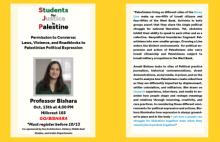
Permission to Converse: Laws, Violence, and Roadblocks to Palestinian Political Expression

Palestinians living on different sides of the Green Line make up approximately one-fifth of Israeli citizens and about four-fifths of the population of the West Bank. Activists in both groups assert that they share a single political struggle for national liberation. Yet, obstacles inhibit their ability to speak to each other and as a collective. Geopolitical boundaries fragment Palestinians into ever smaller groups.

Franklin Environmental Center, The Orchard-Hillcrest 103

Closed to the Public

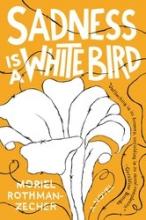
Jewish Studies: Moriel Rothman-Zecher '11 Reading from his novel, "Sadness is a White Bird"

Moriel Rothman-Zecher, ‘11, returns to Middlebury to read from his first novel, Sadness Is a White Bird, a coming-of-age novel of which the Jerusalem Post has said that it “conveys the complexities of Israeli and Palestinian life with passion, nuance and tenderness…” Rothman-Zecher “has shown a fearlessness and vulnerability on these pages that speak to his ability to explore difficult terrain without feeling the need to draw any neat or concise conclusions. It shuns certainty and is open, nuanced, inconclusive and often contradictory. Just like Israeli reality.”

Axinn Center Abernethy Room (221)

Towards a Palestinian Third Cinema

In 1970 the filmmakers Jean-Luc Godard and Jean-Pierre Gorin were commissioned by Fatah (with funding from the Arab League) to create a film about the Palestinian Revolution. The footage they shot eventually became the well known essay film Ici et Ailleurs. In 1971 Masao Adachi and Koji Wakamatsu visited the region to shoot footage for their film Japanese Red Army/PFLP Declaration of World War. These works have received considerable critical attention since they first appeared.

Robert A. Jones '59 Conference Room
Open to the Public

Lecture by Waïl S. Hassan

Sponsored by:
Arabic
As novelists, poets, playwrights, and essayists, and as founders of influential literary salons, individuals from Greater Syria were key contributors to the Arabic literary awakening. By turning the spotlight on to one of these writers – the pioneering writer, poet, and artist Kahlil Gibran (1883-1931) – Waïl Hassan will share with the Middlebury community his groundbreaking research on the reception and translation of Kahlil Gibran’s work in Brazil, one of the most important centers of Arabic literary production in the diaspora.

Robert A. Jones '59 Conference Room
Lecture by Kareem Abu-Zeid

Sponsored by:
Arabic
Public talk: Translating Arabic Poetry, Pre-Islamic to Modern: Creative Challenges and Opportunities. 

Robert A. Jones '59 Conference Room

Leaks, Hacks, and Scandals: Arab Culture in the Digital Age

Sponsored by:
Arabic
Discussing his recently published book, Leaks, Hacks, and Scandals: Arab Culture in the Digital Age (Princeton UP 2019), Tarek El-Ariss explores the way modes of confrontation, circulation, and writing shape contemporary knowledge production and critiques of power. Focusing on a new generation of activists and authors from the Arab world and beyond, El-Ariss connects Wikileaks to The Arabian Nights, Twitter to mystical revelation, cyberattacks to pre-Islamic tribal raids, and digital activism to the affective scene-making of Arab popular culture.

Axinn Center 229

Open to the Public

Jewish Refugees in Israeli Camps: Iraqi Jews in the 1950s

Professor Orit Bashkin (University of Chicago) will discuss her new book Impossible Exodus: Iraqi Jews in Israel (Stanford University Press, 2017). Professor Bashkin’s book is co-winner of the 2018 Nikki Keddie Book Award from the Middle East Studies Association. The lecture will relate the experience of tens of thousands of Arabic-speaking Iraqi Jews who migrated to Israel between 1949-1951, and will survey their struggle for resettlement and civil rights during the 1950s, as well as the discrimination they faced from the Israeli government and Ashkenazi Jews.

Axinn Center 229

Open to the Public

Hands-on translation workshop: Literary Translation for Students of Arabic: A Hands-On Workshop.

Sponsored by:
Arabic
Hands-on translation workshop: Literary Translation for Students of Arabic: A Hands-On Workshop. 

A hands-on translation workshop in which all students will translate the same text. Afterward, everyone will workshop the translations together as a group, discussing the merits and drawbacks of the various solutions the students have found. This workshop is open to all students, not only those with a background in Arabic.

Axinn Center 219