Jewish Studies JWST

The IHRA Definition of Antisemitism and Academic Freedom

Faculty, staff, and students are invited to a conversation with Kenneth Stern, drafter of the IHRA Working Definition of Antisemitism, and Emma Saltzberg of the Diaspora Alliance, on its implications for teaching, research, and campus policy. Speakers will explore how universities can address antisemitism while safeguarding academic freedom and open discourse.

This event will be in hybrid format, with virtual speakers.
Register via the Middlebury website at: go/AAUPIHRA/

Robert A. Jones '59 Conference Room

Closed to the Public

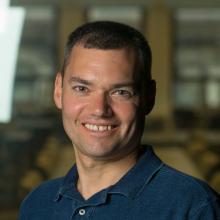
"Being Jewish after the Destruction of Gaza," A conversation with Prof. Peter Beinart

Peter Beinart is Professor of Journalism and Political Science at CUNY. He is also a Contributing Opinion Writer for The New York Times, a political commentator on MSNBC, and Editor-at-Large of Jewish Currents. Over the years he served as Editor of The New Republic and wrote for publications like The Wall Street Journal, The Atlantic, Die Zeit, and the Financial Times. He is the author of four books including The Icarus Syndrome: A History of American Hubris (Harper, 2010) and The Crisis of Zionism (Times Books, 2012).

Wilson Hall, McCullough Student Center

Open to the Public

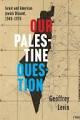
Our Palestine Question

Title: Book talk: Our Palestine Question

Geoffrey Levin (Emory University) will discuss his new book, Our Palestine Question: Israel and American Jewish Dissent, 1948-1978 (Yale 2023), a new history of the American Jewish relationship with Israel, which focuses on its most urgent and sensitive issue: the question of Palestinian rights.

Robert A. Jones '59 Conference Room

Open to the Public

The Rebbe and the Denial of Death

Sponsored by:
Jewish Studies
Lubavitch, Messianism, The Rebbe and the Denial of Death by Samuel Heilman, Howard Proshansky Chair of Jewish Studies, Department of Sociology, Queens College. He is co-author, with Menachem Friedman, of The Rebbe: The Life and Afterlife of Menachem Mendel Schneerson, which won the 2010 National Jewish Book Award. Sponsored by the Jewish Studies Program, the Department of Religion, and the Department of Sociology and Anthropology.

Robert A. Jones '59 Conference Room

Open to the Public

The Poetry of Kabbalah

Sponsored by:
Religion and Jewish Studies
“The Kabbalah of Poetry, the Poetry of Kabbalah.” Reading and lecture by Peter Cole Peter Cole, poet, translator, scholar and MacArthur Fellow, will speak on and read from his new book, The Poetry of Kabbalah (Yale University Press, 2012), seeking the connection between poetic creation and mystical experience. Booklist has praised this latest work of Cole’s as “a dazzling treasury of verse spanning more than 1,500 years and accompanied by fascinating, illuminating commentary rich in history, biography, and literary expertise.” A book-signing will follow.

Axinn Center Abernethy Room (221)

Free
Open to the Public

Suffering Job

Sponsored by:
Jewish Studies
“Suffering Job” provides an introduction to the Book of Job for those unfamiliar but interested. Professor Robert Schine will explain the book’s significance in Judaism as a precursor to the October 31 “The Book of Job in Art” by Professor Choon Leong Seow, which will focus on Job’s significance in literature, art, and music.

LaForce Hall Seminar Room

Screening: "Trembling Before G-d"

Sponsored by:
Jewish Studies
Screening of “Trembling Before G-d” (2001), a film that shatters basic assumptions about faith, sexuality, and religious fundamentalism. Built around intimately-told personal stories of Hasidic and Orthodox Jews who are gay or lesbian, this documentary portrays a group of people who face a profound dilemma: how to reconcile their passionate love of Judaism and the Divine with the drastic Biblical prohibitions that forbid homosexuality.

Axinn Center 109

Open to the Public

Lecture: Ted Sasson, "On the New American Zionism"

Professor Ted Sasson will speak on his new book The New American Zionism (NYU Press, November 2013). Sasson argues that, at the core, the new relationship between American Jews and Israel is being fundamentally misunderstood. Conflicting viewpoints and strategies regarding the Israeli/Palestinian conflict and the Iran deal reflect sharpening polarization in the American Jewish community. But contrary to what many observers have claimed, the fracturing of a unified voice within the Jewish community does not reflect diminished attachment to Israel.

McCardell Bicentennial Hall 219

Open to the Public