Alumni College
Join old friends and new in this beloved Middlebury tradition!
Return to Learn at the 50th Anniversary of Alumni College!
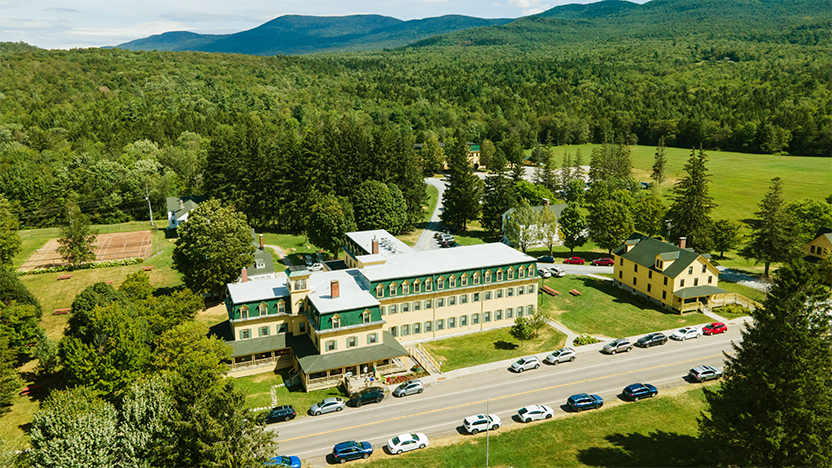
Learn from some of the College’s finest faculty while enjoying camaraderie with fellow alumni, delicious meals, and spectacular views on our Bread Loaf campus. Save the date for Wednesday, August 26–Saturday, August 29, 2026*.
Registration opens on Wednesday, April 8, 2026 at 12:00 noon Eastern. Please see below for course descriptions and faculty bios for details about this year’s offerings.
*Please note that Alumni College classes will start on a Wednesday and end on a Saturday this year, which is different than in previous years. Participants may register to arrive early on Tuesday for an additional fee.
Event Highlights
- Courses taught by some of Middlebury’s finest instructors
- Movie Night!
- Cocktail reception and celebration of the 50th Anniversary of Alumni College
Pricing
| With Lodging | Without Lodging | Tues Arrival w/Lodging |
|---|---|---|
| $650 | $525 | $725 |
Course Descriptions
Storytelling for Impact: Culture, Context, and Change
Netta Avineri
Storytelling and story-listening are central to how individuals, groups, and communities engage with one another across contexts. Storytellers seek to make an impact on a particular audience — educating, persuading, connecting, advocating, sharing, entertaining, and relating. In this interactive, hands-on course, we will take an applied linguistic anthropological approach to the role of stories at individual, interpersonal, institutional, and global scales. Using the framework of storyframing, storyforming, and storytelling, we will create our own culturally-informed stories of change — guided by principles of audience design, sensitivity to genre, and scale of impact. Join us!
Our Expanding Universe
McKinley Brumback
How did astronomers discover that the universe is expanding? What are dark energy and dark matter and what do they have to do with the possible fate of the universe? This introductory astronomy course will present an overview of our expanding universe including the results that led to this discovery and the implications it has on the formation and eventual fate of the universe. Topics will include examining how astronomers measure distance across space, the infamous Hubble’s Law, the age of the universe, and more. Students can anticipate lectures that mix historical results with modern astronomical discoveries to shed light on what we know and do not know about the cosmos. Students should expect to see quantitative reasoning in class, but mathematical proficiency beyond algebra is not required. Night-time observations with portable telescopes may be offered as the availability of equipment, and the weather allows.
Mammal Tracks and Tales
Alexis Mychajliw
There are over 6,000 mammal species alive today— and you are one of them! In this course, students will learn about the biological qualities that make a mammal a mammal, from the evolutionary histories locked deep in our bones and genes to the unique behaviors that mammals display across habitats around the planet. Students will have hands-on learning experiences with skull casts and will build a field-based mammal tracking skillset they can apply in their own backyard, including practicing the use of camera traps. Class discussions will center on topics of popular interest including the evolution of venom, ancient DNA and de-extinction, surviving the dinosaur mass extinction, island evolution, zoonotic disease spillover, and the La Brea Tar Pits. The class will include animal-tracking in nearby woods and participants should be able to walk up to two miles on uneven ground.
Robert Frost and the Nature of Vermont
Jay Parini
Robert Frost was, perhaps, the greatest American poet of the twentieth century, and he usually set his poems somewhere “North of Boston,” which was the title of his second book. Vermont, in particular, was a subject of his work, as he lived there for many years, with a home near the Bread Loaf campus in Ripton. His poetry can well be described as a field guide to the flora and fauna, and to the people — farmers, mostly — who live in Vermont. In this course, we’ll look at many of his key poems, from “Mending Wall” through “‘Out, Out-‘,” “The Wood-pile,” “Two Tramps in Mud Time,” “Birches,” “The Road Not Taken,” “After Apple-Picking,” “Home Burial,” “Design,” and “Directive.” We will examine poems very closely, pausing to listen to his exquisite phrasing. There will be comparisons to the writings of Ralph Waldo Emerson, who was a major influence on Frost. In particular, we will talk about Nature (1836), a major early book by Emerson that Frost loved.
Documentary & Truth in an Age of Doubt
James Chase Sanchez
Recent Pew Polling shows that more Americans trust documentaries to tell them the truth than network news. In this course, students will learn how documentaries often blur the line as “truth-telling” artifacts, focusing on how they employ evidence, emotions, and editing to frame different versions of truth. Using scenes from Errol Morris’s The Thin Blue Line (1988), Michael Moore’s Bowling for Columbine (2002), and Leni Riefenstahl’s Triumph of the Will (1935), we will explore how documentaries play with this slipperiness—sometimes for the sake of truth and sometimes to propagandize.
Faculty Bios
Netta Avineri (Storytelling for Impact: Culture, Context, and Change)
Netta Avineri is Executive Director of the Kathryn Wasserman Davis Collaborative in Conflict Transformation and Professor of Intercultural Communication. She is an applied linguistic anthropologist whose research and practice focus on ethical university-community partnerships, storytelling for impact, and language and social change. Netta has two decades of interdisciplinary expertise that bridges individual, institutional, community, and government sectors for common collective commitments. She has published several books on critical research methodologies, language and social change, and heritage language socialization, and is Series Editor for the Critical Approaches in Applied Linguistics book series. She served as the inaugural Public Affairs and Engagement Chair for the American Association for Applied Linguistics, and is an Executive Board member for the Society for Linguistic Anthropology.
McKinley Brumback (Our Expanding Universe)
McKinley Brumback is an Assistant Professor of Physics. She completed her PhD in physics and astronomy at Dartmouth College and then traveled the United States for postdoctoral research positions at Caltech and the University of Michigan. She uses observations from NASA and ESA X-ray observatories to investigate how matter behaves close to neutron stars, and in particular, her research focuses on reverberation mapping of neutron star X-ray binaries and the effect of super-Eddington accretion on pulse profiles.
Alexis Mychajliw (Mammal Tracks and Tales)
Alexis Mychajliw is an Assistant Professor of Biology and Environmental Studies. Previously, she was a postdoctoral fellow at the La Brea Tar Pits & Museum, Hokkaido University in Japan, and the University of Oklahoma. She earned a BS from Cornell University (2012) and a PhD from Stanford University (2017). She has coauthored 40+ scientific articles and received research support from the National Science Foundation and National Geographic. She is a deputy chair of the IUCN’s Small Mammal Specialist Group, where she guides the conservation of shrews, hedgehogs, and moles globally. In her spare time, she rescues domestic rats.
Jay Parini (Robert Frost and the Nature of Vermont)
Jay Parini is the Axinn Professor of English and Creative Writing emeritus and currently serves as Writer in Residence. He is a poet, novelist, biographer, and critic. His many volumes of poetry include New and Collected Poems: 1975-2015. His nine novels include The Damascus Road, Benjamin’s Crossing and The Last Station, which was made into an Academy Award-nominated film in 2009, starring Helen Mirren and Christopher Plummer. His memoir Borges and Me was recently turned into a film. He has written biographies of John Steinbeck, Robert Frost, William Faulkner, Gore Vidal, and Jesus. His other publications include Promised Land: Thirteen Books that Changed America and Why Poetry Matters. His reviews and articles appear regularly in The New York Times, The Guardian, and elsewhere.
James Chase Sanchez (Documentary & Truth in an Age of Doubt)
James Chase Sanchez is an Associate Professor of Writing and Rhetoric. He recently published his third academic book, Countermemory (2025), which explores how communities and publics (de-)construct public memories that challenge accepted narratives. James is also a documentary producer. His first film, titled Man on Fire, won an International Documentary Association Award in 2017 and aired on PBS via Independent Lens in 2018. Sanchez recently produced a short, titled The Spiritual Advisor, which was bought by Rolling Stone Films and Documentary+ and has a feature investigative documentary, titled In Loco Parentis, set to premiere in 2026.
Additional Information
ADA Accommodations
The Disability Resource Center (DRC) provides a range of supportive accommodations for students with disabilities at Middlebury. For ADA accommodations, please reach out to the DRC staff at ada@middlebury.edu.
Questions?
Visit the FAQ’s section for more information about pricing, housing, and more!
Still have questions? Email us at alumni@middlebury.edu or call the Alumni Office at 802-443-5183.