European Studies EUROPEAN STUDIES

Black Life in a Nazi Internment Camp: The Art of Josef Nassy

During World War II, Black people living in Nazi Germany and occupied Europe were in some cases incarcerated in internment and concentration camps. One of the most significant visual documents of this neglected chapter of the war are a series of drawings and paintings created by Caribbean artist Josef Nassy during his internment. This talk introduces the little known Josef Nassy Collection as a unique visual record of the experiences of Black prisoners in the Nazi camp system.

Axinn Center 229

Closed to the Public

Gensler Symposium Podcast: Feminism, Fascism and the Future

Snacks and Silent Listening Podcast Party

BYOE (Bring Your Own Earphones) for an opening of the podcast “Feminism, Fascism & the Future.” Some of the makers of this podcast will talk about the process of tracing the global rise of anti-gender ideology movements in podcast form. Then you can go listen to whatever episode you want (and bonus: many of our speakers for the conference are in these episodes)!

Franklin Environmental Center, The Orchard-Hillcrest 103
Open to the Public
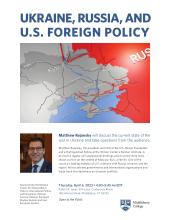
Map of central Europe

Ukraine, Russia and US Foreign Policy

Matthew Rojansky will discuss the current state of the war in Ukraine and take questions from the audience.

Matthew Rojansky, the President and CEO of the U.S. Russia Foundation and a Distinguished Fellow at the Wilson Center’s Kennan Institute, is as much a regular at Congressional briefings and on prime-time news shows as he is on the streets of Moscow, Kyiv, or Berlin. One of the country’s leading analysts of US relations with Russia, Ukraine, and the region, he has advised governments and international organizations and leads track two diplomacy on Eurasian conflicts.

Robert A. Jones '59 Conference Room

Open to the Public

The Myth of French Republican Universalism

Officially, France does not recognize ethnic, religious, or linguistic minorities. Yet, France is the European country with the most varied origins among its population. How can we explain the disjuncture between a political discourse that claims to be difference-blind and the reality of day-to-day life of French citizens? What is the future for minority citizens in France?

Robert A. Jones '59 Conference Room

Closed to the Public

Survivors into Minorities: Armenians in Post-Genocide Turkey

This talk follows the trajectories of the survivors of the 1915 Armenian Genocide who remained inside Turkish borders after the signing of the 1918 Mudros Armistice (and during the Allied occupation years of Istanbul) and after the 1923 establishment of the new country as the Turkish Republic. How did the Kemalist state treat the remaining Armenians? What were Armenians’ responses to the new (but also old) Turkish regime?

Robert A. Jones '59 Conference Room

Open to the Public

Ill Fares the Land: OPENING REMARKS-Inequality in the 21st Century

“Ill fares the land, to hastening ills a prey, Where wealth accumulates, and men decay” —Oliver Goldsmith, “The Deserted Village” (1770) Inequality is on the rise in the contemporary global economy, both within prosperous economies and between developed and developing countries. Can democracy sustain itself while acquiescing in a growing gap between the world’s haves and have-nots? Does the American dream depend on a foundation of shared prosperity that is increasingly a historical artifact?

Robert A. Jones '59 Conference Room

Open to the Public

“Cursed Paradise: The Russian Annexation of Crimea” by Dimiter Kenarov ’03

Dimiter Kenarov ‘03, is a freelance journalist and poet. He has covered the Balkans and the Black Sea region for a number of print and online publications, including Esquire, Foreign Policy, The International New York Times, The Nation, Outside, The Atlantic, and VQR. He is teaching the Winter Term course “Garden of the Empire”: History and Myth in Crimea.

Robert A. Jones '59 Conference Room

Open to the Public