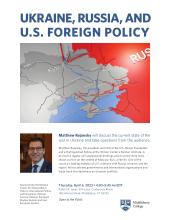
Matthew Rojansky will discuss the current state of the war in Ukraine and take questions from the audience.
Matthew Rojansky, the President and CEO of the U.S. Russia Foundation and a Distinguished Fellow at the Wilson Center’s Kennan Institute, is as much a regular at Congressional briefings and on prime-time news shows as he is on the streets of Moscow, Kyiv, or Berlin. One of the country’s leading analysts of US relations with Russia, Ukraine, and the region, he has advised governments and international organizations and leads track two diplomacy on Eurasian conflicts.
“World Cup Soccer and the Global South: From South Africa 2010 to Brazil 2014” a presentation by Peter Alegi, professor of history at Michigan State University. He is the author of African Soccerscapes: How a Continent Changed the World’s Game (2010) and co-editor with Chris Bolsmann of Africa’ World Cup: Critical Reflection on Play, Patriotism, Spectatorship, and Space (University of Michigan Press, 2013).
This workshop aims to bring together faculty from political science and economics departments at AALAC member institutions for a workshop on the economic history of states and societies. The workshop will include sessions discussing new research papers, a session on teaching in the liberal arts, and a keynote by Saumitra Jha (Stanford GSB).
David Leblang, Professor of Politics at the University of Virginia, will present on the politics of the EU sovereign debt crisis. When the crisis began, it was widely understood that Germany’s
response would dictate its ultimate resolution. If Germany chose to support bailouts, then it was possible that debt-saddled countries would be able to survive within the Eurozone. If not, it would likely result in a wave of financial sector failures, defaults and, possibly, exiting the Eurozone. Leblang argues that the decision to bailout Greece reflected domestic political calculations.
Lecture “Normalizing US-Cuban Relations: The Obama Legacy” by Peter Kornbluh, Senior Analyst at the National Security Archives. Kornbluh currently directs the Archive’s Cuba and Chile Documentation Projects, and formerly was co-director of the Iran-contra documentation project and director of the Archive’s project on U.S. policy toward Nicaragua. From 1990-1999, he taught at Columbia University. He has authored numerous articles and four books, including his latest —”Back Channel to Cuba: The Hidden History of Negotiations between Washington and Havana” (UNC Press, 2014).
Lecture by Ambassador Richard LeBaron, Atlantic Council.
Ambassador LeBaron is a career diplomat with over thirty years experience abroad and in Washington. His most recent overseas posting was as deputy chief of mission at the US embassy in London from August 2007 to August 2010. Ambassador LeBaron served as ahargé d’affaires in London from February to August 2009. Previous to his assignment to London, Ambassador LeBaron served as the US ambassador to Kuwait (2004 to 2007).
Professor Pyle will be hosting an informal ice-cream-and-hot-chocolate-cum-advising event for all International Politics and Economics (IPE) majors (and potential majors). Topics to discuss will likely include questions relating to study abroad, preparatory steps for writing a thesis and much, much more.”