Spanish & Portuguese Department SPAN

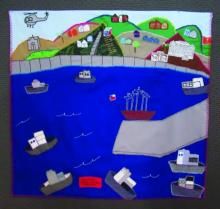
Exhibit by Arpilleras presented by Cecilia Araneda

A public lecture (4:30 to 5:30 pm) and exhibit opening (5:30 to 7 pm with beverages and hors d’oeuvres) by Cecilia Araneda, educator and textile artist, who will share the work of her group Arpilleras, Sitios Y Memoria. This group began in 2016 with the wish to reflect on human rights violations inflicted against Chilean citizens by the military dictatorship in Chile’s Valparaiso Region. Through textile art depicting the locations of such crimes, survivor-participants invite Chileans to reclaim their public spaces and resist forgetfulness and impunity.

Robert A. Jones '59 Conference Room

Open to the Public

Between Realism and Science Fiction

Sponsored by:
Spanish Department
At Middlebury Professor Paz Soldán will deliver a talk connected to two courses: SPAN 310, a course titled Otherness in the Hispanic World, and SPAN 350, a course about “los raros” or alternative fiction in Spanish. In SPAN 310, the students will read the short stories found in Las visiones. In this science fiction book, a racially-segregated dystopian world is created where biopolitical technology is used to discriminate against and control certain ethnicities deemed to be inferior, and that rebel against power in various ways to fight for their humanity and dignity.

Robert A. Jones '59 Conference Room

Cinema of the Crisis: Feminist and Queer Filmmaking in Puerto Rico in 2018

Screening of two short documentaries

“The Feminine Creature Within,” is an experimental short film directed by Lorraine Jones of FemTrap, a project that focuses on feminine empowerment through breaking norms and stigmas. FemTrap is a collective of female artists who came together after Hurricane Maria, and collaborate with other women and men: artists, dancers, photographers, DJ’s, trap singers, and skaters.

McCardell Bicentennial Hall 216

Open to the Public

CANCELLED: Materia Oscura: a travel through time and poetry

Sponsored by:
Spanish Department
Carlos Villacorta (Perú 1976) will discuss his literary work as a poet and as a fiction writer using the idea of Materia Oscura or Dark Matter. Villacorta is an Associate Professor of Spanish at the University of Maine and he published his first poetry book el grito in 2001 and since he has published three more poetry books. In 2014, he published his first novel Alicia esto es el capitalismo. Materia Oscura, title of his last poetry book, addresses the idea that dark matter surrounds in our everyday life.

Franklin Environmental Center, The Orchard-Hillcrest 103

Closed to the Public

How Will it End? Interdisciplinary Perspectives on the End of the World

Keynote Address at 2:30: “Politics in Apocalyptic Times: The Case of Machiavelli” by Alison McQueen, Political Science, Stanford University


Panel presentations, Q&A with Faculty at 4:00 featuring Eilat Glikman (Physics), Sarah Laursen (HARC), Paul Monod (History), Daniel Suarez (Environmental Studies) and Larry Yarborough (Religion)

Robert A. Jones '59 Conference Room

Open to the Public

“El cine de horror existe aquí” / “Horror cinema exists here”: Mapping Affect and its Limits in Transnational Horror

Sponsored by:
Spanish Department
Horror cinema is arguably the most transnational of film genres with Spain and select Latin American countries presently operating as both nodes of production and consumption. If horror and its various subgenres are consumed and produced across multiple national markets, one may presume that the emotions and affects of horror accompany this circuit. In this talk, Prof.

Robert A. Jones '59 Conference Room

Open to the Public

"Opening the Earth: The Potato King Documentary" Screening

Sponsored by:
Spanish Department and Food Studies
Come watch “Opening the Earth: the Potato King,” a documentary directed by Aaron Ebner, MIIS alum and founder of the Andean Alliance for Sustainable Development. This screening will be followed by a virtual moderated Q&A with food studies professor Molly Anderson. Filmed in Peru, the documentary centers on the story of “the guardian of biodiversity,” farmer Julio Hancco, and how his necessary agricultural work is at odds with our modernizing work.

Dana Auditorium (Sunderland Language Center)

Closed to the Public

Memory and Art in Post-Dictatorship Argentina

Sponsored by:
Spanish Department
What is the relation between political and social trauma and the arts? Can we think on artistic creation as a form of personal and collective resistance? How does art become a privileged and powerful medium that bear witness to the traumatic events of the past? This lecture will address these questions and the responses that through artistc creation are given to the complex issues of violence, memory and its subjective and social dimension after Argentina´s last and most brutal dictatorship (1976-1983). Focusing on visual art, film and literature, Prof.

Virtual Middlebury

Open to the Public

Archives of Indictment: Afro-Latinx & Equatorial Guinean Studies

Sponsored by:
Spanish Department
How do we map relations across the Afro-Atlantic? How do the diasporic cultural productions of the sole Spanish-speaking nation in Subsaharan Africa connect with works emerging from the Spanish-speaking Caribbean (Cuba, Puerto Rico, The Dominican Republic)? What insights do we gain by reading these contemporary works alongside each other? This talk will examine the long history of Atlantic crossings between Equatorial Guinea and the Latinx Caribbean and engage in a robust discussion about colonialism, diaspora, feminisms, decolonization, literature, and the human.

Virtual Middlebury