
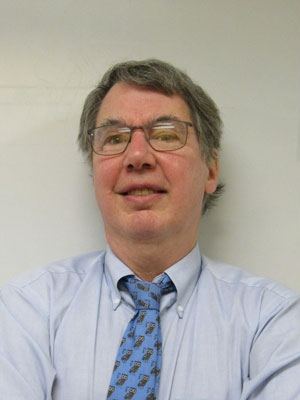
Jeff Byers
Philip Battell & Sarah F. Cowles Stewart Professor Emeritus of Chemistry
- byers@middlebury.edu
Jeff Byers is a synthetic organic chemist, having received a B.S. degree from the University of Rochester in 1979 and a Ph.D. from Dartmouth College in 1984, where he worked in the group of Thomas A. Spencer . He held a postdoctoral fellowship in the group of Gary Keck at the University of Utah before joining the Middlebury faculty in 1986. Jeff is currently on leave.
His teaching interests lie predominately in General Chemistry (CHEM 0103, CHEM 0104) and Introductory and Advanced Organic Chemistry (CHEM 0241, CHEM 0242 and CHEM 0442). He has also taught Freshman Seminars entitled “Fraud, Foolishness, and Serendipity”, and “Smart Energy Choices” in recent years. He has also been experimenting in the use of social networking sites such as Facebook as tools for collaborative learning in chemistry courses.
Hobbies and Interests included hiking (especially peak-bagging), skiing (nordic and alpine), running and piano.
He authors a blog on trailrunning in Addison County called “The Middlebury Trailrunner”
Courses Taught
CHEM 0203
Organic I: Struct & Reactivity
Course Description
Organic Chemistry I: Structure and Reactivity
The course will provide students with an introduction to the structure and reactivity of organic molecules sufficient to continue directly to the study of biochemistry (CHEM 0322). Topics covered will include models of chemical bonding, acid-base relationships, three-dimensional molecular structure (conformations and stereochemistry), reaction mechanisms and energy diagrams, substitution and elimination reactions, carbonyl reactions (additions, reductions, interconversions, and alpha-reactivity), and the fundamentals of biological molecules (carbohydrates, DNA, and RNA). Laboratory experiments will relate to purification techniques (recrystallization, distillation, extraction, and chromatography), as well as microscale organic reactions that complement the lecture material. (CHEM 0104 or CHEM 0107) 3 hrs. lect., 3 hrs. lab.
Terms Taught
Requirements
CHEM 0442
Advanced Organic Chemistry
Course Description
Advanced Organic Chemistry
In this course we will cover advanced topics in organic chemistry with a focus on the interrelationships between molecular structure and reactivity. Methods such as qualitative molecular orbital theory and conformational analysis will be used to rationalize the reactivity of different molecules, including reactive intermediates beyond the scope covered in the introductory organic chemistry sequence. We will also cover more advanced techniques in NMR spectroscopy, and their use in the structural and conformational determination of molecules. Through examination of the primary literature, students will explore how reaction mechanisms can be elucidated experimentally. (CHEM 0305)
Terms Taught
CHEM 0500
Independent Study
Course Description
Independent Study Project
Individual study for qualified students. (Approval required)
Terms Taught
CHEM 0700
Senior Research
Course Description
Senior Research
In this course students complete individual projects involving laboratory research on a topic chosen by the student and a faculty advisor. Prior to registering for CHEM 0700, a student must have discussed and agreed upon a project topic with a faculty member in the Chemistry and Biochemistry Department. Attendance at all Chemistry and Biochemistry Department seminars is expected. (Approval required; open only to seniors)
Terms Taught
CHEM 0701
Senior Thesis
Course Description
Senior Thesis
Students who have initiated research projects in CHEM 0400 and who plan to complete a senior thesis should register for CHEM 0701. Students are required to write a thesis, give a public presentation, and defend their thesis before a committee of at least three faculty members. The final grade will be determined by the department. Attendance at all Chemistry and Biochemistry Department seminars is expected. (CHEM 0400; approval required)
Terms Taught
Publications
“Social Networking Sites for Online Collaboration in Chemistry Courses: A Facebook Experiment” Byers, J. H. The Chemical Educator, 2011 (online journal).
“Radical Aromatic Substitution with Benzene Chromiumtricarbonyl” Byers, J. H.*; Neale, N. R.*; Alexander, J. B.* Gangemi, S. P.* Tetrahedron Lett. 2007, 48, 7903-7905.
“The Radical Addition of Dimethyl 2-Ethynylcyclopropane-1,1-dicarboxylate to Electron-Rich Olefins” Byers, J. H.; Goff, P. H.*; Janson, N. J.*; Mazzotta, M. G.*; Swigor, J. E. Synthetic Commun. 2007, 37, 1865-1871.
“Radical Additions to (n6-Styrene) Chromium Tricarbonyl” Byers, J. H.; Janson, N. J.* Organic Lett. 2006, 8, 3453.
“Thiocarbonyldiimidazole” Byers, J.H. Encyclopedia of Reagents for Organic Synthesis, L. A. Paquette, Ed. Wiley, 2006.
“Radical Reactions Mediated by Cyclobutadieneiron Tricarbonyl” Byers, J. H.; Sontum, S. F.; Dimitrova, T. S.*; Huque, S.*; Zhang, Y.*; Zegarelli, B. M.*; Jasinski, J. P; Butcher, R. P. Organometallics 2006, 25, 3787.
“Tandem Radical-Electrophilic Annulations to Pyrrole” Byers, J. H.; DeWitt, A.*; Nasveschuk, C. G.*; Swigor, J. E. Tetrahedron Lett., 2004, 45, 6587-6590.
“A One-step Radical Synthesis of Pyrrol-2-Acetic Acids” Byers, J. H.; Duff, M. P.*; Woo, G. W.*, Tetrahedron Lett., 2003, 44, 6853-6855 .
“Syntheses of 3-Acylindoles via the Alkylation of the Dianion of 3-Acetylindole” Byers, J. H.; Zhang, Y.* Heterocycles, 2002, 57, 1293-1297.