
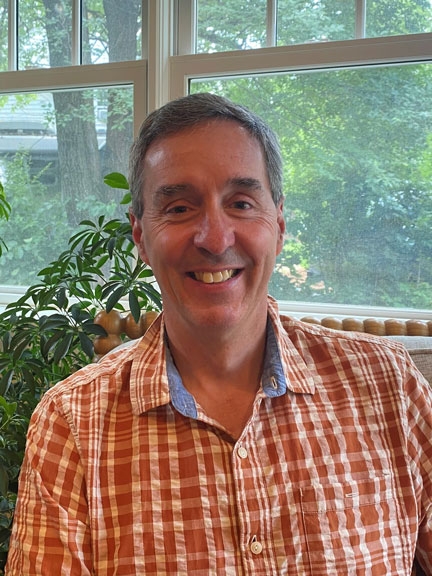
Stephen Abbott
he/him
Nathan Beman Professor of Mathematics
- Office
- Warner 211
- Tel
- (802) 443-2256
- abbott@middlebury.edu
- Office Hours
- Monday and Wednesday 3:00-4:00 PM, Tuesday and Thursday 3:30-4:30 PM
I have been a professor of mathematics at Middlebury since 1993. I’ve also had visiting appointments at Saint Olaf College, the University of Virginia, CRASSH at Cambridge University, and the University of Otago in Dunedin, New Zealand. In the past, I’ve served as co-editor of Math Horizons and am currently co-editing the undergraduate series Texts for Quantitative Critical Thinking, published by Springer. I am also a program chair for The Bridges Organization, an interdisciplinary group dedicated to the intersections of mathematics and art.
Courses Taught
INTD 1095
Upcoming
Science as Art in Theatre
Course Description
Science as Art in Contemporary Theatre
In this course we will explore the complementary ways that theater and science seek out their respective forms of truth by reading and performing scenes from a host of highly-regarded plays that engage with the mathematical sciences. Examples include Arcadia by Tom Stoppard (chaos and thermodynamics), Copenhagen by Michael Frayn (quantum theory), and Proof by David Auburn (mathematics). Taking a hands-on approach, we will engage in a series of labs and scene work with the goal of experiencing how playwrights have employed science to craft richly human stories for the stage.
Terms Taught
Requirements
MATH 0121
Calculus I
Course Description
Calculus I
Introductory analytic geometry and calculus. Topics include limits, continuity, differential calculus of algebraic and trigonometric functions with applications to curve sketching, optimization problems and related rates, the indefinite and definite integral, area under a curve, and the fundamental theorem of calculus. Inverse functions and the logarithmic and exponential functions are also introduced along with applications to exponential growth and decay. (MATH 0103 Or MATH 0105 or by placement) 4 hrs. lect./disc.
Terms Taught
Requirements
MATH 0122
Calculus II
Course Description
Calculus II
A continuation of MATH 0121, may be elected by first-year students who have had an introduction to analytic geometry and calculus in secondary school. Topics include a brief review of natural logarithm and exponential functions, calculus of the elementary transcendental functions, techniques of integration, improper integrals, applications of integrals including problems of finding volumes, infinite series and Taylor's theorem, polar coordinates, ordinary differential equations. MATH 0121 or equivalent, or by placement) 4 hrs. lect/disc.
Terms Taught
Requirements
MATH 0200
Upcoming
Linear Algebra
Course Description
Linear Algebra
Matrices and systems of linear equations, the Euclidean space of three dimensions and other real vector spaces, independence and dimensions, scalar products and orthogonality, linear transformations and matrix representations, eigenvalues and similarity, determinants, the inverse of a matrix and Cramer's rule. (MATH 0121 or equivalent, or by placement) 3 hrs. lect./disc.
Terms Taught
Requirements
MATH 0223
Multivariable Calculus
Course Description
Multivariable Calculus
The calculus of functions of more than one variable. Introductory vector analysis, analytic geometry of three dimensions, partial differentiation, multiple integration, line integrals, elementary vector field theory, and applications. (MATH 0122 or equivalent. Not open to students who have taken MATH 0224.) 3 hrs. lect./disc.
Terms Taught
Requirements
MATH 0310
Probability
Course Description
Probability
An introduction to the concepts of probability and their applications, covering both discrete and continuous random variables. Probability spaces, elementary combinatorial analysis, densities and distributions, conditional probabilities, independence, expectation, variance, weak law of large numbers, central limit theorem, and numerous applications. (Concurrent or prior: MATH 0223 or MATH 0224) 3 hrs. lect./disc.
Terms Taught
Requirements
MATH 0323
Current
Real Analysis
Course Description
Real Analysis
An axiomatic treatment of the topology of the real line, real analysis, and calculus. Topics include neighborhoods, compactness, limits, continuity, differentiation, Riemann integration, and uniform convergence. (MATH 0200 and MATH 0223, or MATH 0224) 3 hrs. lect./disc.
Terms Taught
Requirements
MATH 0500
Current
Upcoming
Advanced Study
Course Description
Advanced Study
Individual study for qualified students in more advanced topics in algebra, number theory, real or complex analysis, topology. Particularly suited for those who enter with advanced standing. (Approval required) 3 hrs. lect./disc.
Terms Taught
MATH 0723
Current
Topics in Analysis Seminar
Course Description
Topics in Analysis Seminar
The foundation in analysis covered in MATH 0323 provides the tools necessary to engage a range of important and fascinating topics of both a pure and applied nature. In the first part of this seminar we will collectively work our way through the theory of Lebesgue measure and integration, studying the classical Banach spaces of integrable functions. After this common introduction, students will each choose a project from a range of options that includes topics in functional analysis (e.g., the open mapping theorem, the Hahn-Banach theorem) or more classical real analysis (e.g., Fourier series, orthogonal polynomials, the gamma function). Working independently and in small groups, students will gain experience reading advanced sources and communicating their insights in expository writing and oral presentations. This course fulfills the capstone senior work requirement for the mathematics major. (MATH 0323 or by approval). 3 hrs. sem.
Terms Taught
Areas of Interest
Real and functional analysis
Intersections of mathematics and the arts, particularly with theater
Academic Degrees
A.B., Colgate University (1986)
M.S., Ph.D., University of Virginia (1993)
Selected Publications
Understanding Analysis, Springer 2015
The Proof Stage, Princeton University Press, 2023