The Other Side of the Ice
I didn’t feel like a starstruck outsider. There was something closer to an unspoken understanding—they knew the sport, I knew the sport, and that fluency was its own kind of credential.
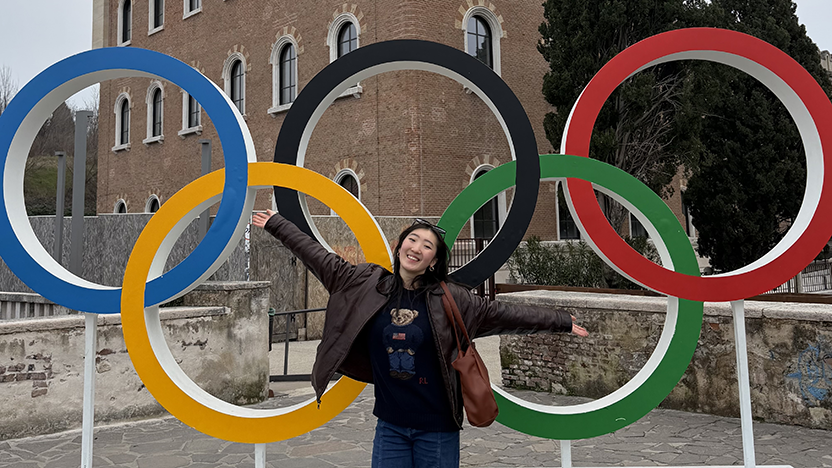
On January 31, I graduated from Middlebury College. On February 1, I drove my Prius—packed with a dorm room’s worth of accumulated life that had nowhere to go yet—to New York for a flight. I walked into the terminal with my luggage and headed to the 2026 Milan Cortina Winter Olympics. Not as an athlete, as I had long dreamed, but as a researcher with NBC Sports.
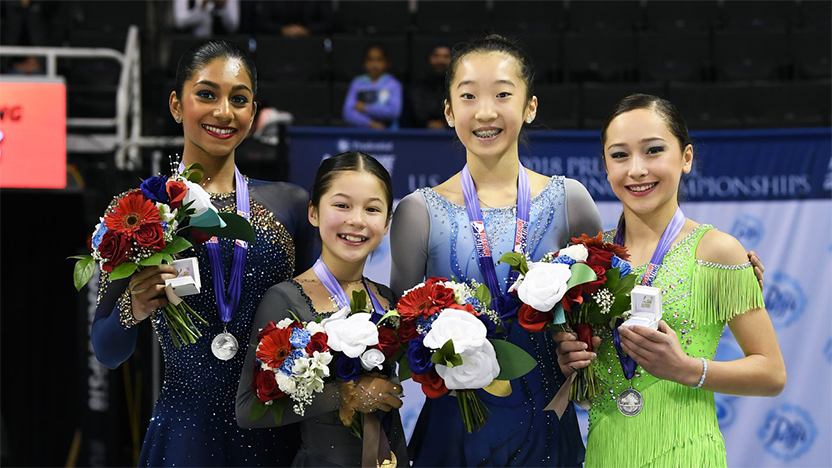


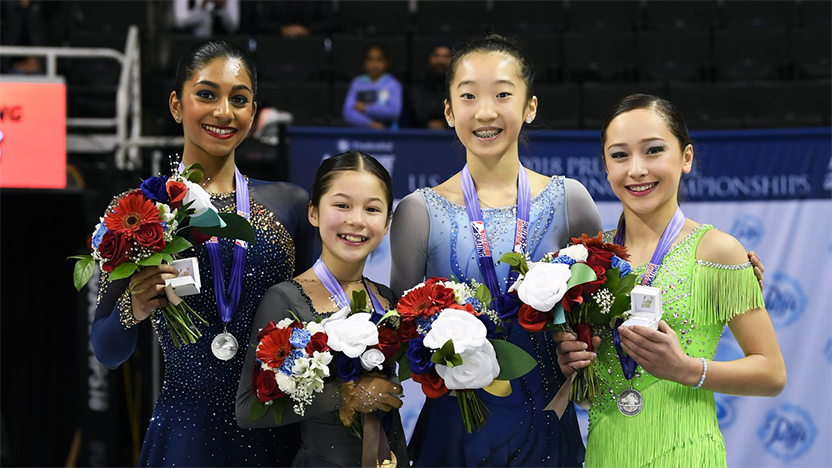
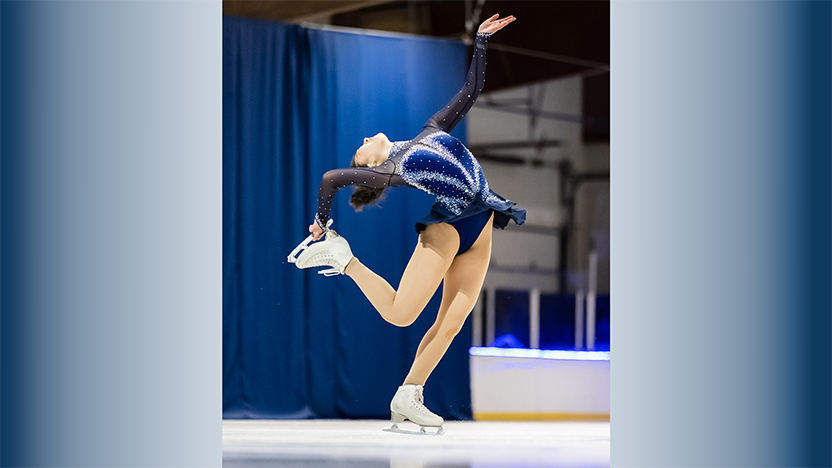
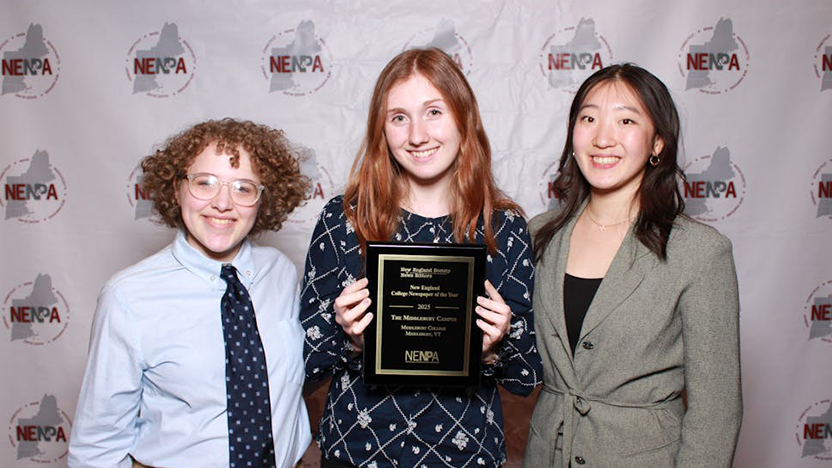
Skating has been the organizing principle of my life since I was a child. I competed in the U.S. Nationals and shared a Junior Worlds podium in 2019 with two skaters who would go on to win Olympic gold and silver three years later. I had been close enough to believe the Olympics were possible. A persistent ankle injury rewrote that story. Now I was heading to Milan anyway—17 years of figure skating in my legs and nearly four years of student journalism at Middlebury College in my head, and some version of both of them in my carry-on.
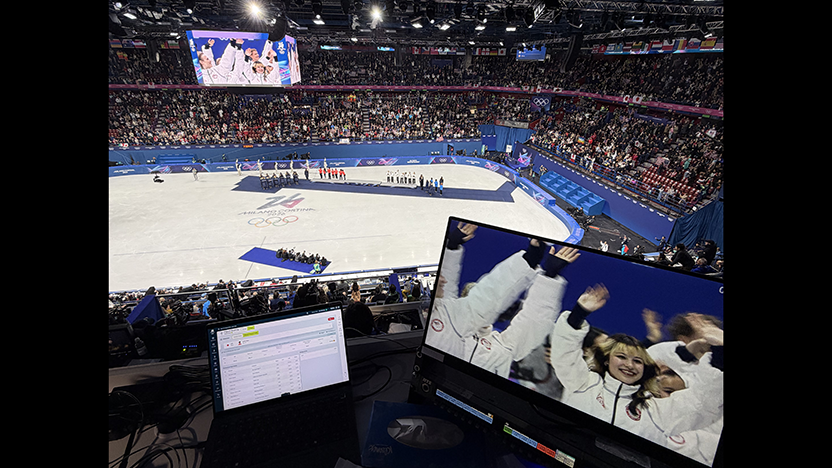
Milan in February is cold and rainy and older than most places I had been. I would spend three weeks primarily inside one small corner of it, the Milano Ice Skating Arena in Assago, a suburb just outside of Milan. The complex is a maze, much like the older part of the College’s athletics center. In my first few days, I stumbled upon a full-size rink underneath the main one, low-ceilinged and hidden. I had only discovered it because I got lost navigating the building’s back corridors with a nice Italian man who was also lost. Together, we learned that the Italian ice dance team practiced down there, as did short-track athletes.
The arena itself was older than I expected. Smaller than I imagined an Olympic venue ought to feel. It looked half-assembled when I arrived. Vendor stalls and screens were not yet finished. Stadium floors scattered with dust. Forklifts hidden in corners. It didn’t help that the boards seemed to be pieced together wrong the first few days, with the Olympic decals not lining up. It made me think: this is an Olympic arena? But I came to love it precisely because of that smallness, the way a crowd filled it to the brim and transformed the atmosphere into something almost conspiratorial. Despite my doubts, when the competitions began, the skaters blessed the ice, and the audience certainly roared as an Olympic crowd should.
Locals piled into the stands just to watch practice sessions, since it was so difficult and expensive to get seats. They lost their minds over each single twist—a move where a pairs skater tosses his partner into the air as she splits and rotates once before he catches her again to land weightlessly back on the ice. The crowd went wild for the single while politely acknowledging the triple, the more difficult element. This was possibly because, to an untrained eye, the single twist appeared more impressive with its larger split. I thought about how fluency changes what you’re able to see, and who gets to see it. It was a thought that came back to me as Amber Glenn delivered what appeared to be a flawless short program only to finish 13th. Again when Madison Chock and Evan Bates placed second in the Rhythm Dance due to a less-than-perfect back outside bracket.
My job had a few components, but a large part of it was to know the skaters’ programs better than almost anyone in the building. I watched hours of practice every day, taking notes on jump content, element order, choreography, until I could close my eyes and move through most of the programs beat by beat. As someone on my team described it, I wrote the written GPS directions for a skater’s program for the broadcast. When content changed at the last minute—as it often did, especially with the men jockeying for points in the team event—the pressure was immediate and physical. Tracking down a Team Canada skater who had quietly altered her program to try to squeeze in more points was the kind of problem that had no graceful solution, only a fast one. It was an even more chaotic situation when a Japanese skater contemplated the addition of an extra quadruple jump to try to challenge top-ranked American Ilia Malinin in the team event free skate.
I spent most days entirely at the rink.
There was a catering hall for the media in an old theater steps from the arena. Il Teatro was decommissioned, or maybe just repurposed, with a smell that took me a few days to stop noticing. Buffet lines, rotating cuisines, people sitting with their respective groups (researchers with researchers, graphics producers with graphics producers). The whole thing was a little reminiscent of Proctor Dining Hall. For Chinese New Year, catering served dumplings. China Media Group (CMG) strung red lanterns between their broadcast compounds; their staff set up a Chinese calligraphy station. The hall was also prime territory for pin trading, the arena’s unofficial economy. I had a sought-after NBC red squirrel that had more than a few people staring at my chest. I was unwilling to part with it, despite the valiant efforts by an Olympic Broadcast Service (OBS) cameraman who badly wanted it for his collection.
On a day when my colleagues were occupied with event coverage in the main arena, I was in the practice arena tracking down info on a broken boot. Kao Miura had damaged his skate on a triple Axel during practice. With no official translator present, I grabbed our production manager, who was fluent in Japanese, and together we pieced the story together at speed: how it happened, when, whether he had backups. I loved interviewing in the mixed zone, it felt like real reporting. It felt like something I had built toward without knowing it. The curiosity that Middlebury built in me applied now to a broken boot at the Olympics.
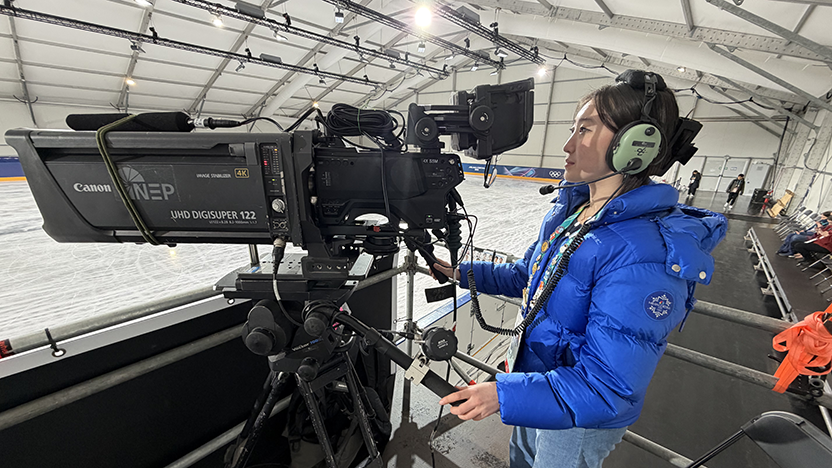
On days when practices and competition didn’t overlap, I swapped the practice rink for NBC’s commentator booth, which centered around former Olympians Johnny Weir and Tara Lipinski, and veteran sportscaster Terry Gannon. They were the voices I had grown up hearing as a skater, voices that had also commentated my own performances at U.S. Nationals. Their voices coming through a television somewhere meant that what was happening on the ice mattered enough for the world to watch. Now I was on the other side with them. Sitting a row above them, I didn’t feel like a starstruck outsider. There was something closer to an unspoken understanding—they knew the sport, I knew the sport, and that fluency was its own kind of credential.
Headset on, I had every channel lit up on my control panel, listening to the full machinery of the live broadcast. The countdown from commercial break. The director calling camera two to camera three. Tape shouting time codes for replays. Every editorial decision crashing against the next one in real time. Their overlapping voices filled my ears. For someone nearly brand new to the world of broadcast, it was extraordinary. An orchestra of people working in tandem to deliver Olympic magic to an invisible audience at home—the whole apparatus humming underneath what looked from the outside like a clean and effortless television broadcast.
There was always an empty seat next to my place in the booth, filled by rotating visitors. 2018 Olympic figure skater Adam Rippon kept me company for most of the events. AJ Mleczko also stopped by during one of her off days from commentating on women’s hockey. Our arena would also host a good number of celebrities during my time there: Snoop Dogg, Martha Stewart, Megan Thee Stallion, and Jackie Chan, to name a few.
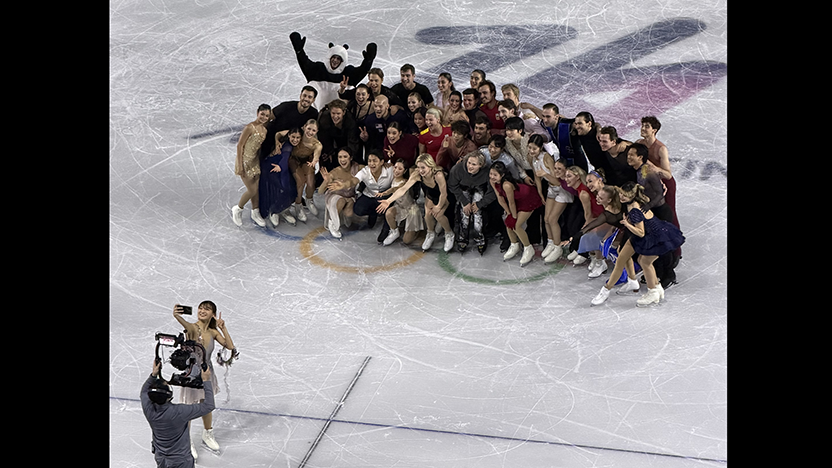
There were also moments in the arena that had nothing to do with the job. Quiet tears after Ilia Malinin’s poor free skate, knowing him and his parents, knowing what that moment cost and what it would take to carry on afterward. Trading pins and hugs with former training mates. Exchanging hellos with the “Blade Angels” that the Internet was madly in love with: Amber Glenn, Alysa Liu, and Isabeau Levito. The strange doubling of it all—watching people I had competed against, now from a press booth with a credential around my neck.
An old arena that looked half-built when I first walked in became, over three weeks, as familiar as any place I have ever lived.
The Ice beyond the Arena
The 2026 Games were never one place, though. The Olympics fanned out across six sites spanning hundreds of miles: Cortina in the Dolomites, Bormio, Livigno near the Swiss border, Anterselva almost into Austria. Athletes from different sports barely saw each other. Even within alpine skiing, the men and women were divided across different mountain ranges, two and a half hours apart from one another, separated as if the mountains themselves had drawn a line.
Nikhil Alleyne ’28.5, a Middlebury sophomore who made history as one of Trinidad and Tobago’s first-ever Olympic alpine skiers and carried the flag at opening ceremonies, was stationed all the way in Bormio, unreachable from my rink by anything less than a full expedition. Ali Nullmeyer ’23, a Canadian alpine skier, was in Cortina for her second Winter Games. Matt Whitcomb ’01 was leading the U.S. cross-country team for the fourth consecutive Olympics in Tesero. And in a few weeks, Peter Wolter ’22 would be at the same site guiding Jake Adicoff, a Paralympic skier, to two Olympic golds. A small Vermont college, scattered across the Italian Alps—showing up, as it always seems to, in places you wouldn’t expect.
When the figure skating events ended and the downtime opened up, I tried to experience as much of the Olympics as I could. A subway voice announcing each Olympic venue in too-perfectly-enunciated, faintly absurd English was my guide. I rode two metro lines to Rho to watch Jordan Stolz win gold in speed skating at an arena that looked like an empty Costco with a world-class oval inside. I went from metro to metro to shuttle to a long walk up a hill to a brand new hockey stadium in the middle of the boonies to watch the Team USA men’s hockey team win Olympic gold. After my work assignment concluded, I went looking for the rest of Italy—Verona, Venice, and Florence—before flying home.
Now I am back stateside. In Milan, I knew exactly what I was. I was an NBC researcher, credentialed and useful, fluent in a room where skating was the only language that mattered. Back home, I am still figuring out what comes next, which door, which version of the life I’ve been building toward. Maybe the ice is a broadcast booth at the next Games. Maybe it’s competing again, lacing up with something still left to prove. Maybe it’s a newsroom, a courtroom, or a rink in Baltimore where I’m trying to give kids from the city their first encounter with the sport that shaped everything in me. I don’t know yet. But home has always been where the ice is, and the ice holds more than one way of belonging to it. And my belonging in Milan, off the ice, was an adventure of a lifetime.