

Día de Muertos 2025 & the Cultural Community Collaboration Course
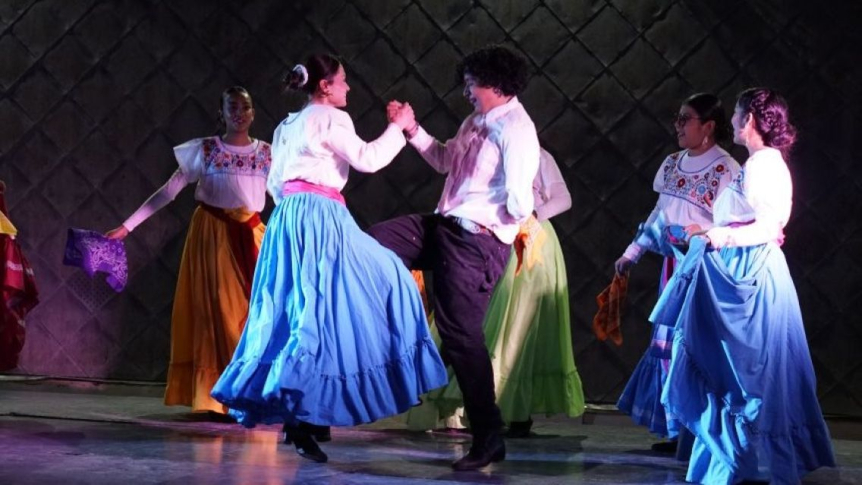
The first and second of November mark Día de los Muertos, or Day of the Dead, the vibrant Mexican holiday that honors and pays respect to the dead through a celebration of life. It is a tradition where families gather in procession to visit burial grounds, where they clean the grave sites and create elaborate ofrendas, altars for their deceased loved ones, decorated with photos, garlands, and flowers. Typically, there is music, folk dance, costumes, symbolic foods, bright colors, and a spirited atmosphere of community and remembrance.
Now, thanks to the vision and dedication of Assistant Professor of Theatre Olga Sanchez Saltveit and a team of students, an adaptation of this rich tradition at Middlebury College is anticipated and appreciated by both the on- and off-campus communities. Fall 2025 marked the fourth annual Día de Muertos Celebration (DdmC) at the College, which features a collaborative two-week-long series of events, workshops, and performances culminating in festivities at the Mahaney Arts Center this year and, also new, at St. Peter’s Church in Vergennes.
“It’s a season…a season of commemorating, of thinking about your dead,” says Sanchez Saltveit, who had the idea to bring this cultural tradition to the College in 2021 during the COVID-19 pandemic, when all communities were grappling with loss. “I felt the presence of the celebration was missing…” says Sanchez Saltveit, “Where’s the day of the dead to process this in a different way, at least contemplate death in a way that I know to be transformative.” Día de los Muertos has been present on campus every year since.
One new aspect of DdmC 2025 is the addition of the Cultural Community Collaboration Course (THEA 0121), an experiential learning class taught by Sanchez Saltveit, specifically designed to engage with the celebration and bring more students into the process of producing the entire scope of the event. With this academic foundation, students can strengthen their project management skills and deepen their cultural competency while spearheading complex logistics that involve dozens of college departments, organizations, community partners, and individual volunteers. Some of those include the Theatre Department, Luso-Hispanic Studies, Beyond the Page, the Catholic Migrant Ministry of Addison County, and many more. The project was hosted by Juntos, the student-led Community Engagement Organization that supports the migrant community of Addison County, and played a significant role this year in outreach and event coordination.
Every DdmC event is highly collaborative, requiring coordination among the various partners and managing multiple events. This was especially true this year with the DdmC’s alignment with the inauguration of Middlebury’s new president, Ian Baucom. The DdmC team developed event programming in concert with Inauguration Weekend’s Celebration of the Arts on November 1st by moving ofrendas, typically displayed on the uphill path to Middlebury Chapel, to the MAC Plaza, where attendees of the inauguration could seamlessly engage with festivities and watch performances. The DdmC Spanish Mass on November 2nd, facilitated by the Catholic Migrant Ministry, was relocated from St. Mary’s Church in Middlebury to St. Peter’s Church in Vergennes, an evening which also included a procession, crafting, performances, and community meal. Despite annual programming adjustments, this Middlebury tradition has strong roots that continue to extend deeper into Addison County. The goal now is to keep the tradition going.
Ryan Ulen ’26, the Project Assistant (PA) for the course, is part of a small cohort of students who have been involved in the planning of DdmC for several years. “There is this sense that we need to pass on this institutional knowledge to the up-and-coming generation of students,” says Ulen. “That way, this thing keeps on going. That’s where I come in as a PA for this project, as a mentor for students.”
The PA Program, through the Center for Community Engagement (CCE), trains, supports, and funds PAs to support faculty members teaching courses that involve community-connected experiential learning projects, such as DdmC, with community and campus partners. Through their training with the CCE, PAs learn how to support instruction and student projects on many levels.“This is a class that’s really unlike any other class at Middlebury College,” says Ulen, “because it’s mostly experiential and it’s about really hands-on work that goes on outside the classroom. My work as a PA is thinking about how I help my instructor engage students throughout the semester.”
As a young theatre artist majoring in English and Theatre, Ulen approaches his role as a PA as an opportunity to learn about how different modes of pedagogy might engage students in the class. For example, by using traditional Mexican folklore such as La Llorona, he led students in the Cultural and Community Production Course through an exercise to explore their own oral histories and how these can serve a community. “I think that’s what the main idea of Dia de los Muertos is. It’s about serving a community. It’s about the remembrance of our family, those who have passed on.”
While the course spends much of the time focused on the logistics of DdmC, the heart of the course is about engaging with the concept of death and what it means to lose loved ones. “I think the class is becoming very personal [for students] for different reasons,” says Sanchez Saltveit. “We are celebrating what folks gave us, what their gifts were to us. And that’s what we remember about them…” The course delves further into how students can transform that feeling and that tradition of remembrance into action. Action that, for the DdmC team, has resulted in Dia de los Muertos-themed dinners, community film screenings, craft workshops, ofrenda making, performances and more, all of which have enriched the local community with the energy and centuries-long tradition of remembrance for Mexican communities. Because, despite differences across cultures, death is universal, and the longing to pay respects to those we’ve loved and lost is something everybody can understand.