

An Alumnus Reflects on Jewish Community Building on Campus
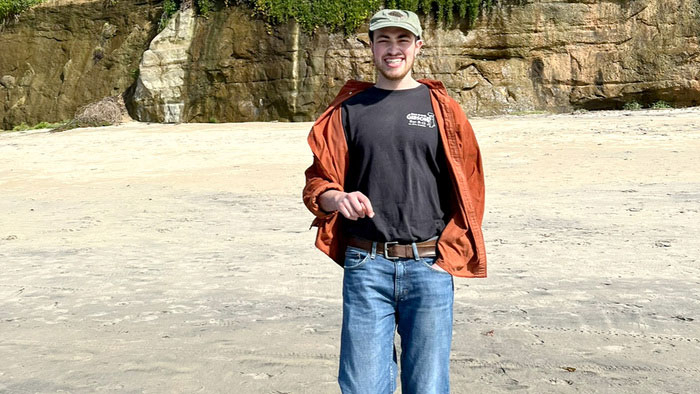
Jessie Raymond: Hi, Noah. Thanks for taking the time to talk to me. Let’s start with the easy stuff: what was your major at Middlebury?
Noah Hochfelder: I was an English major on the creative writing track. I’m Class of 2022, but I graduated in February of 2023; I took a semester off during COVID.
JR: Did you get involved with Jewish life at Middlebury as soon as you came here?
NH: Yes. I grew up in a rural area in the Berkshires. The Jewish community was pretty strong but still small. I was excited to see what it would look like to be a Jewish leader in college and to explore that community. When I was a high school senior, I actually did an overnight with the president of the Middlebury Jewish student group. That was awesome. So yeah, I dove right into it.
JR: What groups did you get involved in at Middlebury?
NH: On the non-Jewish community side of things, I was music director for a bit for the radio station, and I had a bunch of shows. I interned with the New England Review. I loved the people there. That was such a special time. And I played music; I was in a band. In terms of Jewish community stuff, I think I started off as part of the board, as social chair, organizing fun social events. Then I was copresident with another alum, Ben Dohan ’20, and that was kind of crazy, because I started that position when COVID happened. I was maybe a semester into it. And then my senior year-ish—the timeframe all got funky because I took a semester off—I basically ran for a position that, as far as I know, we had not had before. We created this position and called it something like “Israel dialogue chair.” It was basically created out of this need and desire a bunch of Jewish students, as part of the Jewish student community, were having around wanting to challenge ourselves and explore what it was like to not only think about the content of the Israeli-Palestinian conflict but also discover what it looked like to be in dialogue about that.
JR: How did you know how to lead something like that?
NH: Rabbi Danielle facilitated a dialogue training for us around my junior year with this great facilitation organization called Resetting the Table. And I’m grateful to her. Not all college campus Jewish community organizations really dive into that work, and she clearly was really receptive to it. It wasn’t an advocacy position. I wasn’t in charge of educating about Israeli society or Israeli culture; that’s less my expertise. It was much more of a facilitation position, trying to create programs where we could explore and interrogate our own perspectives in community together.
JR: Still, that’s a lot.
NH: Yeah, yeah.
JR: Was there a good response?
NH: Decent. For a position like that, I wish that there could have been multiple people involved. It’s so much for just one person. I definitely have my own biases in politics and opinions, and it can be really fruitful to have other people come in and bring different perspectives. And I wish there had been more time. That type of work takes a ton of patience, because a lot of it is truly relationship building, and involves trust building and story sharing as a foundational part of that work. I think that for the time it happened, we had people show up to some of these events and totally engage and be present, and that was great. I would have loved to have done it for longer. And then Danielle invited me back to campus as an alum the year after I graduated to basically facilitate a workshop, kind of like what I had been doing as a student, for current students.
JR: When exactly was this?
NH: This was in the months after October 7 and the ensuing attacks and assault on Gaza. She wanted me to come into that environment, and I was psyched about that. That was obviously really hard work, but I just feel that American Jewish communities, especially college campus communities, are in such a kind of unique moment right now to confront a lot of the hard things that maybe we have been told about our identity, hard things that we really believe, and so I was very excited to come back and do that. And I was grateful that Rabbi Danielle trusted me to do something like that.
JR: What did you do after Middlebury?
NH: After I graduated, I traveled a bit. I moved back home to the Berkshires and was working some service jobs. Then that fall were the attacks in Israel and the beginning of destruction and attacks in Gaza. That was my first fall away from campus, and I really missed being involved in campus Jewish life, partly because I had just graduated, but also because it was such a fragile moment. And, quite frankly, personally, I was disappointed at how a lot of mainstream Jewish organizations and Jewish campus organizations were responding to that moment.
JR: In what ways?
NH: As somebody whose Jewish identity demands of me a commitment to the safety and dignity and care of all oppressed people, I was disappointed at some of what I was seeing. And it’s so complicated. There’s so much trauma, there’s so much reactivity. But I was feeling that disappointment, not in a holier-than-thou way, but out of real sort of care for what some of these Jewish organizations had given me. I was like, wait, I want to be in the thick of this, as my way of maybe giving back to these communities and these people, trying to join them in healing in a way that is going to ensure that American Jewish students continue to see themselves and their safety as entwined with others, essentially. I’m sorry to ramble; it’s so hard to be concise.
JR: No, it’s a massive topic.
NH: It’s hard to boil down.
JR: So what did you do to get in the thick of it?
NH: Well, that’s what led me to Brandeis, just outside of Boston. There is a fellowship through Hillel International that basically places somewhat recent college graduates at college Hillels around the country for two years to do student engagement and community-building work. I went through the whole process and ended up at Brandeis for the past two years. My job finished up this past June.
JR: What are you doing now?
NH: I’m looking for work!
JR: [Laughs]
NH: It’s actually an exciting time. I’m hoping to become a high school teacher. I want to teach English, and I’m looking at different pathways to do that right now. That’s the longer-term goal.
JR: You have a heart of gold if you do that, because teaching is not an easy walk.
NH: It is not an easy walk. I know, I know. It’s really hard, but it does feel like one of those things where I just have to try it, you know?
JR: I’m sure your past leadership experience must help. But back to Brandeis. Was it a good fit for you?
NH: Yes, 100 percent. I had awesome colleagues. There are a lot of people working in various Hillels that are so sweet and motivated and energetic, and I really learned in that job that I love being a mentor. I love helping people surprise themselves.
JR: Well said.
NH: I love helping people find self-compassion, and inspiration, and it was a cool way to start exploring what that would look like for me professionally.
JR: What’s something you enjoyed about the work?
NH: One thing is that my days were all so different. Some days I was teaching, or facilitating workshops, or meeting with students on campus for coffee to chat with them about, honestly, anything. In some ways, I was sort of a lay guidance counselor, but kind of using the Jewish experience as a base for those conversations. It was great. It was hard work. It was emotional work.
Within Hillel International, it’s a really fraught and complex time. I think it’s very clear that the organization is figuring out and grappling with its identity right now. I want to distinguish pretty clearly—and I think that Middlebury’s a great case study in this—between the leadership of Hillel International, the students who choose to attend, and the staff who work on individual Hillels. I don’t want to make that world seem like a monolith, you know? It was hard, because sometimes I had some pretty, like, significant differences with the direction I was hoping Hillel International would take, in these times.
I found that at Middlebury—this may not be everyone’s experience—for much of my time, there was a cool plurality of perspective that was actually practiced and not just used to justify complacency. Sometimes, in some spaces, we see where people talk about “dialogue building,” for example, to delay actual action and progress.
JR: Middlebury was different?
NH. Yeah. I felt like I got a lot of practice, seeing what a pluralistic Jewish community looked like at Middlebury. At Brandeis, I got to interact with a lot of other Hillel staff around the country, many of whom were doing cool things, but it made me especially grateful for the Jewish community I had at Middlebury because it was so student-led.
JR: Is it not that way at most Hillels?
NH: Well, some of them have massive staff and big buildings. At Middlebury, we students cooked Shabbat dinner every week. I don’t know if they still do this—
JR: I believe they do.
NH: We would get ingredients from the dining hall, and some local ingredients, and people would sign up. We even had a meals chair as part of our leadership board. It was so student-directed, and that was cool. And it showed me how to build community, and how to do that in creative ways. It was good training for a lot of what I did at Brandeis.
JR: You mean in terms of community building?
NH: Yeah, 100 percent. As a staff leader at Brandeis, I was trying to help students work through questions, doubts, passions in a way that both lit them up and led them to want to take care of others, essentially. To create connections and community. I wanted to push students in that direction, and say yes to their ideas and workshop them. I had students who had these awesome passions and awesome ideas, and it felt great to be a kind of project and idea partner with them. I think that’s something I saw myself doing.
JR: But you were disappointed with some of the national Hillel leadership…?
NH: Yes, but I want to be clear that there are a lot of wonderful, hardworking people within the Hillel world who are really pushing the organization to show up differently. And those people need to be heard. We’ve seen that not only with Hillel staff members around the country, but with students, like at Middlebury. And those students should not be under-resourced and left behind. I think it’s important to be open about that.
JR: You come across as someone with a lot of enthusiasm to connect with people; is that something you came to Middlebury with, or did Middlebury bring that out in you?
NH: I think Middlebury brought out a lot of it. The way the Jewish community group at Middlebury was structured was so student-led. I was fortunate to feel really at home in that space. And my experience being involved with Jewish life built up so much self-confidence in me. I felt challenged in a lot of important ways.
JR: Can you point to anything in particular?
NH: Danielle was very supportive. I love the whole Center for Spiritual and Religious Life. I love that whole staff. They were awesome to be in community with. In many ways—again, just my experience—I felt like we were given a lot of creative freedom, as student leaders. I think we’re in a time where there are a lot of voices trying to keep Jewish campus life almost in a box. That might be rooted in some trauma, some fear, some … intergenerational patterns of insularity. That creative freedom was counter to that, and I feel grateful that I got to experience what that looks like on a college campus. It’s not the case everywhere.
JR: Do you think you brought that sense of freedom to Brandeis?
NH: I hope so. I hope the students I worked with—like some of the Jewish students at Middlebury—continue to explore and expand our understanding of what sharing safety and sharing community looks like. Because I think it needs to be bigger. And that is not just a call to “just get along.” At all. I think if we’re going to live in a world where we take care of one another, we have to do some of that work.