

Jewish Midd
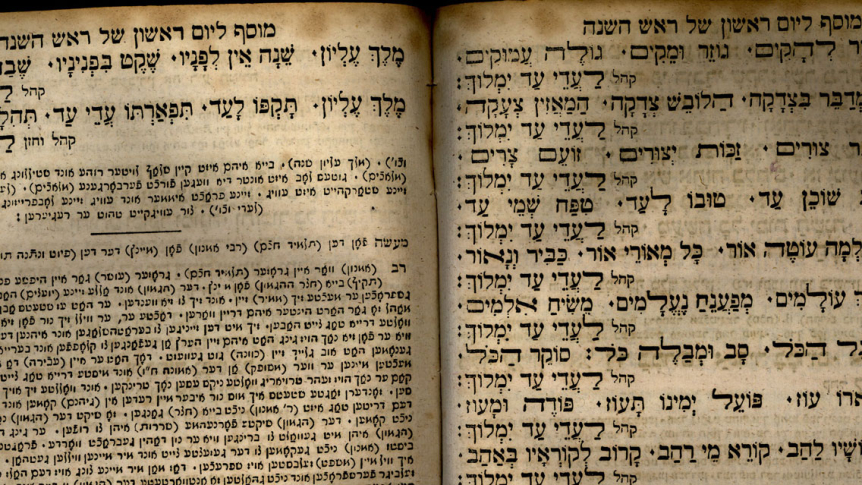
In a new course, students dig into the Archives to explore Judaism at Middlebury, in Vermont, and across higher education.
Adi Livny, a Jewish Studies professor, is described on her Middlebury bio page as “a historian of knowledge institutions,” particularly in Israel and Mandatory Palestine. In fall 2025, she turned her attention to our very own knowledge institution, Middlebury College, with an interdisciplinary course titled Jewish Midd: Histories of Jews and Judaism in Middlebury and Beyond. The course was a collaboration with Special Collections and part of the Public Humanities Labs Initiative, a grant-funded program that lets students undertake hands-on, community-curated projects addressing topics of cultural, social, and intellectual importance.
Jews in Vermont
The first part of the course looked at the history of Jews and Judaism in Vermont, from the earliest Jewish peddlers who sold their wares along the Connecticut River to the Jewish back-to-the-landers who settled in Vermont in the 1970s. The class’s 11 students, some Jewish, some not, took a field trip to Little Jerusalem in the North End of Burlington, where a vibrant Jewish community flourished in the late 19th and early 20th centuries.
Livny, an Israeli Jew who came to Middlebury—and Vermont—four years ago, had expected the course to reveal more overlap between Jewish life at Middlebury and in Vermont as a whole. “Not so much, actually,” she says, smiling.
Jews at Middlebury
Livny was surprised again in the second part of the course, which focused on the history of Jews at Middlebury. She thought the College would serve as a sort of “case study of Jews in higher education. But it turned out to be an exception.” For instance, in their earlier years, most colleges had limits on the number of Jewish students they would accept; Middlebury didn’t. Nor did the College prevent Jewish students from joining fraternities or sororities. “Middlebury didn’t fit a lot of the ideas we had about Jews in higher education,” Livny says.
Jewish student enrollment at the College increased after World War II. But many of these students were choosing Middlebury as a means to gain eligibility into advanced degree programs at universities whose quotas would have excluded them as undergraduates.
The Jewish students who did choose Middlebury in those days tended not to be very religious. Livny wonders if that was because Middlebury traditionally did not offer the sort of religious community or diversity in culture or food that might have appealed to more observant Jews.
She notes that the College has, in recent decades, actively worked to attract students of wide religious, ethnic, and socioeconomic backgrounds. This may be why her students found that much of their findings about Jews at Middlebury applied to other groups as well. Livny says that in that way, Jewish Midd “wasn’t about Jews. It became kind of like a course about minorities at Middlebury and inclusion in higher education.”
Jewish Voices of Middlebury
An important part of the class involved oral histories. Rebekah Irwin, director of Special Collections, helped guide the students in interviewing and writing about people related to Jewish history at Middlebury. Interview subjects included Timi Mayer, Robert R. Churchill Professor Emerita of Geosciences, and alumna Janine Zacharia ’95, among others.
Ben Bryan ’28 interviewed Robert Schine, Curt C. and Else Silberman Professor Emeritus of Jewish Studies and the first director of the Program in Jewish Studies. Bryan says this part of Jewish Midd was the most meaningful to him. “The interview gave me a glimpse at how many stories are contained in an individual’s mind that take another curious mind to unlock. The interviewees for this oral history project were so excited to share stories of their past that might be lost if not for the work of my peers in the course.”
Livny is proud of the reciprocal nature of this assignment. “It was kind of like a gift to give back to the Archives, which provided material for us during the course.”
Another assignment required students to write biographies of deceased Jewish alumni based on notes, correspondence, and news items collected by the College in the years after their graduation. These materials are saved for all alumni in Special Collections and remain sealed until after their deaths. Livny says the class “really got connected with the students they researched.”
Student Perspectives
For their final projects, her students got to choose the topic—and medium—of their choice. One student analyzed the availability of Kosher food in higher education (it is not specifically offered at Middlebury). Another recorded a podcast about their Jewish experience at Midd compared to their father’s experience at Dartmouth and how things have changed in a generation. Another made a poster about Jewish environmentalism and spoke about how the Environmental Studies Program, particularly after the Dalai Lama’s visits in 1984 and 1990, was influenced by the study of religion and spirituality, as opposed to taking a strictly scientific approach.
Bryan’s final project explored how the Program in Jewish Studies came to be. He enjoyed talking to the professors who contributed their various areas of expertise to the program but says he struggled. “I felt like I learned so much, but there is so much missing that I did not uncover or didn’t have the time to uncover.”
Bryan’s characterization of his experience in Jewish Midd underscores the value of the Public Humanities Lab Initiative in bringing together Jewish studies and Special Collections: “This course was based on archival research, something I had zero experience with prior. I was surprised by how interested I became in understanding personal stories that are hidden in the Archives.”
Jewish Midd will be offered again in fall 2026.